

4.5 Results and Discussion
139
2. Induce a large anisotropic shift in vibrational frequencies
Temperature Effects: Phonon Bath Populations
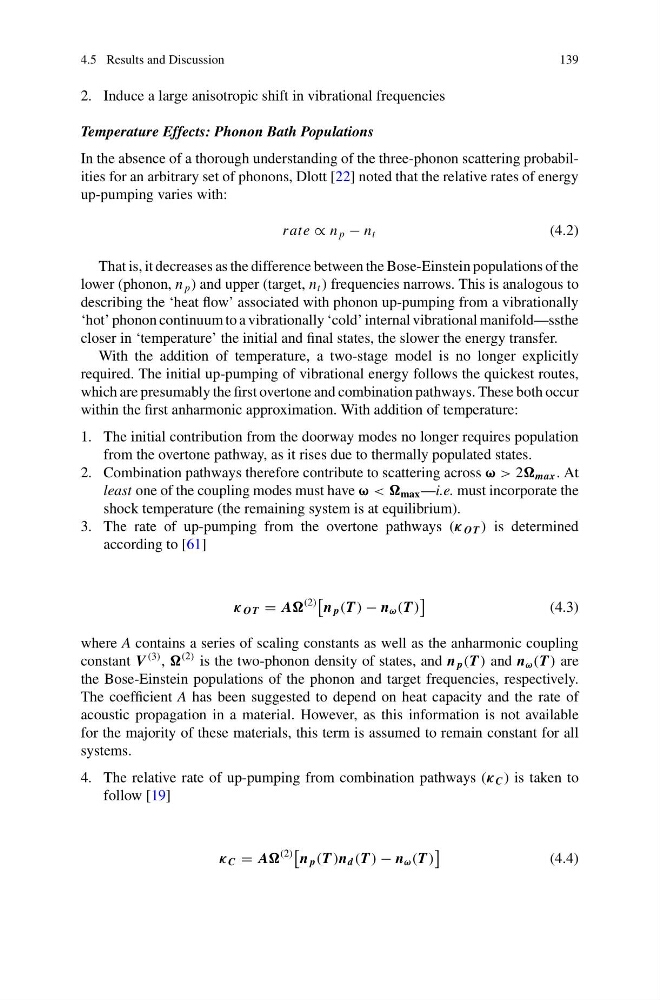
In the absence of a thorough understanding of the three-phonon scattering probabilities for an arbitrary set of phonons, Dlott [22] noted that the relative rates of energy
up-pumping varies with:
rate ∝ n p − n t
(4.2)
That is, it decreases as the difference between the Bose-Einstein populations of the
lower (phonon, n p ) and upper (target, n t ) frequencies narrows. This is analogous to
describing the ‘heat flow’ associated with phonon up-pumping from a vibrationally
‘hot’ phonon continuum to a vibrationally ‘cold’ internal vibrational manifold—ssthe
closer in ‘temperature’ the initial and final states, the slower the energy transfer.
With the addition of temperature, a two-stage model is no longer explicitly
required. The initial up-pumping of vibrational energy follows the quickest routes,
which are presumably the first overtone and combination pathways. These both occur
within the first anharmonic approximation. With addition of temperature:
1. The initial contribution from the doorway modes no longer requires population
from the overtone pathway, as it rises due to thermally populated states.
2. Combination pathways therefore contribute to scattering across ω > 2 max . At
least one of the coupling modes must have ω < max —i.e. must incorporate the
shock temperature (the remaining system is at equilibrium).
3. The rate of up-pumping from the overtone pathways (κ OT ) is determined
according to [61]
κ OT = A
(2)
n p (T ) − n ω (T )
(4.3)
where A contains a series of scaling constants as well as the anharmonic coupling
constant V
(3) ,
(2) is the two-phonon density of states, and n p (T ) and n ω (T ) are
the Bose-Einstein populations of the phonon and target frequencies, respectively.
The coefficient A has been suggested to depend on heat capacity and the rate of
acoustic propagation in a material. However, as this information is not available
for the majority of these materials, this term is assumed to remain constant for all
systems.
4. The relative rate of up-pumping from combination pathways (κ C ) is taken to
follow [19]
κ C = A
(2)
n p (T )n d (T ) − n ω (T )
(4.4)
139
2. Induce a large anisotropic shift in vibrational frequencies
Temperature Effects: Phonon Bath Populations
In the absence of a thorough understanding of the three-phonon scattering probabilities for an arbitrary set of phonons, Dlott [22] noted that the relative rates of energy
up-pumping varies with:
rate ∝ n p − n t
(4.2)
That is, it decreases as the difference between the Bose-Einstein populations of the
lower (phonon, n p ) and upper (target, n t ) frequencies narrows. This is analogous to
describing the ‘heat flow’ associated with phonon up-pumping from a vibrationally
‘hot’ phonon continuum to a vibrationally ‘cold’ internal vibrational manifold—ssthe
closer in ‘temperature’ the initial and final states, the slower the energy transfer.
With the addition of temperature, a two-stage model is no longer explicitly
required. The initial up-pumping of vibrational energy follows the quickest routes,
which are presumably the first overtone and combination pathways. These both occur
within the first anharmonic approximation. With addition of temperature:
1. The initial contribution from the doorway modes no longer requires population
from the overtone pathway, as it rises due to thermally populated states.
2. Combination pathways therefore contribute to scattering across ω > 2 max . At
least one of the coupling modes must have ω < max —i.e. must incorporate the
shock temperature (the remaining system is at equilibrium).
3. The rate of up-pumping from the overtone pathways (κ OT ) is determined
according to [61]
κ OT = A
(2)
n p (T ) − n ω (T )
(4.3)
where A contains a series of scaling constants as well as the anharmonic coupling
constant V
(3) ,
(2) is the two-phonon density of states, and n p (T ) and n ω (T ) are
the Bose-Einstein populations of the phonon and target frequencies, respectively.
The coefficient A has been suggested to depend on heat capacity and the rate of
acoustic propagation in a material. However, as this information is not available
for the majority of these materials, this term is assumed to remain constant for all
systems.
4. The relative rate of up-pumping from combination pathways (κ C ) is taken to
follow [19]
κ C = A
(2)
n p (T )n d (T ) − n ω (T )
(4.4)