

140
4 Vibrational Up-Pumping in Some Molecular Energetic Materials
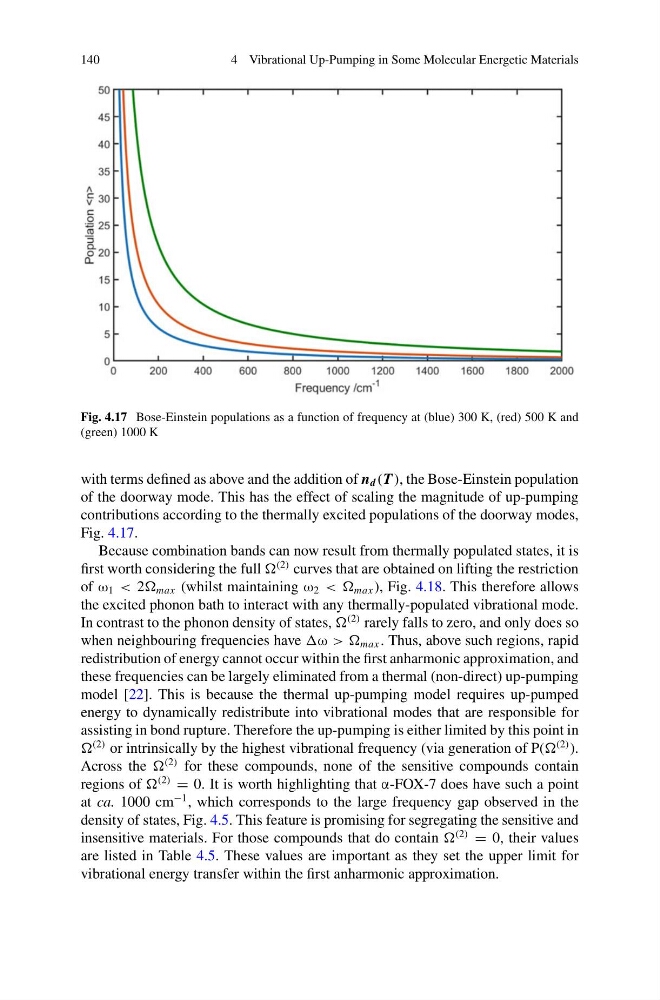
Fig. 4.17 Bose-Einstein populations as a function of frequency at (blue) 300 K, (red) 500 K and
(green) 1000 K
with terms defined as above and the addition of n d (T ), the Bose-Einstein population
of the doorway mode. This has the effect of scaling the magnitude of up-pumping
contributions according to the thermally excited populations of the doorway modes,
Fig. 4.17.
Because combination bands can now result from thermally populated states, it is
first worth considering the full
(2) curves that are obtained on lifting the restriction
of ω 1 < 2 max (whilst maintaining ω 2 < < max ), Fig. 4.18. This therefore allows
the excited phonon bath to interact with any thermally-populated vibrational mode.
In contrast to the phonon density of states,
(2) rarely falls to zero, and only does so
when neighbouring frequencies have ω > > max . Thus, above such regions, rapid
redistribution of energy cannot occur within the first anharmonic approximation, and
these frequencies can be largely eliminated from a thermal (non-direct) up-pumping
model [22]. This is because the thermal up-pumping model requires up-pumped
energy to dynamically redistribute into vibrational modes that are responsible for
assisting in bond rupture. Therefore the up-pumping is either limited by this point in
(2) or intrinsically by the highest vibrational frequency (via generation of P(
(2) ).
Across the
(2) for these compounds, none of the sensitive compounds contain
regions of
(2)
= 0. It is worth highlighting that α-FOX-7 does have such a point
at ca. 1000 cm
−1 , which corresponds to the large frequency gap observed in the
density of states, Fig. 4.5. This feature is promising for segregating the sensitive and
insensitive materials. For those compounds that do contain
(2)
= 0, their values
are listed in Table 4.5. These values are important as they set the upper limit for
vibrational energy transfer within the first anharmonic approximation.
4 Vibrational Up-Pumping in Some Molecular Energetic Materials
Fig. 4.17 Bose-Einstein populations as a function of frequency at (blue) 300 K, (red) 500 K and
(green) 1000 K
with terms defined as above and the addition of n d (T ), the Bose-Einstein population
of the doorway mode. This has the effect of scaling the magnitude of up-pumping
contributions according to the thermally excited populations of the doorway modes,
Fig. 4.17.
Because combination bands can now result from thermally populated states, it is
first worth considering the full
(2) curves that are obtained on lifting the restriction
of ω 1 < 2 max (whilst maintaining ω 2 < < max ), Fig. 4.18. This therefore allows
the excited phonon bath to interact with any thermally-populated vibrational mode.
In contrast to the phonon density of states,
(2) rarely falls to zero, and only does so
when neighbouring frequencies have ω > > max . Thus, above such regions, rapid
redistribution of energy cannot occur within the first anharmonic approximation, and
these frequencies can be largely eliminated from a thermal (non-direct) up-pumping
model [22]. This is because the thermal up-pumping model requires up-pumped
energy to dynamically redistribute into vibrational modes that are responsible for
assisting in bond rupture. Therefore the up-pumping is either limited by this point in
(2) or intrinsically by the highest vibrational frequency (via generation of P(
(2) ).
Across the
(2) for these compounds, none of the sensitive compounds contain
regions of
(2)
= 0. It is worth highlighting that α-FOX-7 does have such a point
at ca. 1000 cm
−1 , which corresponds to the large frequency gap observed in the
density of states, Fig. 4.5. This feature is promising for segregating the sensitive and
insensitive materials. For those compounds that do contain
(2)
= 0, their values
are listed in Table 4.5. These values are important as they set the upper limit for
vibrational energy transfer within the first anharmonic approximation.