

4.5 Results and Discussion
131
excellent agreement if the materials which contain explosophoric −NO 2 groups are
considered in isolation (red points on Fig. 4.8). As N is increased, this correlation
holds quite well, with the notable exception of α-FOX-7, Fig. 4.8. When the second
overtone contributions are considered (N = 3), the total P(
(2) ) for α-FOX-7 and
β-HMX become nearly equal, with the latter appearing to fall short of the exponential
trend. However, consideration of Fig. 4.5 for β-HMX (which agrees well with INS
data) shows that very little density sits within the region ω = 2 max → 3 max . It is
therefore not surprising to find that the value of P(
(2) ) falls as N increases.
It is worth considering the other two compounds, ABT and HBT. Both compounds
are based on the same tetrazole base, and do not contain −NO 2 moieties. Instead,
their explosophoric groups are based on N–N bonds. Interestingly, while the values of
(2) do not fall in line with the trend exhibited by the −NO 2 containing compounds,
ABT is predicted more sensitive than HBT, consistent with experimental reports.
The offset between the two sets of materials presumably reflects the nature of the
electronic contribution to dissociation (i.e. the dissociation energies).
While it is important to note that higher order overtones are unlikely to contribute
to up-pumping due to their lower probabilities, P(
(2) ) was generated up to N = 6,
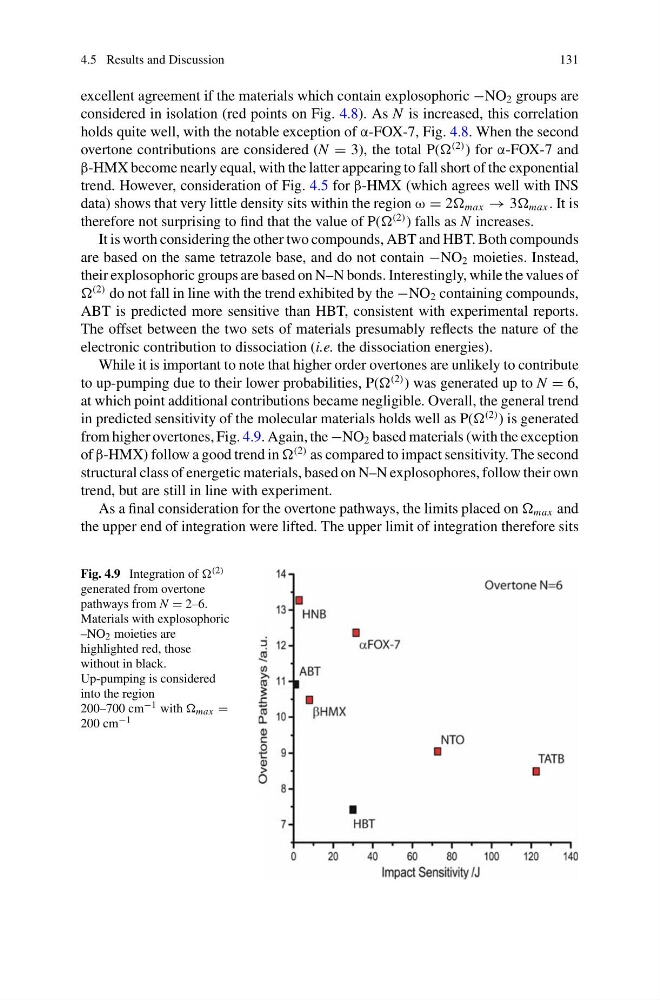
at which point additional contributions became negligible. Overall, the general trend
in predicted sensitivity of the molecular materials holds well as P(
(2) ) is generated
from higher overtones, Fig. 4.9. Again, the −NO 2 based materials (with the exception
of β-HMX) follow a good trend in
(2) as compared to impact sensitivity. The second
structural class of energetic materials, based on N–N explosophores, follow their own
trend, but are still in line with experiment.
As a final consideration for the overtone pathways, the limits placed on max and
the upper end of integration were lifted. The upper limit of integration therefore sits
Fig. 4.9 Integration of (2)
generated from overtone
pathways from N = 2–6.
Materials with explosophoric
–NO 2 moieties are
highlighted red, those
without in black.
Up-pumping is considered
into the region
200–700 cm −1 with max =
200 cm −1
131
excellent agreement if the materials which contain explosophoric −NO 2 groups are
considered in isolation (red points on Fig. 4.8). As N is increased, this correlation
holds quite well, with the notable exception of α-FOX-7, Fig. 4.8. When the second
overtone contributions are considered (N = 3), the total P(
(2) ) for α-FOX-7 and
β-HMX become nearly equal, with the latter appearing to fall short of the exponential
trend. However, consideration of Fig. 4.5 for β-HMX (which agrees well with INS
data) shows that very little density sits within the region ω = 2 max → 3 max . It is
therefore not surprising to find that the value of P(
(2) ) falls as N increases.
It is worth considering the other two compounds, ABT and HBT. Both compounds
are based on the same tetrazole base, and do not contain −NO 2 moieties. Instead,
their explosophoric groups are based on N–N bonds. Interestingly, while the values of
(2) do not fall in line with the trend exhibited by the −NO 2 containing compounds,
ABT is predicted more sensitive than HBT, consistent with experimental reports.
The offset between the two sets of materials presumably reflects the nature of the
electronic contribution to dissociation (i.e. the dissociation energies).
While it is important to note that higher order overtones are unlikely to contribute
to up-pumping due to their lower probabilities, P(
(2) ) was generated up to N = 6,
at which point additional contributions became negligible. Overall, the general trend
in predicted sensitivity of the molecular materials holds well as P(
(2) ) is generated
from higher overtones, Fig. 4.9. Again, the −NO 2 based materials (with the exception
of β-HMX) follow a good trend in
(2) as compared to impact sensitivity. The second
structural class of energetic materials, based on N–N explosophores, follow their own
trend, but are still in line with experiment.
As a final consideration for the overtone pathways, the limits placed on max and
the upper end of integration were lifted. The upper limit of integration therefore sits
Fig. 4.9 Integration of (2)
generated from overtone
pathways from N = 2–6.
Materials with explosophoric
–NO 2 moieties are
highlighted red, those
without in black.
Up-pumping is considered
into the region
200–700 cm −1 with max =
200 cm −1