

132
4 Vibrational Up-Pumping in Some Molecular Energetic Materials
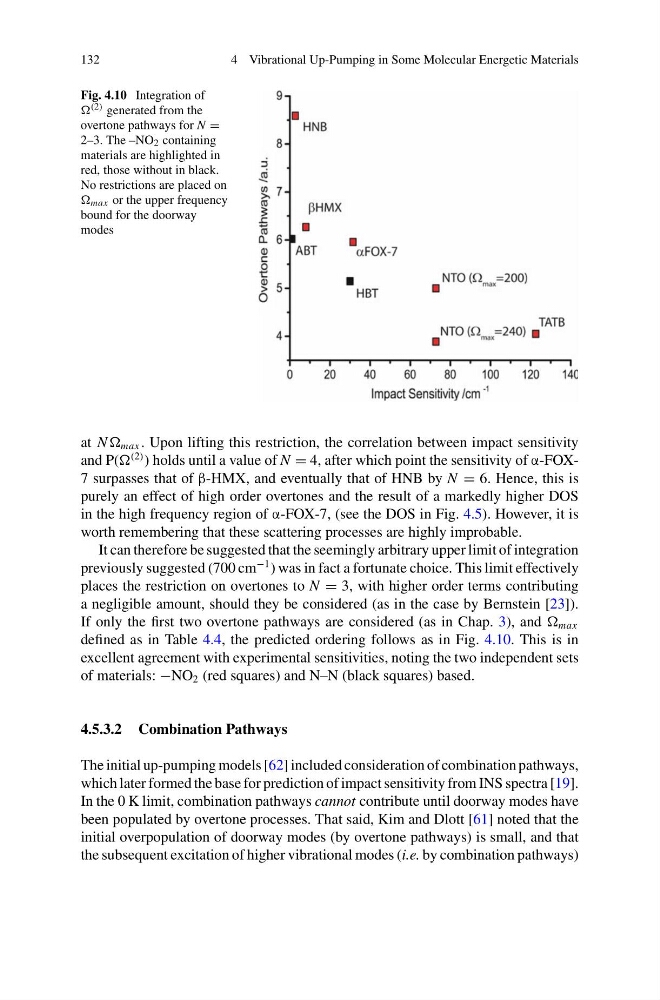
Fig. 4.10 Integration of
(2) generated from the
overtone pathways for N =
2–3. The –NO 2 containing
materials are highlighted in
red, those without in black.
No restrictions are placed on
max or the upper frequency
bound for the doorway
modes
at N max . Upon lifting this restriction, the correlation between impact sensitivity
and P(
(2) ) holds until a value of N = 4, after which point the sensitivity of α-FOX7 surpasses that of β-HMX, and eventually that of HNB by N = 6. Hence, this is
purely an effect of high order overtones and the result of a markedly higher DOS
in the high frequency region of α-FOX-7, (see the DOS in Fig. 4.5). However, it is
worth remembering that these scattering processes are highly improbable.
It can therefore be suggested that the seemingly arbitrary upper limit of integration
previously suggested (700 cm
−1 ) was in fact a fortunate choice. This limit effectively
places the restriction on overtones to N = 3, with higher order terms contributing
a negligible amount, should they be considered (as in the case by Bernstein [23]).
If only the first two overtone pathways are considered (as in Chap. 3), and max
defined as in Table 4.4, the predicted ordering follows as in Fig. 4.10. This is in
excellent agreement with experimental sensitivities, noting the two independent sets
of materials: −NO 2 (red squares) and N–N (black squares) based.
4.5.3.2 Combination Pathways
The initial up-pumping models [62] included consideration of combination pathways,
which later formed the base for prediction of impact sensitivity from INS spectra [19].
In the 0 K limit, combination pathways cannot contribute until doorway modes have
been populated by overtone processes. That said, Kim and Dlott [61] noted that the
initial overpopulation of doorway modes (by overtone pathways) is small, and that
the subsequent excitation of higher vibrational modes (i.e. by combination pathways)
4 Vibrational Up-Pumping in Some Molecular Energetic Materials
Fig. 4.10 Integration of
(2) generated from the
overtone pathways for N =
2–3. The –NO 2 containing
materials are highlighted in
red, those without in black.
No restrictions are placed on
max or the upper frequency
bound for the doorway
modes
at N max . Upon lifting this restriction, the correlation between impact sensitivity
and P(
(2) ) holds until a value of N = 4, after which point the sensitivity of α-FOX7 surpasses that of β-HMX, and eventually that of HNB by N = 6. Hence, this is
purely an effect of high order overtones and the result of a markedly higher DOS
in the high frequency region of α-FOX-7, (see the DOS in Fig. 4.5). However, it is
worth remembering that these scattering processes are highly improbable.
It can therefore be suggested that the seemingly arbitrary upper limit of integration
previously suggested (700 cm
−1 ) was in fact a fortunate choice. This limit effectively
places the restriction on overtones to N = 3, with higher order terms contributing
a negligible amount, should they be considered (as in the case by Bernstein [23]).
If only the first two overtone pathways are considered (as in Chap. 3), and max
defined as in Table 4.4, the predicted ordering follows as in Fig. 4.10. This is in
excellent agreement with experimental sensitivities, noting the two independent sets
of materials: −NO 2 (red squares) and N–N (black squares) based.
4.5.3.2 Combination Pathways
The initial up-pumping models [62] included consideration of combination pathways,
which later formed the base for prediction of impact sensitivity from INS spectra [19].
In the 0 K limit, combination pathways cannot contribute until doorway modes have
been populated by overtone processes. That said, Kim and Dlott [61] noted that the
initial overpopulation of doorway modes (by overtone pathways) is small, and that
the subsequent excitation of higher vibrational modes (i.e. by combination pathways)