

130
4 Vibrational Up-Pumping in Some Molecular Energetic Materials
have propagated from early experimental work (which placed a limit at 600 cm
−1 )
[19]. However, this experimental work employed this limit artificially, as it was the
upper limit of experimental resolution at the time. No alternative explanation has
yet been provided for this upper boundary limit. Within the framework of the model
proposed in Chap. 3, these previous works exhibit two major flaws:
1. Table 4.4 shows that the limiting value of the phonon bath cannot always be
taken to be 200 cm
−1 . This is particularly notable in cases such as TATB, with a
well-defined max at 160 cm
−1 .
2. There is no physical rationale for limiting up-pumping to 700 cm
−1 , particularly
when higher order overtones are considered, as has previously been done [23].
Given the conservation of energy, the maximum overtone contribution from uppumping should scale as N max , where N is the order of the overtone.
At low overtone numbers (N) (see Eq. 3.7) the arbitrary maximum of 700 cm
−1 is
in fact meaningless. For example, consider the two dominant overtone pathways, N
= 2 and N = 3. For a system with max 200 cm
−1 the maximum overtone frequency
is 400 (for N = 2) or 600 cm
−1 for (N = 3). Hence no density will exist above
N max in these cases. Despite these deficiencies, if the criteria set out by Bernstein
are followed ( max = 200 cm
−1 overtone vibrational up-pumping and projection
onto the 200–700 cm
−1 region), remarkable correlation is made against experimental
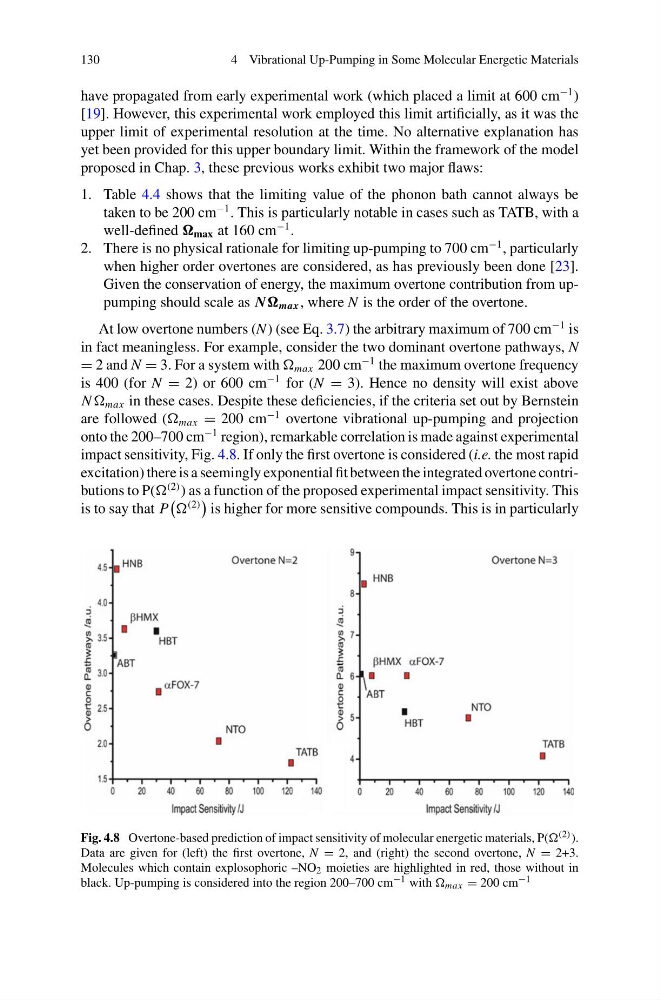
impact sensitivity, Fig. 4.8. If only the first overtone is considered (i.e. the most rapid
excitation) there is a seemingly exponential fit between the integrated overtone contributions to P(
(2) ) as a function of the proposed experimental impact sensitivity. This
is to say that P
(2)
is higher for more sensitive compounds. This is in particularly
Fig. 4.8 Overtone-based prediction of impact sensitivity of molecular energetic materials, P( (2) ).
Data are given for (left) the first overtone, N = 2, and (right) the second overtone, N = 2+3.
Molecules which contain explosophoric –NO 2 moieties are highlighted in red, those without in
black. Up-pumping is considered into the region 200–700 cm −1 with max = 200 cm −1
4 Vibrational Up-Pumping in Some Molecular Energetic Materials
have propagated from early experimental work (which placed a limit at 600 cm
−1 )
[19]. However, this experimental work employed this limit artificially, as it was the
upper limit of experimental resolution at the time. No alternative explanation has
yet been provided for this upper boundary limit. Within the framework of the model
proposed in Chap. 3, these previous works exhibit two major flaws:
1. Table 4.4 shows that the limiting value of the phonon bath cannot always be
taken to be 200 cm
−1 . This is particularly notable in cases such as TATB, with a
well-defined max at 160 cm
−1 .
2. There is no physical rationale for limiting up-pumping to 700 cm
−1 , particularly
when higher order overtones are considered, as has previously been done [23].
Given the conservation of energy, the maximum overtone contribution from uppumping should scale as N max , where N is the order of the overtone.
At low overtone numbers (N) (see Eq. 3.7) the arbitrary maximum of 700 cm
−1 is
in fact meaningless. For example, consider the two dominant overtone pathways, N
= 2 and N = 3. For a system with max 200 cm
−1 the maximum overtone frequency
is 400 (for N = 2) or 600 cm
−1 for (N = 3). Hence no density will exist above
N max in these cases. Despite these deficiencies, if the criteria set out by Bernstein
are followed ( max = 200 cm
−1 overtone vibrational up-pumping and projection
onto the 200–700 cm
−1 region), remarkable correlation is made against experimental
impact sensitivity, Fig. 4.8. If only the first overtone is considered (i.e. the most rapid
excitation) there is a seemingly exponential fit between the integrated overtone contributions to P(
(2) ) as a function of the proposed experimental impact sensitivity. This
is to say that P
(2)
is higher for more sensitive compounds. This is in particularly
Fig. 4.8 Overtone-based prediction of impact sensitivity of molecular energetic materials, P( (2) ).
Data are given for (left) the first overtone, N = 2, and (right) the second overtone, N = 2+3.
Molecules which contain explosophoric –NO 2 moieties are highlighted in red, those without in
black. Up-pumping is considered into the region 200–700 cm −1 with max = 200 cm −1