

4.5 Results and Discussion
129
2. Initial energy transfer that results from overtone up-pumping into the doorway
modes can subsequently up-pump via combination pathways.
3. It follows from (2) that combination pathways are limited to the excitation of
modes below a maximum of 3 max . That is to say that mode combinations can
further populate other, higher frequency doorway modes, or they can populate
higher frequency internal modes. Secondary combination pathways, including
vibrational cooling, are not considered.
4. The energy up-pumping model is based on the total number of available
pathways.
5. Overtone pathways lead to initial excitation of the vibrational manifold to a
maximum of 2 max from the first set of overtones. The second overtone can
excite to a maximum of 3 max albeit at a slower rate. Higher order processes
may occur at even lower rates, but are not competitive. This is due to the rapidly
decreasing probability of higher order scattering events [22].
6. The population of the phonon bath is assumed to remain constant, and the contributions of overtones and combinations are taken as being fully separable: i.e.
they do not compete. This holds approximately for the initial energy transfer
step [61].
Hence, the total energy transfer into the molecular vibrational region is again
dominated by the fastest combination and overtone processes.
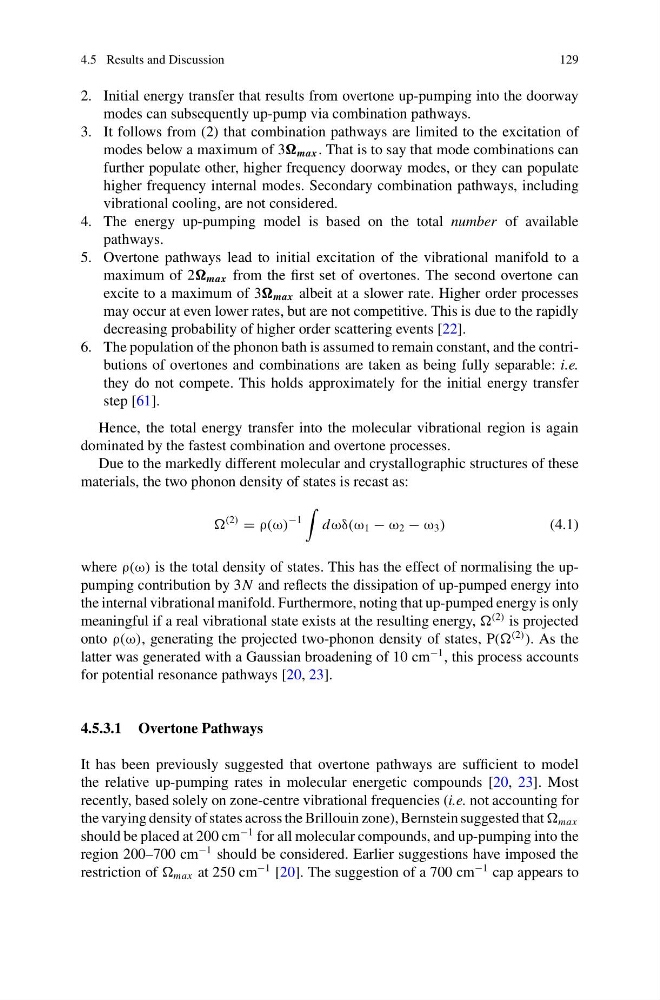
Due to the markedly different molecular and crystallographic structures of these
materials, the two phonon density of states is recast as:
(2)
= ρ(ω)
−1
dωδ(ω 1 − ω 2 − ω 3 )
(4.1)
where ρ(ω) is the total density of states. This has the effect of normalising the uppumping contribution by 3N and reflects the dissipation of up-pumped energy into
the internal vibrational manifold. Furthermore, noting that up-pumped energy is only
meaningful if a real vibrational state exists at the resulting energy,
(2) is projected
onto ρ(ω), generating the projected two-phonon density of states, P(
(2) ). As the
latter was generated with a Gaussian broadening of 10 cm
−1 , this process accounts
for potential resonance pathways [20, 23].
4.5.3.1 Overtone Pathways
It has been previously suggested that overtone pathways are sufficient to model
the relative up-pumping rates in molecular energetic compounds [20, 23]. Most
recently, based solely on zone-centre vibrational frequencies (i.e. not accounting for
the varying density of states across the Brillouin zone), Bernstein suggested that max
should be placed at 200 cm
−1 for all molecular compounds, and up-pumping into the
region 200–700 cm
−1 should be considered. Earlier suggestions have imposed the
restriction of max at 250 cm
−1 [20]. The suggestion of a 700 cm
−1 cap appears to
129
2. Initial energy transfer that results from overtone up-pumping into the doorway
modes can subsequently up-pump via combination pathways.
3. It follows from (2) that combination pathways are limited to the excitation of
modes below a maximum of 3 max . That is to say that mode combinations can
further populate other, higher frequency doorway modes, or they can populate
higher frequency internal modes. Secondary combination pathways, including
vibrational cooling, are not considered.
4. The energy up-pumping model is based on the total number of available
pathways.
5. Overtone pathways lead to initial excitation of the vibrational manifold to a
maximum of 2 max from the first set of overtones. The second overtone can
excite to a maximum of 3 max albeit at a slower rate. Higher order processes
may occur at even lower rates, but are not competitive. This is due to the rapidly
decreasing probability of higher order scattering events [22].
6. The population of the phonon bath is assumed to remain constant, and the contributions of overtones and combinations are taken as being fully separable: i.e.
they do not compete. This holds approximately for the initial energy transfer
step [61].
Hence, the total energy transfer into the molecular vibrational region is again
dominated by the fastest combination and overtone processes.
Due to the markedly different molecular and crystallographic structures of these
materials, the two phonon density of states is recast as:
(2)
= ρ(ω)
−1
dωδ(ω 1 − ω 2 − ω 3 )
(4.1)
where ρ(ω) is the total density of states. This has the effect of normalising the uppumping contribution by 3N and reflects the dissipation of up-pumped energy into
the internal vibrational manifold. Furthermore, noting that up-pumped energy is only
meaningful if a real vibrational state exists at the resulting energy,
(2) is projected
onto ρ(ω), generating the projected two-phonon density of states, P(
(2) ). As the
latter was generated with a Gaussian broadening of 10 cm
−1 , this process accounts
for potential resonance pathways [20, 23].
4.5.3.1 Overtone Pathways
It has been previously suggested that overtone pathways are sufficient to model
the relative up-pumping rates in molecular energetic compounds [20, 23]. Most
recently, based solely on zone-centre vibrational frequencies (i.e. not accounting for
the varying density of states across the Brillouin zone), Bernstein suggested that max
should be placed at 200 cm
−1 for all molecular compounds, and up-pumping into the
region 200–700 cm
−1 should be considered. Earlier suggestions have imposed the
restriction of max at 250 cm
−1 [20]. The suggestion of a 700 cm
−1 cap appears to