

128
4 Vibrational Up-Pumping in Some Molecular Energetic Materials
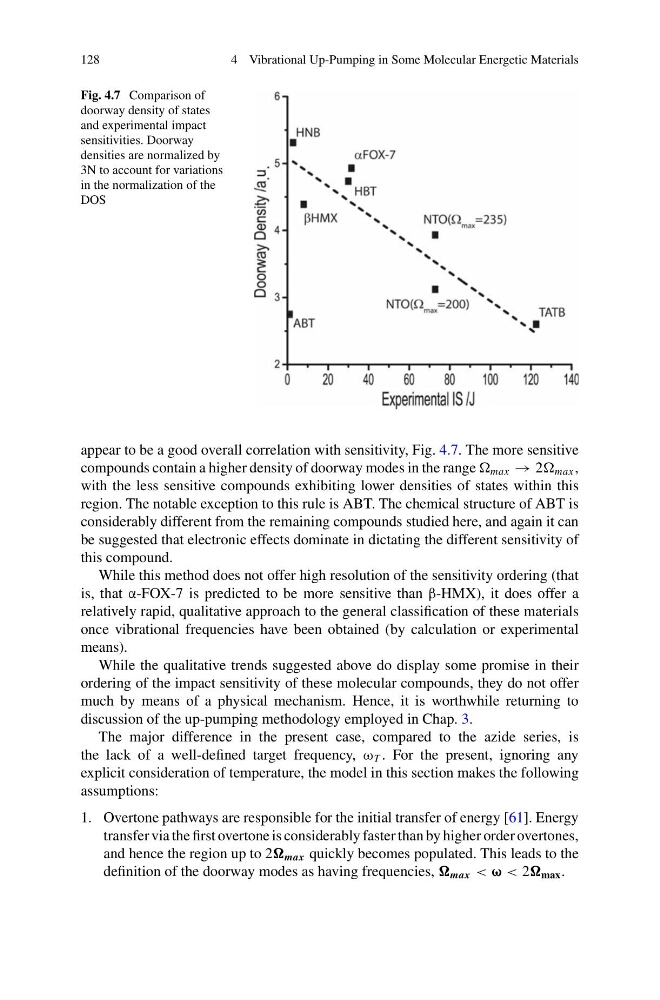
Fig. 4.7 Comparison of
doorway density of states
and experimental impact
sensitivities. Doorway
densities are normalized by
3N to account for variations
in the normalization of the
DOS
appear to be a good overall correlation with sensitivity, Fig. 4.7. The more sensitive
compounds contain a higher density of doorway modes in the range max → 2 max ,
with the less sensitive compounds exhibiting lower densities of states within this
region. The notable exception to this rule is ABT. The chemical structure of ABT is
considerably different from the remaining compounds studied here, and again it can
be suggested that electronic effects dominate in dictating the different sensitivity of
this compound.
While this method does not offer high resolution of the sensitivity ordering (that
is, that α-FOX-7 is predicted to be more sensitive than β-HMX), it does offer a
relatively rapid, qualitative approach to the general classification of these materials
once vibrational frequencies have been obtained (by calculation or experimental
means).
While the qualitative trends suggested above do display some promise in their
ordering of the impact sensitivity of these molecular compounds, they do not offer
much by means of a physical mechanism. Hence, it is worthwhile returning to
discussion of the up-pumping methodology employed in Chap. 3.
The major difference in the present case, compared to the azide series, is
the lack of a well-defined target frequency, ω T . For the present, ignoring any
explicit consideration of temperature, the model in this section makes the following
assumptions:
1. Overtone pathways are responsible for the initial transfer of energy [61]. Energy
transfer via the first overtone is considerably faster than by higher order overtones,
and hence the region up to 2 max quickly becomes populated. This leads to the
definition of the doorway modes as having frequencies, max < ω < 2 max .
4 Vibrational Up-Pumping in Some Molecular Energetic Materials
Fig. 4.7 Comparison of
doorway density of states
and experimental impact
sensitivities. Doorway
densities are normalized by
3N to account for variations
in the normalization of the
DOS
appear to be a good overall correlation with sensitivity, Fig. 4.7. The more sensitive
compounds contain a higher density of doorway modes in the range max → 2 max ,
with the less sensitive compounds exhibiting lower densities of states within this
region. The notable exception to this rule is ABT. The chemical structure of ABT is
considerably different from the remaining compounds studied here, and again it can
be suggested that electronic effects dominate in dictating the different sensitivity of
this compound.
While this method does not offer high resolution of the sensitivity ordering (that
is, that α-FOX-7 is predicted to be more sensitive than β-HMX), it does offer a
relatively rapid, qualitative approach to the general classification of these materials
once vibrational frequencies have been obtained (by calculation or experimental
means).
While the qualitative trends suggested above do display some promise in their
ordering of the impact sensitivity of these molecular compounds, they do not offer
much by means of a physical mechanism. Hence, it is worthwhile returning to
discussion of the up-pumping methodology employed in Chap. 3.
The major difference in the present case, compared to the azide series, is
the lack of a well-defined target frequency, ω T . For the present, ignoring any
explicit consideration of temperature, the model in this section makes the following
assumptions:
1. Overtone pathways are responsible for the initial transfer of energy [61]. Energy
transfer via the first overtone is considerably faster than by higher order overtones,
and hence the region up to 2 max quickly becomes populated. This leads to the
definition of the doorway modes as having frequencies, max < ω < 2 max .