

4.5 Results and Discussion
127
some point following evolution of the highly excited vibrational state [17]. The redistribution of vibrational energy within the internal molecular vibrational manifold is
relatively quick, and once energy reaches this manifold it can quickly redistribute.
In contrast to the azide systems, the rate determining step is instead taken to be the
transfer of energy from the phonon manifold into the internal vibrational manifold
[20, 23]. This occurs in two steps: (1) population of the doorway modes (i.e. modes
with max < ω < 2 max ) and (2) population of higher-lying modes [61].
The concept of the ‘target’ frequency, ω T , is therefore no longer meaningful,
as there is not a single (or known subset) of vibrational modes into which shock
wave energy must be localised to induce a chemical response. Hence, it is no longer
appropriate to consider the ‘frequency gap’ criterion based on ω = ω T − max .
Instead, this simple criterion can be recast as ω = ω d − max , where ω d is the first
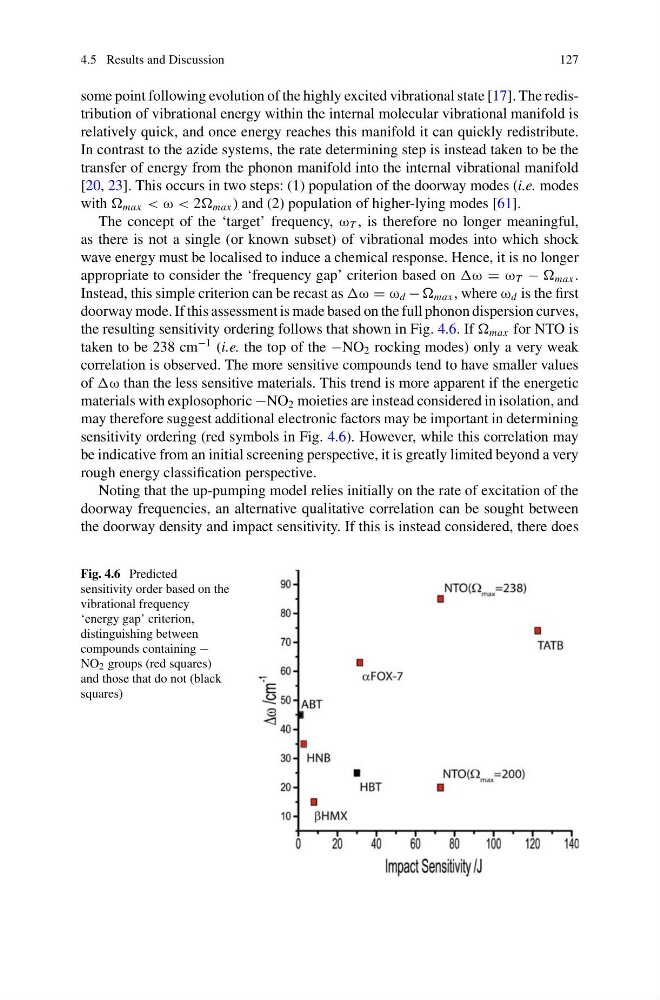
doorway mode. If this assessment is made based on the full phonon dispersion curves,
the resulting sensitivity ordering follows that shown in Fig. 4.6. If max for NTO is
taken to be 238 cm
−1 (i.e. the top of the −NO 2 rocking modes) only a very weak
correlation is observed. The more sensitive compounds tend to have smaller values
of ω than the less sensitive materials. This trend is more apparent if the energetic
materials with explosophoric −NO 2 moieties are instead considered in isolation, and
may therefore suggest additional electronic factors may be important in determining
sensitivity ordering (red symbols in Fig. 4.6). However, while this correlation may
be indicative from an initial screening perspective, it is greatly limited beyond a very
rough energy classification perspective.
Noting that the up-pumping model relies initially on the rate of excitation of the
doorway frequencies, an alternative qualitative correlation can be sought between
the doorway density and impact sensitivity. If this is instead considered, there does
Fig. 4.6 Predicted
sensitivity order based on the
vibrational frequency
‘energy gap’ criterion,
distinguishing between
compounds containing −
NO 2 groups (red squares)
and those that do not (black
squares)
127
some point following evolution of the highly excited vibrational state [17]. The redistribution of vibrational energy within the internal molecular vibrational manifold is
relatively quick, and once energy reaches this manifold it can quickly redistribute.
In contrast to the azide systems, the rate determining step is instead taken to be the
transfer of energy from the phonon manifold into the internal vibrational manifold
[20, 23]. This occurs in two steps: (1) population of the doorway modes (i.e. modes
with max < ω < 2 max ) and (2) population of higher-lying modes [61].
The concept of the ‘target’ frequency, ω T , is therefore no longer meaningful,
as there is not a single (or known subset) of vibrational modes into which shock
wave energy must be localised to induce a chemical response. Hence, it is no longer
appropriate to consider the ‘frequency gap’ criterion based on ω = ω T − max .
Instead, this simple criterion can be recast as ω = ω d − max , where ω d is the first
doorway mode. If this assessment is made based on the full phonon dispersion curves,
the resulting sensitivity ordering follows that shown in Fig. 4.6. If max for NTO is
taken to be 238 cm
−1 (i.e. the top of the −NO 2 rocking modes) only a very weak
correlation is observed. The more sensitive compounds tend to have smaller values
of ω than the less sensitive materials. This trend is more apparent if the energetic
materials with explosophoric −NO 2 moieties are instead considered in isolation, and
may therefore suggest additional electronic factors may be important in determining
sensitivity ordering (red symbols in Fig. 4.6). However, while this correlation may
be indicative from an initial screening perspective, it is greatly limited beyond a very
rough energy classification perspective.
Noting that the up-pumping model relies initially on the rate of excitation of the
doorway frequencies, an alternative qualitative correlation can be sought between
the doorway density and impact sensitivity. If this is instead considered, there does
Fig. 4.6 Predicted
sensitivity order based on the
vibrational frequency
‘energy gap’ criterion,
distinguishing between
compounds containing −
NO 2 groups (red squares)
and those that do not (black
squares)