

3.5 Results and Discussion
87
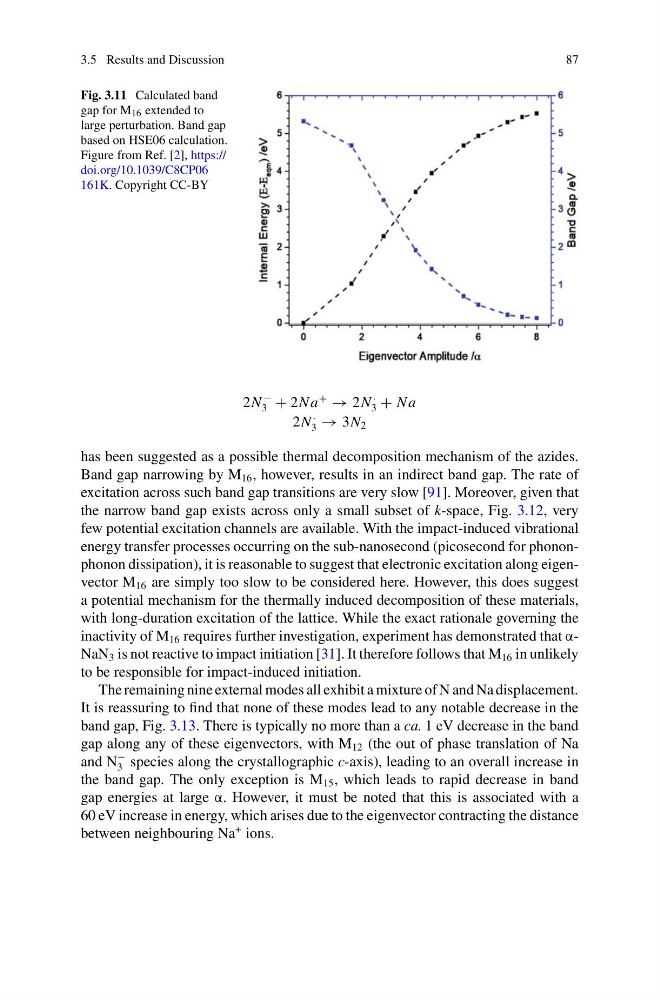
Fig. 3.11 Calculated band
gap for M 16 extended to
large perturbation. Band gap
based on HSE06 calculation.
Figure from Ref. [2], https://
doi.org/10.1039/C8CP06
161K. Copyright CC-BY
2N
−
3 + 2N a
+
→ 2N
·
3 + N a
2N
·
3 → 3N 2
has been suggested as a possible thermal decomposition mechanism of the azides.
Band gap narrowing by M 16 , however, results in an indirect band gap. The rate of
excitation across such band gap transitions are very slow [91]. Moreover, given that
the narrow band gap exists across only a small subset of k-space, Fig. 3.12, very
few potential excitation channels are available. With the impact-induced vibrational
energy transfer processes occurring on the sub-nanosecond (picosecond for phononphonon dissipation), it is reasonable to suggest that electronic excitation along eigenvector M 16 are simply too slow to be considered here. However, this does suggest
a potential mechanism for the thermally induced decomposition of these materials,
with long-duration excitation of the lattice. While the exact rationale governing the
inactivity of M 16 requires further investigation, experiment has demonstrated that αNaN 3 is not reactive to impact initiation [31]. It therefore follows that M 16 in unlikely
to be responsible for impact-induced initiation.
The remaining nine external modes all exhibit a mixture of N and Na displacement.
It is reassuring to find that none of these modes lead to any notable decrease in the
band gap, Fig. 3.13. There is typically no more than a ca. 1 eV decrease in the band
gap along any of these eigenvectors, with M 12 (the out of phase translation of Na
and N
−
3 species along the crystallographic c-axis), leading to an overall increase in
the band gap. The only exception is M 15 , which leads to rapid decrease in band
gap energies at large α. However, it must be noted that this is associated with a
60 eV increase in energy, which arises due to the eigenvector contracting the distance
between neighbouring Na
+ ions.
87
Fig. 3.11 Calculated band
gap for M 16 extended to
large perturbation. Band gap
based on HSE06 calculation.
Figure from Ref. [2], https://
doi.org/10.1039/C8CP06
161K. Copyright CC-BY
2N
−
3 + 2N a
+
→ 2N
·
3 + N a
2N
·
3 → 3N 2
has been suggested as a possible thermal decomposition mechanism of the azides.
Band gap narrowing by M 16 , however, results in an indirect band gap. The rate of
excitation across such band gap transitions are very slow [91]. Moreover, given that
the narrow band gap exists across only a small subset of k-space, Fig. 3.12, very
few potential excitation channels are available. With the impact-induced vibrational
energy transfer processes occurring on the sub-nanosecond (picosecond for phononphonon dissipation), it is reasonable to suggest that electronic excitation along eigenvector M 16 are simply too slow to be considered here. However, this does suggest
a potential mechanism for the thermally induced decomposition of these materials,
with long-duration excitation of the lattice. While the exact rationale governing the
inactivity of M 16 requires further investigation, experiment has demonstrated that αNaN 3 is not reactive to impact initiation [31]. It therefore follows that M 16 in unlikely
to be responsible for impact-induced initiation.
The remaining nine external modes all exhibit a mixture of N and Na displacement.
It is reassuring to find that none of these modes lead to any notable decrease in the
band gap, Fig. 3.13. There is typically no more than a ca. 1 eV decrease in the band
gap along any of these eigenvectors, with M 12 (the out of phase translation of Na
and N
−
3 species along the crystallographic c-axis), leading to an overall increase in
the band gap. The only exception is M 15 , which leads to rapid decrease in band
gap energies at large α. However, it must be noted that this is associated with a
60 eV increase in energy, which arises due to the eigenvector contracting the distance
between neighbouring Na
+ ions.