

86
3 Vibrational Up-Pumping: Predicting Impact Sensitivity of Some …
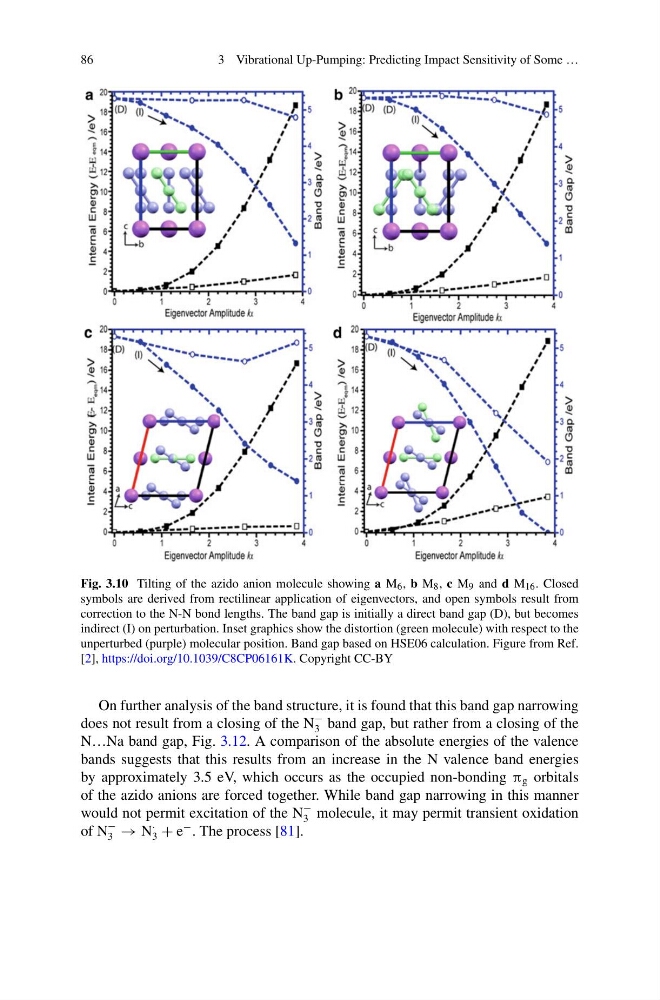
Fig. 3.10 Tilting of the azido anion molecule showing a M 6 , b M 8 , c M 9 and d M 16 . Closed
symbols are derived from rectilinear application of eigenvectors, and open symbols result from
correction to the N-N bond lengths. The band gap is initially a direct band gap (D), but becomes
indirect (I) on perturbation. Inset graphics show the distortion (green molecule) with respect to the
unperturbed (purple) molecular position. Band gap based on HSE06 calculation. Figure from Ref.
[2], https://doi.org/10.1039/C8CP06161K. Copyright CC-BY
On further analysis of the band structure, it is found that this band gap narrowing
does not result from a closing of the N
−
3 band gap, but rather from a closing of the
N…Na band gap, Fig. 3.12. A comparison of the absolute energies of the valence
bands suggests that this results from an increase in the N valence band energies
by approximately 3.5 eV, which occurs as the occupied non-bonding π g orbitals
of the azido anions are forced together. While band gap narrowing in this manner
would not permit excitation of the N
−
3 molecule, it may permit transient oxidation
of N
−
3 → N
·
3 + e
− . The process [81].
3 Vibrational Up-Pumping: Predicting Impact Sensitivity of Some …
Fig. 3.10 Tilting of the azido anion molecule showing a M 6 , b M 8 , c M 9 and d M 16 . Closed
symbols are derived from rectilinear application of eigenvectors, and open symbols result from
correction to the N-N bond lengths. The band gap is initially a direct band gap (D), but becomes
indirect (I) on perturbation. Inset graphics show the distortion (green molecule) with respect to the
unperturbed (purple) molecular position. Band gap based on HSE06 calculation. Figure from Ref.
[2], https://doi.org/10.1039/C8CP06161K. Copyright CC-BY
On further analysis of the band structure, it is found that this band gap narrowing
does not result from a closing of the N
−
3 band gap, but rather from a closing of the
N…Na band gap, Fig. 3.12. A comparison of the absolute energies of the valence
bands suggests that this results from an increase in the N valence band energies
by approximately 3.5 eV, which occurs as the occupied non-bonding π g orbitals
of the azido anions are forced together. While band gap narrowing in this manner
would not permit excitation of the N
−
3 molecule, it may permit transient oxidation
of N
−
3 → N
·
3 + e
− . The process [81].