

3.3.2.2 Environmental Factors Regulating Sclerotia Formation
Apart from relationships with mesofauna, the development of sclerotia by fungi is
reported to be promoted by a high content of active aluminum in low-pH soils
(Watanabe et al. 2002). Table 3.3 shows the soil pH and exchangeable aluminum
data. Soils with a higher exchangeable aluminum (AlEx) content also contained
sclerotia with a larger diameter. This is in accordance with reports by Watanabe et al.
(2002) and Sakagami (2008), who considered the content of exchangeable aluminum to be an effective factor for accelerating formation of large sclerotia. Formation
of large sclerotia can be interpreted as a physiological response of sclerotia-forming
ectomycorrhizal fungi to aluminum stress.
Sclerotia formation was also affected by exchangeable aluminum content, which
was 10.40% higher in soil with sclerotia than in sclerotia-free soil at Iwaki
(Fig. 3.18). This result also suggests that sclerotia were formed as a result of high
acidity and aluminum stress in soil.
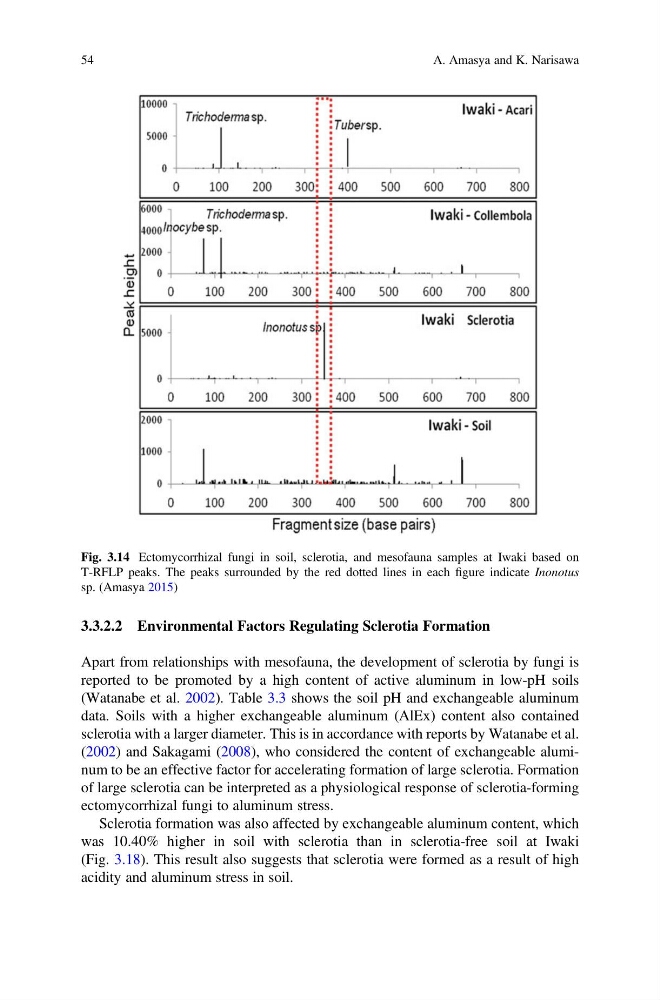
Fig. 3.14 Ectomycorrhizal fungi in soil, sclerotia, and mesofauna samples at Iwaki based on
T-RFLP peaks. The peaks surrounded by the red dotted lines in each figure indicate Inonotus
sp. (Amasya 2015)
54
A. Amasya and K. Narisawa
Apart from relationships with mesofauna, the development of sclerotia by fungi is
reported to be promoted by a high content of active aluminum in low-pH soils
(Watanabe et al. 2002). Table 3.3 shows the soil pH and exchangeable aluminum
data. Soils with a higher exchangeable aluminum (AlEx) content also contained
sclerotia with a larger diameter. This is in accordance with reports by Watanabe et al.
(2002) and Sakagami (2008), who considered the content of exchangeable aluminum to be an effective factor for accelerating formation of large sclerotia. Formation
of large sclerotia can be interpreted as a physiological response of sclerotia-forming
ectomycorrhizal fungi to aluminum stress.
Sclerotia formation was also affected by exchangeable aluminum content, which
was 10.40% higher in soil with sclerotia than in sclerotia-free soil at Iwaki
(Fig. 3.18). This result also suggests that sclerotia were formed as a result of high
acidity and aluminum stress in soil.
Fig. 3.14 Ectomycorrhizal fungi in soil, sclerotia, and mesofauna samples at Iwaki based on
T-RFLP peaks. The peaks surrounded by the red dotted lines in each figure indicate Inonotus
sp. (Amasya 2015)
54
A. Amasya and K. Narisawa