

a relatively large proportion of sclerotial carbon. According to Uchida et al. (1998),
the contribution of microbial carbon to soil T-C in the surface A horizon was 1.0% in
boreal Picea mariana (black spruce) forest in Canada (53
50
0 N, 105
30
0 W). Thus,
in the sites sampled in this study, sclerotial carbon may be equivalent to the
microbial carbon contribution.
Based on the results of the present study, the presence of sclerotia is not always
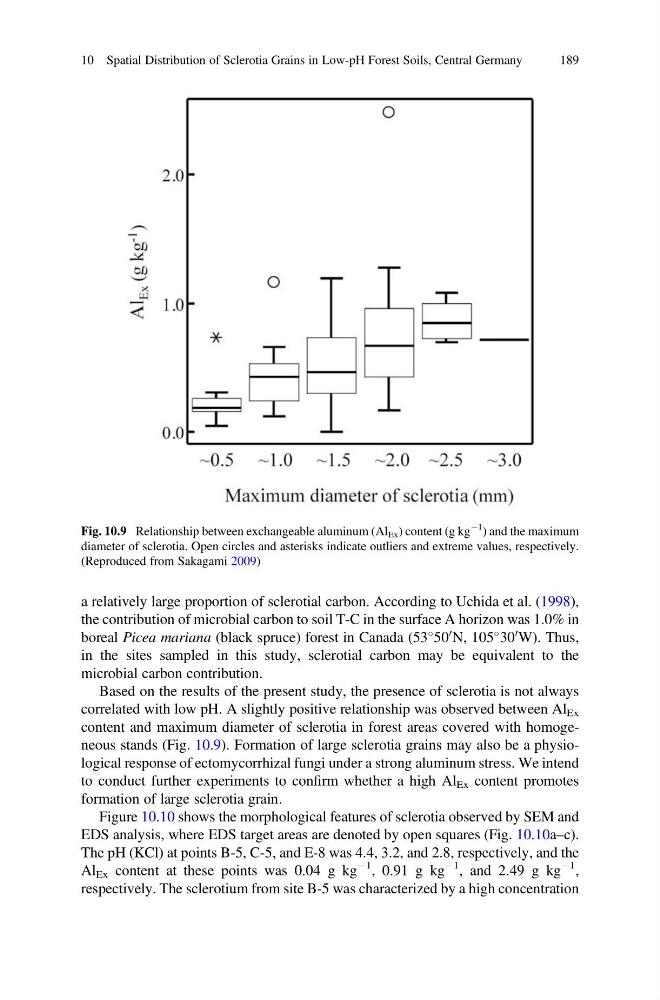
correlated with low pH. A slightly positive relationship was observed between Al Ex
content and maximum diameter of sclerotia in forest areas covered with homogeneous stands (Fig. 10.9). Formation of large sclerotia grains may also be a physiological response of ectomycorrhizal fungi under a strong aluminum stress. We intend
to conduct further experiments to confirm whether a high Al Ex content promotes
formation of large sclerotia grain.
Figure 10.10 shows the morphological features of sclerotia observed by SEM and
EDS analysis, where EDS target areas are denoted by open squares (Fig. 10.10a–c).
The pH (KCl) at points B-5, C-5, and E-8 was 4.4, 3.2, and 2.8, respectively, and the
Al Ex content at these points was 0.04 g kg
À1 , 0.91 g kg
À1 , and 2.49 g kg
À1 ,
respectively. The sclerotium from site B-5 was characterized by a high concentration
Fig. 10.9 Relationship between exchangeable aluminum (Al Ex ) content (g kg
À1
) and the maximum
diameter of sclerotia. Open circles and asterisks indicate outliers and extreme values, respectively.
(Reproduced from Sakagami 2009)
10 Spatial Distribution of Sclerotia Grains in Low-pH Forest Soils, Central Germany
189
the contribution of microbial carbon to soil T-C in the surface A horizon was 1.0% in
boreal Picea mariana (black spruce) forest in Canada (53
50
0 N, 105
30
0 W). Thus,
in the sites sampled in this study, sclerotial carbon may be equivalent to the
microbial carbon contribution.
Based on the results of the present study, the presence of sclerotia is not always
correlated with low pH. A slightly positive relationship was observed between Al Ex
content and maximum diameter of sclerotia in forest areas covered with homogeneous stands (Fig. 10.9). Formation of large sclerotia grains may also be a physiological response of ectomycorrhizal fungi under a strong aluminum stress. We intend
to conduct further experiments to confirm whether a high Al Ex content promotes
formation of large sclerotia grain.
Figure 10.10 shows the morphological features of sclerotia observed by SEM and
EDS analysis, where EDS target areas are denoted by open squares (Fig. 10.10a–c).
The pH (KCl) at points B-5, C-5, and E-8 was 4.4, 3.2, and 2.8, respectively, and the
Al Ex content at these points was 0.04 g kg
À1 , 0.91 g kg
À1 , and 2.49 g kg
À1 ,
respectively. The sclerotium from site B-5 was characterized by a high concentration
Fig. 10.9 Relationship between exchangeable aluminum (Al Ex ) content (g kg
À1
) and the maximum
diameter of sclerotia. Open circles and asterisks indicate outliers and extreme values, respectively.
(Reproduced from Sakagami 2009)
10 Spatial Distribution of Sclerotia Grains in Low-pH Forest Soils, Central Germany
189