

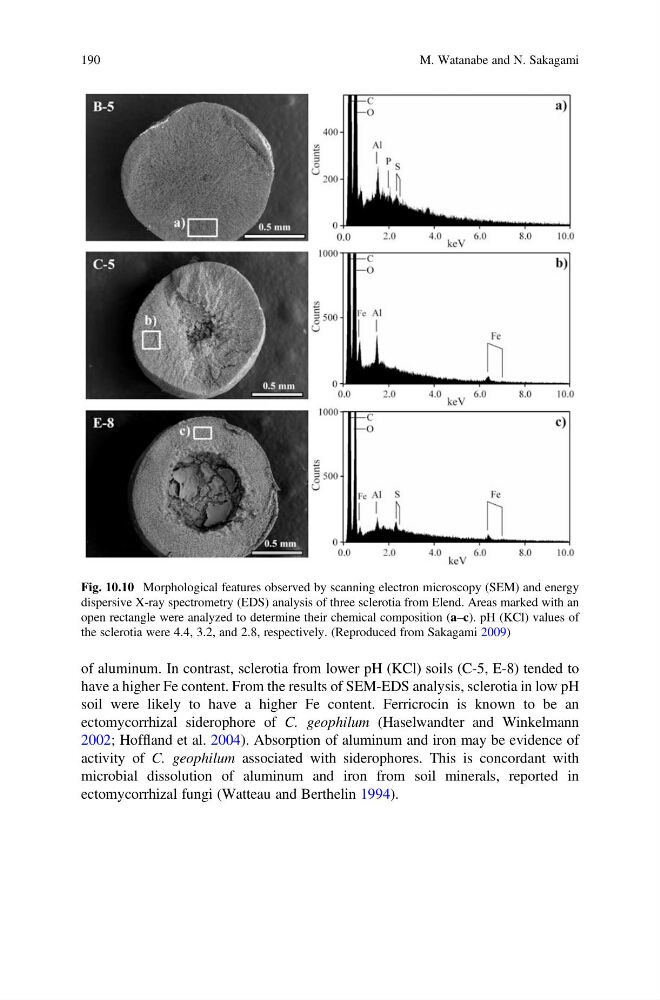
of aluminum. In contrast, sclerotia from lower pH (KCl) soils (C-5, E-8) tended to
have a higher Fe content. From the results of SEM-EDS analysis, sclerotia in low pH
soil were likely to have a higher Fe content. Ferricrocin is known to be an
ectomycorrhizal siderophore of C. geophilum (Haselwandter and Winkelmann
2002; Hoffland et al. 2004). Absorption of aluminum and iron may be evidence of
activity of C. geophilum associated with siderophores. This is concordant with
microbial dissolution of aluminum and iron from soil minerals, reported in
ectomycorrhizal fungi (Watteau and Berthelin 1994).
Fig. 10.10 Morphological features observed by scanning electron microscopy (SEM) and energy
dispersive X-ray spectrometry (EDS) analysis of three sclerotia from Elend. Areas marked with an
open rectangle were analyzed to determine their chemical composition (a–c). pH (KCl) values of
the sclerotia were 4.4, 3.2, and 2.8, respectively. (Reproduced from Sakagami 2009)
190
M. Watanabe and N. Sakagami
have a higher Fe content. From the results of SEM-EDS analysis, sclerotia in low pH
soil were likely to have a higher Fe content. Ferricrocin is known to be an
ectomycorrhizal siderophore of C. geophilum (Haselwandter and Winkelmann
2002; Hoffland et al. 2004). Absorption of aluminum and iron may be evidence of
activity of C. geophilum associated with siderophores. This is concordant with
microbial dissolution of aluminum and iron from soil minerals, reported in
ectomycorrhizal fungi (Watteau and Berthelin 1994).
Fig. 10.10 Morphological features observed by scanning electron microscopy (SEM) and energy
dispersive X-ray spectrometry (EDS) analysis of three sclerotia from Elend. Areas marked with an
open rectangle were analyzed to determine their chemical composition (a–c). pH (KCl) values of
the sclerotia were 4.4, 3.2, and 2.8, respectively. (Reproduced from Sakagami 2009)
190
M. Watanabe and N. Sakagami