

colonize host species effectively. Furthermore, LoBuglio (1999) reported that the
predominance of C. geophilum in extreme environments is a testimony to the
beneficial nature of C. geophilum as an ectomycorrhizal symbiont. The correspondence observed in this study between distribution of sclerotia and understory
vegetation can be interpreted as biologically synchronized responses in a restricted
condition.
These studies suggested a close association of sclerotia with formation of soil
humic substances and indicate their importance as a soil organic component. Based
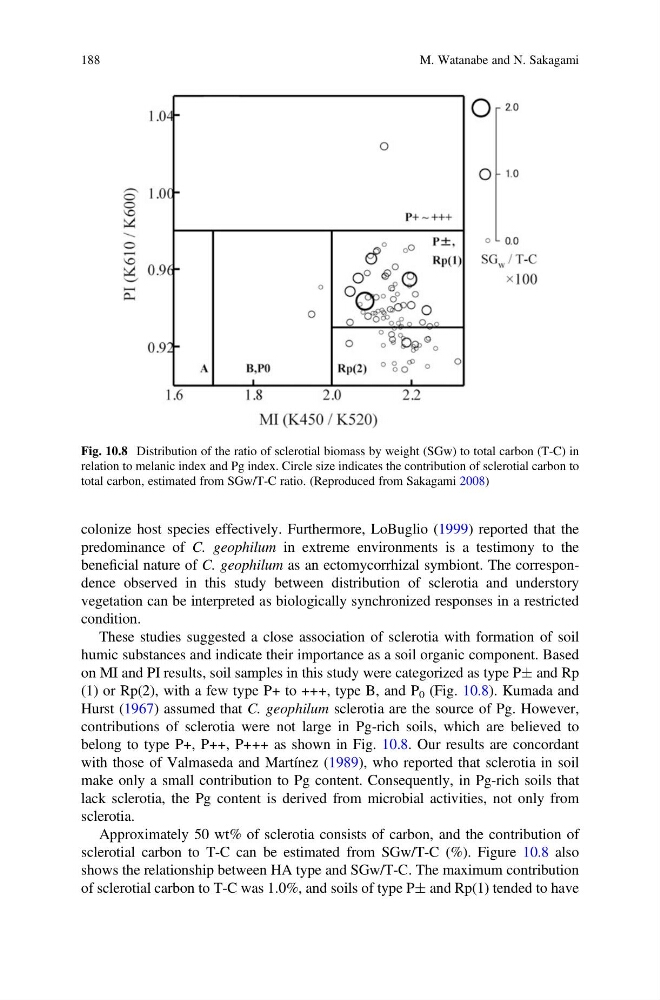
on MI and PI results, soil samples in this study were categorized as type PÆ and Rp
(1) or Rp(2), with a few type P+ to +++, type B, and P 0 (Fig. 10.8). Kumada and
Hurst (1967) assumed that C. geophilum sclerotia are the source of Pg. However,
contributions of sclerotia were not large in Pg-rich soils, which are believed to
belong to type P+, P++, P+++ as shown in Fig. 10.8. Our results are concordant
with those of Valmaseda and Martínez (1989), who reported that sclerotia in soil
make only a small contribution to Pg content. Consequently, in Pg-rich soils that
lack sclerotia, the Pg content is derived from microbial activities, not only from
sclerotia.
Approximately 50 wt% of sclerotia consists of carbon, and the contribution of
sclerotial carbon to T-C can be estimated from SGw/T-C (%). Figure 10.8 also
shows the relationship between HA type and SGw/T-C. The maximum contribution
of sclerotial carbon to T-C was 1.0%, and soils of type PÆ and Rp(1) tended to have
Fig. 10.8 Distribution of the ratio of sclerotial biomass by weight (SGw) to total carbon (T-C) in
relation to melanic index and Pg index. Circle size indicates the contribution of sclerotial carbon to
total carbon, estimated from SGw/T-C ratio. (Reproduced from Sakagami 2008)
188
M. Watanabe and N. Sakagami
predominance of C. geophilum in extreme environments is a testimony to the
beneficial nature of C. geophilum as an ectomycorrhizal symbiont. The correspondence observed in this study between distribution of sclerotia and understory
vegetation can be interpreted as biologically synchronized responses in a restricted
condition.
These studies suggested a close association of sclerotia with formation of soil
humic substances and indicate their importance as a soil organic component. Based
on MI and PI results, soil samples in this study were categorized as type PÆ and Rp
(1) or Rp(2), with a few type P+ to +++, type B, and P 0 (Fig. 10.8). Kumada and
Hurst (1967) assumed that C. geophilum sclerotia are the source of Pg. However,
contributions of sclerotia were not large in Pg-rich soils, which are believed to
belong to type P+, P++, P+++ as shown in Fig. 10.8. Our results are concordant
with those of Valmaseda and Martínez (1989), who reported that sclerotia in soil
make only a small contribution to Pg content. Consequently, in Pg-rich soils that
lack sclerotia, the Pg content is derived from microbial activities, not only from
sclerotia.
Approximately 50 wt% of sclerotia consists of carbon, and the contribution of
sclerotial carbon to T-C can be estimated from SGw/T-C (%). Figure 10.8 also
shows the relationship between HA type and SGw/T-C. The maximum contribution
of sclerotial carbon to T-C was 1.0%, and soils of type PÆ and Rp(1) tended to have
Fig. 10.8 Distribution of the ratio of sclerotial biomass by weight (SGw) to total carbon (T-C) in
relation to melanic index and Pg index. Circle size indicates the contribution of sclerotial carbon to
total carbon, estimated from SGw/T-C ratio. (Reproduced from Sakagami 2008)
188
M. Watanabe and N. Sakagami