

important role as a sink and/or source of soil carbon in cool-alpine to alpine zones,
aside from seasonal turnover.
A classical model proposed by Mohr and Van Baren (1954) explained humus
accumulation in temperature gradient (i.e., altitudinal gradient) by the balance of
humus production and humus destruction. Similarly, the distributional optimum of
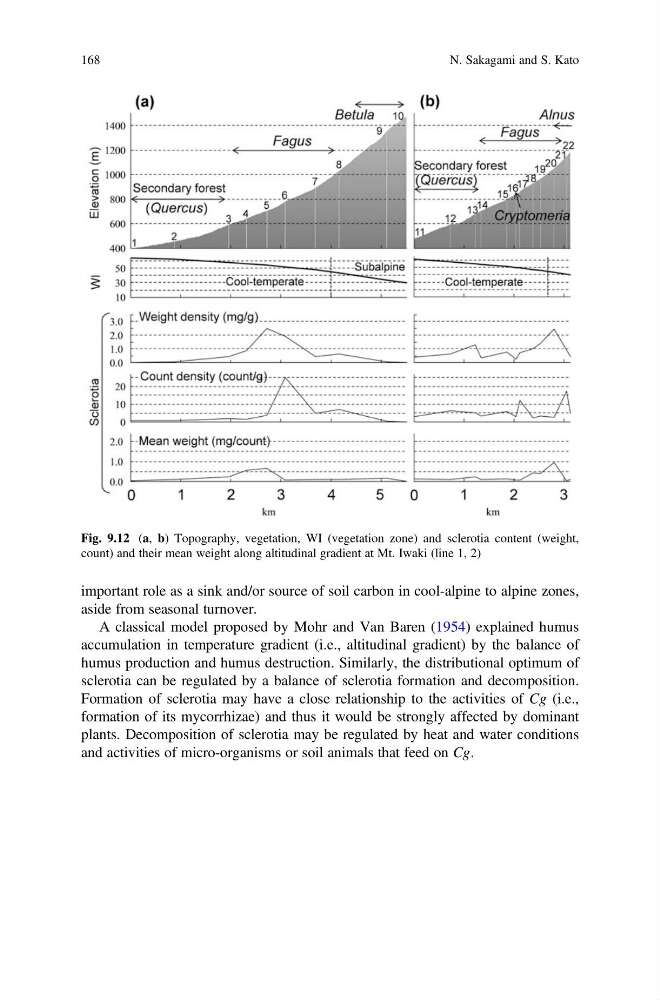
sclerotia can be regulated by a balance of sclerotia formation and decomposition.
Formation of sclerotia may have a close relationship to the activities of Cg (i.e.,
formation of its mycorrhizae) and thus it would be strongly affected by dominant
plants. Decomposition of sclerotia may be regulated by heat and water conditions
and activities of micro-organisms or soil animals that feed on Cg.
Fig. 9.12 (a, b) Topography, vegetation, WI (vegetation zone) and sclerotia content (weight,
count) and their mean weight along altitudinal gradient at Mt. Iwaki (line 1, 2)
168
N. Sakagami and S. Kato
aside from seasonal turnover.
A classical model proposed by Mohr and Van Baren (1954) explained humus
accumulation in temperature gradient (i.e., altitudinal gradient) by the balance of
humus production and humus destruction. Similarly, the distributional optimum of
sclerotia can be regulated by a balance of sclerotia formation and decomposition.
Formation of sclerotia may have a close relationship to the activities of Cg (i.e.,
formation of its mycorrhizae) and thus it would be strongly affected by dominant
plants. Decomposition of sclerotia may be regulated by heat and water conditions
and activities of micro-organisms or soil animals that feed on Cg.
Fig. 9.12 (a, b) Topography, vegetation, WI (vegetation zone) and sclerotia content (weight,
count) and their mean weight along altitudinal gradient at Mt. Iwaki (line 1, 2)
168
N. Sakagami and S. Kato