

9.5 Concluding Remarks
When we find sclerotia in soil, we may be able to deduce a low pH property in the
soil. If these sclerotia have large diameters, the soil may have a high content of Al Ex ,
or experienced some event which enriched its content of Al Ex in the past. Formation
of sclerotia may be caused by Cg’s own requirement to survive or preserve itself, but
it can be concluded to be a naturally symbiotically designed phenomenon in soil
ecosystems. Further examination on sclerotia accumulation in soil, such as studies
on food webs related to Cg in forest soils, is recommended to understand the
implication of sclerotia formation in such low pH forest soils.
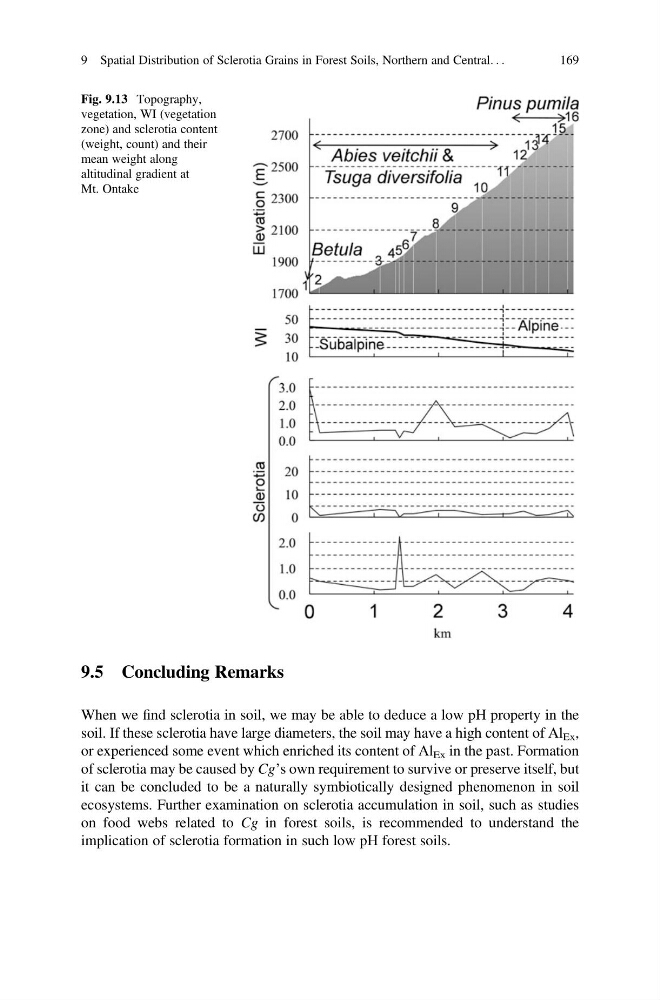
Fig. 9.13 Topography,
vegetation, WI (vegetation
zone) and sclerotia content
(weight, count) and their
mean weight along
altitudinal gradient at
Mt. Ontake
9 Spatial Distribution of Sclerotia Grains in Forest Soils, Northern and Central. . .
169
When we find sclerotia in soil, we may be able to deduce a low pH property in the
soil. If these sclerotia have large diameters, the soil may have a high content of Al Ex ,
or experienced some event which enriched its content of Al Ex in the past. Formation
of sclerotia may be caused by Cg’s own requirement to survive or preserve itself, but
it can be concluded to be a naturally symbiotically designed phenomenon in soil
ecosystems. Further examination on sclerotia accumulation in soil, such as studies
on food webs related to Cg in forest soils, is recommended to understand the
implication of sclerotia formation in such low pH forest soils.
Fig. 9.13 Topography,
vegetation, WI (vegetation
zone) and sclerotia content
(weight, count) and their
mean weight along
altitudinal gradient at
Mt. Ontake
9 Spatial Distribution of Sclerotia Grains in Forest Soils, Northern and Central. . .
169