

carbon is a preferred means for adsorption process, the
disadvantages of this material are due to high cost and
complex preparation process as they are derived from natural
resources could contribute to raise the total cost of manufacturing. Furthermore, according to Singh and Arora
(2011), activated carbons are hard to distinguish from the
solution and were discarded with the process sludge after use
in water and wastewater treatment, leading in secondary
pollution (Singh and Arora 2011).
Many studies explored the potential of using a broad
variety of alternative adsorbents to adsorb textile wastewater
from industrial by-products, mineral deposits and agricultural waste as a substitute for commercially costly activated
carbon. The search for an alternative adsorbent is driven by
its abundance, low-cost, low handling requirements and
highly efficient treatment of textile wastewater. Researchers
have, therefore, made countless efforts to develop a fresh and
novel adsorbent with superior efficiency in terms of greater
adsorption capability, greater surface area and enhanced
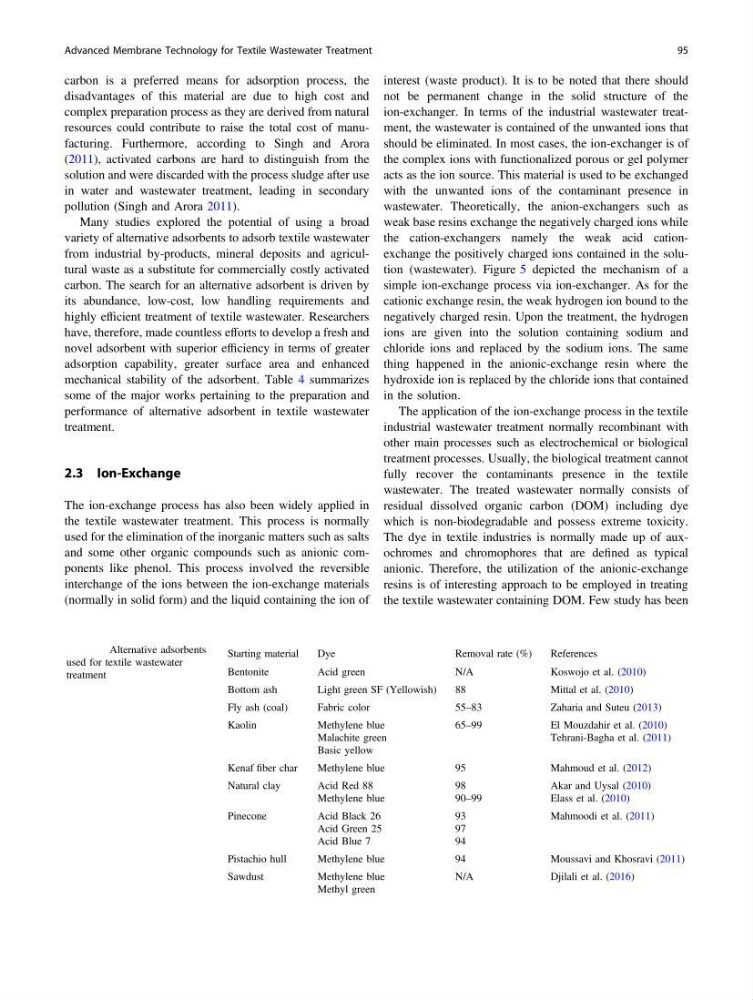
mechanical stability of the adsorbent. Table 4 summarizes
some of the major works pertaining to the preparation and
performance of alternative adsorbent in textile wastewater
treatment.
2.3 Ion-Exchange
The ion-exchange process has also been widely applied in
the textile wastewater treatment. This process is normally
used for the elimination of the inorganic matters such as salts
and some other organic compounds such as anionic components like phenol. This process involved the reversible
interchange of the ions between the ion-exchange materials
(normally in solid form) and the liquid containing the ion of
interest (waste product). It is to be noted that there should
not be permanent change in the solid structure of the
ion-exchanger. In terms of the industrial wastewater treatment, the wastewater is contained of the unwanted ions that
should be eliminated. In most cases, the ion-exchanger is of
the complex ions with functionalized porous or gel polymer
acts as the ion source. This material is used to be exchanged
with the unwanted ions of the contaminant presence in
wastewater. Theoretically, the anion-exchangers such as
weak base resins exchange the negatively charged ions while
the cation-exchangers namely the weak acid cationexchange the positively charged ions contained in the solution (wastewater). Figure 5 depicted the mechanism of a
simple ion-exchange process via ion-exchanger. As for the
cationic exchange resin, the weak hydrogen ion bound to the
negatively charged resin. Upon the treatment, the hydrogen
ions are given into the solution containing sodium and
chloride ions and replaced by the sodium ions. The same
thing happened in the anionic-exchange resin where the
hydroxide ion is replaced by the chloride ions that contained
in the solution.
The application of the ion-exchange process in the textile
industrial wastewater treatment normally recombinant with
other main processes such as electrochemical or biological
treatment processes. Usually, the biological treatment cannot
fully recover the contaminants presence in the textile
wastewater. The treated wastewater normally consists of
residual dissolved organic carbon (DOM) including dye
which is non-biodegradable and possess extreme toxicity.
The dye in textile industries is normally made up of auxochromes and chromophores that are defined as typical
anionic. Therefore, the utilization of the anionic-exchange
resins is of interesting approach to be employed in treating
the textile wastewater containing DOM. Few study has been
Table 4 Alternative adsorbents
used for textile wastewater
treatment
Starting material
Dye
Removal rate (%)
References
Bentonite
Acid green
N/A
Koswojo et al. (2010)
Bottom ash
Light green SF (Yellowish)
88
Mittal et al. (2010)
Fly ash (coal)
Fabric color
55–83
Zaharia and Suteu (2013)
Kaolin
Methylene blue
Malachite green
Basic yellow
65–99
El Mouzdahir et al. (2010)
Tehrani-Bagha et al. (2011)
Kenaf fiber char
Methylene blue
95
Mahmoud et al. (2012)
Natural clay
Acid Red 88
Methylene blue
98
90–99
Akar and Uysal (2010)
Elass et al. (2010)
Pinecone
Acid Black 26
Acid Green 25
Acid Blue 7
93
97
94
Mahmoodi et al. (2011)
Pistachio hull
Methylene blue
94
Moussavi and Khosravi (2011)
Sawdust
Methylene blue
Methyl green
N/A
Djilali et al. (2016)
Advanced Membrane Technology for Textile Wastewater Treatment
95
disadvantages of this material are due to high cost and
complex preparation process as they are derived from natural
resources could contribute to raise the total cost of manufacturing. Furthermore, according to Singh and Arora
(2011), activated carbons are hard to distinguish from the
solution and were discarded with the process sludge after use
in water and wastewater treatment, leading in secondary
pollution (Singh and Arora 2011).
Many studies explored the potential of using a broad
variety of alternative adsorbents to adsorb textile wastewater
from industrial by-products, mineral deposits and agricultural waste as a substitute for commercially costly activated
carbon. The search for an alternative adsorbent is driven by
its abundance, low-cost, low handling requirements and
highly efficient treatment of textile wastewater. Researchers
have, therefore, made countless efforts to develop a fresh and
novel adsorbent with superior efficiency in terms of greater
adsorption capability, greater surface area and enhanced
mechanical stability of the adsorbent. Table 4 summarizes
some of the major works pertaining to the preparation and
performance of alternative adsorbent in textile wastewater
treatment.
2.3 Ion-Exchange
The ion-exchange process has also been widely applied in
the textile wastewater treatment. This process is normally
used for the elimination of the inorganic matters such as salts
and some other organic compounds such as anionic components like phenol. This process involved the reversible
interchange of the ions between the ion-exchange materials
(normally in solid form) and the liquid containing the ion of
interest (waste product). It is to be noted that there should
not be permanent change in the solid structure of the
ion-exchanger. In terms of the industrial wastewater treatment, the wastewater is contained of the unwanted ions that
should be eliminated. In most cases, the ion-exchanger is of
the complex ions with functionalized porous or gel polymer
acts as the ion source. This material is used to be exchanged
with the unwanted ions of the contaminant presence in
wastewater. Theoretically, the anion-exchangers such as
weak base resins exchange the negatively charged ions while
the cation-exchangers namely the weak acid cationexchange the positively charged ions contained in the solution (wastewater). Figure 5 depicted the mechanism of a
simple ion-exchange process via ion-exchanger. As for the
cationic exchange resin, the weak hydrogen ion bound to the
negatively charged resin. Upon the treatment, the hydrogen
ions are given into the solution containing sodium and
chloride ions and replaced by the sodium ions. The same
thing happened in the anionic-exchange resin where the
hydroxide ion is replaced by the chloride ions that contained
in the solution.
The application of the ion-exchange process in the textile
industrial wastewater treatment normally recombinant with
other main processes such as electrochemical or biological
treatment processes. Usually, the biological treatment cannot
fully recover the contaminants presence in the textile
wastewater. The treated wastewater normally consists of
residual dissolved organic carbon (DOM) including dye
which is non-biodegradable and possess extreme toxicity.
The dye in textile industries is normally made up of auxochromes and chromophores that are defined as typical
anionic. Therefore, the utilization of the anionic-exchange
resins is of interesting approach to be employed in treating
the textile wastewater containing DOM. Few study has been
Table 4 Alternative adsorbents
used for textile wastewater
treatment
Starting material
Dye
Removal rate (%)
References
Bentonite
Acid green
N/A
Koswojo et al. (2010)
Bottom ash
Light green SF (Yellowish)
88
Mittal et al. (2010)
Fly ash (coal)
Fabric color
55–83
Zaharia and Suteu (2013)
Kaolin
Methylene blue
Malachite green
Basic yellow
65–99
El Mouzdahir et al. (2010)
Tehrani-Bagha et al. (2011)
Kenaf fiber char
Methylene blue
95
Mahmoud et al. (2012)
Natural clay
Acid Red 88
Methylene blue
98
90–99
Akar and Uysal (2010)
Elass et al. (2010)
Pinecone
Acid Black 26
Acid Green 25
Acid Blue 7
93
97
94
Mahmoodi et al. (2011)
Pistachio hull
Methylene blue
94
Moussavi and Khosravi (2011)
Sawdust
Methylene blue
Methyl green
N/A
Djilali et al. (2016)
Advanced Membrane Technology for Textile Wastewater Treatment
95