

affect this adsorption process such as agitation and concentration of dye. Besides, the rate of adsorption of dye pigments can be determined based on time taken for the
diffusion on the interior adsorbent materials. While step 4 is
frequently depend on the nature of the dye whether anionic
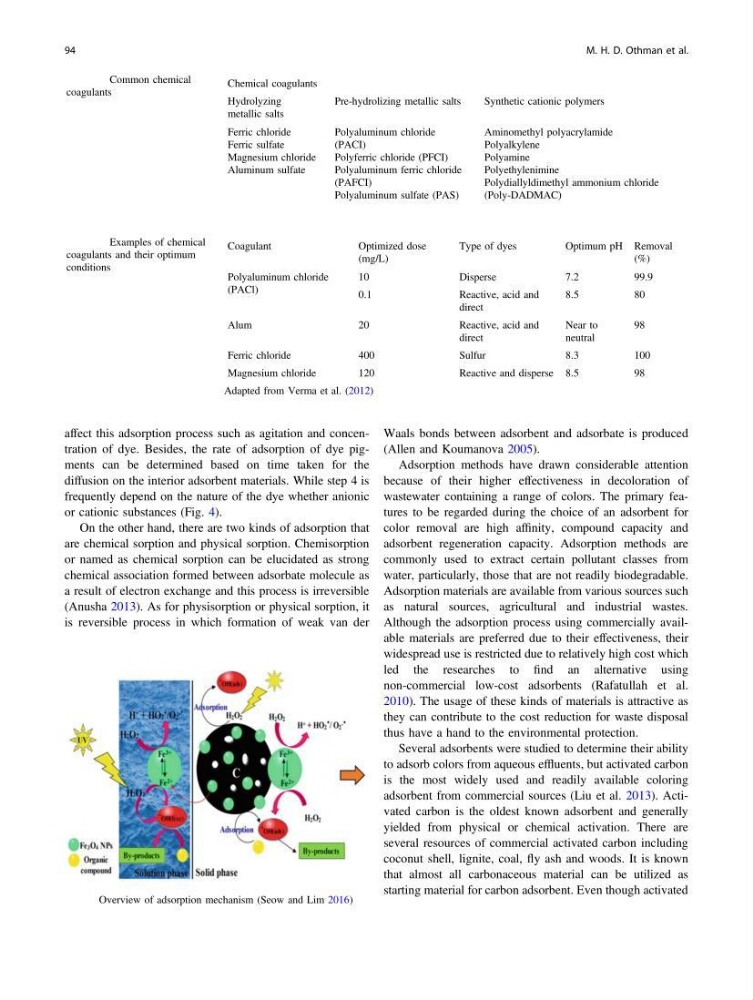
or cationic substances (Fig. 4).
On the other hand, there are two kinds of adsorption that
are chemical sorption and physical sorption. Chemisorption
or named as chemical sorption can be elucidated as strong
chemical association formed between adsorbate molecule as
a result of electron exchange and this process is irreversible
(Anusha 2013). As for physisorption or physical sorption, it
is reversible process in which formation of weak van der
Waals bonds between adsorbent and adsorbate is produced
(Allen and Koumanova 2005).
Adsorption methods have drawn considerable attention
because of their higher effectiveness in decoloration of
wastewater containing a range of colors. The primary features to be regarded during the choice of an adsorbent for
color removal are high affinity, compound capacity and
adsorbent regeneration capacity. Adsorption methods are
commonly used to extract certain pollutant classes from
water, particularly, those that are not readily biodegradable.
Adsorption materials are available from various sources such
as natural sources, agricultural and industrial wastes.
Although the adsorption process using commercially available materials are preferred due to their effectiveness, their
widespread use is restricted due to relatively high cost which
led the researches to find an alternative using
non-commercial low-cost adsorbents (Rafatullah et al.
2010). The usage of these kinds of materials is attractive as
they can contribute to the cost reduction for waste disposal
thus have a hand to the environmental protection.
Several adsorbents were studied to determine their ability
to adsorb colors from aqueous effluents, but activated carbon
is the most widely used and readily available coloring
adsorbent from commercial sources (Liu et al. 2013). Activated carbon is the oldest known adsorbent and generally
yielded from physical or chemical activation. There are
several resources of commercial activated carbon including
coconut shell, lignite, coal, fly ash and woods. It is known
that almost all carbonaceous material can be utilized as
starting material for carbon adsorbent. Even though activated
Table 2 Common chemical
coagulants
Chemical coagulants
Hydrolyzing
metallic salts
Pre-hydrolizing metallic salts
Synthetic cationic polymers
Ferric chloride
Ferric sulfate
Magnesium chloride
Aluminum sulfate
Polyaluminum chloride
(PACI)
Polyferric chloride (PFCI)
Polyaluminum ferric chloride
(PAFCI)
Polyaluminum sulfate (PAS)
Aminomethyl polyacrylamide
Polyalkylene
Polyamine
Polyethylenimine
Polydiallyldimethyl ammonium chloride
(Poly-DADMAC)
Table 3 Examples of chemical
coagulants and their optimum
conditions
Coagulant
Optimized dose
(mg/L)
Type of dyes
Optimum pH Removal
(%)
Polyaluminum chloride
(PACl)
10
Disperse
7.2
99.9
0.1
Reactive, acid and
direct
8.5
80
Alum
20
Reactive, acid and
direct
Near to
neutral
98
Ferric chloride
400
Sulfur
8.3
100
Magnesium chloride
120
Reactive and disperse 8.5
98
Adapted from Verma et al. (2012)
Fig. 4 Overview of adsorption mechanism (Seow and Lim 2016)
94
M. H. D. Othman et al.
diffusion on the interior adsorbent materials. While step 4 is
frequently depend on the nature of the dye whether anionic
or cationic substances (Fig. 4).
On the other hand, there are two kinds of adsorption that
are chemical sorption and physical sorption. Chemisorption
or named as chemical sorption can be elucidated as strong
chemical association formed between adsorbate molecule as
a result of electron exchange and this process is irreversible
(Anusha 2013). As for physisorption or physical sorption, it
is reversible process in which formation of weak van der
Waals bonds between adsorbent and adsorbate is produced
(Allen and Koumanova 2005).
Adsorption methods have drawn considerable attention
because of their higher effectiveness in decoloration of
wastewater containing a range of colors. The primary features to be regarded during the choice of an adsorbent for
color removal are high affinity, compound capacity and
adsorbent regeneration capacity. Adsorption methods are
commonly used to extract certain pollutant classes from
water, particularly, those that are not readily biodegradable.
Adsorption materials are available from various sources such
as natural sources, agricultural and industrial wastes.
Although the adsorption process using commercially available materials are preferred due to their effectiveness, their
widespread use is restricted due to relatively high cost which
led the researches to find an alternative using
non-commercial low-cost adsorbents (Rafatullah et al.
2010). The usage of these kinds of materials is attractive as
they can contribute to the cost reduction for waste disposal
thus have a hand to the environmental protection.
Several adsorbents were studied to determine their ability
to adsorb colors from aqueous effluents, but activated carbon
is the most widely used and readily available coloring
adsorbent from commercial sources (Liu et al. 2013). Activated carbon is the oldest known adsorbent and generally
yielded from physical or chemical activation. There are
several resources of commercial activated carbon including
coconut shell, lignite, coal, fly ash and woods. It is known
that almost all carbonaceous material can be utilized as
starting material for carbon adsorbent. Even though activated
Table 2 Common chemical
coagulants
Chemical coagulants
Hydrolyzing
metallic salts
Pre-hydrolizing metallic salts
Synthetic cationic polymers
Ferric chloride
Ferric sulfate
Magnesium chloride
Aluminum sulfate
Polyaluminum chloride
(PACI)
Polyferric chloride (PFCI)
Polyaluminum ferric chloride
(PAFCI)
Polyaluminum sulfate (PAS)
Aminomethyl polyacrylamide
Polyalkylene
Polyamine
Polyethylenimine
Polydiallyldimethyl ammonium chloride
(Poly-DADMAC)
Table 3 Examples of chemical
coagulants and their optimum
conditions
Coagulant
Optimized dose
(mg/L)
Type of dyes
Optimum pH Removal
(%)
Polyaluminum chloride
(PACl)
10
Disperse
7.2
99.9
0.1
Reactive, acid and
direct
8.5
80
Alum
20
Reactive, acid and
direct
Near to
neutral
98
Ferric chloride
400
Sulfur
8.3
100
Magnesium chloride
120
Reactive and disperse 8.5
98
Adapted from Verma et al. (2012)
Fig. 4 Overview of adsorption mechanism (Seow and Lim 2016)
94
M. H. D. Othman et al.