

through a nonporous membrane. But in some cases, in a
composite membrane with a porous substructure was supported by a dense top layer, Knudsen flow may contribute to
the total flow if and only if the pore sizes in the following
layer were considered.
In order to accomplish a perfect separation of gas in
membrane, selectivity and high flux were used as the key
parameters, and by using nonporous membranes, it will be
depended on the differences in the permeabilities of various
gases through a given membrane. The assessment of the
membrane can be investigated based on high permeabilities
or fluxes. High permeable materials are not required if high
selectivities was used, but low permeable materials based on
glassy polymers will be required for a moderate selectivity to
create a balance between permeability and selectivity (Scoth
1999). According to Ravanchi et al. (2009), approximately
more than 20 companies have commercially equipped
membrane with gas permeation process due to its relatively
simple process since it was first introduced in 1979. The
applications may vary from the supply of pure or enhanced
gases such as N 2 , O 2 and He extracted from air, CO 2 and
H 2 S extraction from acid, separation of H 2 in the petrochemical and chemical industries and other varieties of
smaller applications (Scoth 1990).
The pioneer of using membrane technology in petrochemical industry began in 1950 where the first experiment
of was started (Weller and Steiner 1950). Later, in 1977, the
first notable membrane unit was installed to adjust H 2 /CO
ratio, and in 1978, the first membrane was used for hydrogen
recovery in petrochemical plants from gases elimination
process. Hence, leading from the success of this application
led to another more than 200 membrane systems were built
worldwide (Johnson and Schulman 1993). Recently, the use
of membrane in refinery or petrochemical industry not only
limited to separation and recovery of gas such as hydrogen
recovery, nitrogen production, natural gas sweetening, pervaporation process but has advanced to the application of
solid–liquid and liquid–liquid separation.
It was reported that in 1998, Mobil Oil Corporation used
the new membrane technology where membrane of reverse
osmosis (RO) was installed to separate solvent from lube oil
(Baker 2004). The polymeric membrane was also the first
kind of membrane made from polyamide which not only
solvent resistance but also stable in high temperature up to
300 °C. Another successful application implemented such as
the separation of organic liquid, aromatic compound such as
benzene from paraffin and oleo chemicals. The use of
ultrafiltration membrane developed by Exxon to recover and
enhance their residuals feed product during thermal cracking
was also considered as one of innovative ways where the
application of membrane technology was used in petrochemical industry (Bernardo and Driolo 2010).
Currently, excellent progression of membrane technology
has led to another application of membrane which is to be
used to treat produce water (PW) in petrochemical industry.
Membrane has demonstrated good application in surface
water management brought the idea to use this technology in
water at refinery plant not only for treating the water before
being discharged to environment but also to recover any oil
from the water itself. The expansion of this industry has led
to the exploitation of high amount of water to be used. Thus,
it is essential to review more innovations in membrane
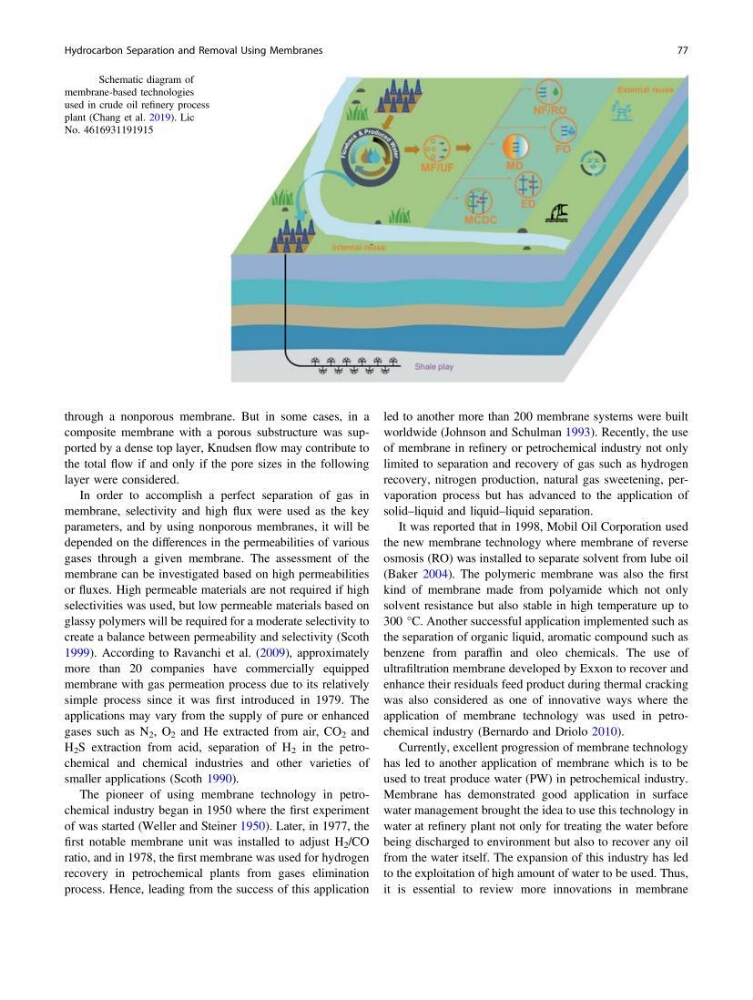
Fig. 4 Schematic diagram of
membrane-based technologies
used in crude oil refinery process
plant (Chang et al. 2019). Lic
No. 4616931191915
Hydrocarbon Separation and Removal Using Membranes
77
composite membrane with a porous substructure was supported by a dense top layer, Knudsen flow may contribute to
the total flow if and only if the pore sizes in the following
layer were considered.
In order to accomplish a perfect separation of gas in
membrane, selectivity and high flux were used as the key
parameters, and by using nonporous membranes, it will be
depended on the differences in the permeabilities of various
gases through a given membrane. The assessment of the
membrane can be investigated based on high permeabilities
or fluxes. High permeable materials are not required if high
selectivities was used, but low permeable materials based on
glassy polymers will be required for a moderate selectivity to
create a balance between permeability and selectivity (Scoth
1999). According to Ravanchi et al. (2009), approximately
more than 20 companies have commercially equipped
membrane with gas permeation process due to its relatively
simple process since it was first introduced in 1979. The
applications may vary from the supply of pure or enhanced
gases such as N 2 , O 2 and He extracted from air, CO 2 and
H 2 S extraction from acid, separation of H 2 in the petrochemical and chemical industries and other varieties of
smaller applications (Scoth 1990).
The pioneer of using membrane technology in petrochemical industry began in 1950 where the first experiment
of was started (Weller and Steiner 1950). Later, in 1977, the
first notable membrane unit was installed to adjust H 2 /CO
ratio, and in 1978, the first membrane was used for hydrogen
recovery in petrochemical plants from gases elimination
process. Hence, leading from the success of this application
led to another more than 200 membrane systems were built
worldwide (Johnson and Schulman 1993). Recently, the use
of membrane in refinery or petrochemical industry not only
limited to separation and recovery of gas such as hydrogen
recovery, nitrogen production, natural gas sweetening, pervaporation process but has advanced to the application of
solid–liquid and liquid–liquid separation.
It was reported that in 1998, Mobil Oil Corporation used
the new membrane technology where membrane of reverse
osmosis (RO) was installed to separate solvent from lube oil
(Baker 2004). The polymeric membrane was also the first
kind of membrane made from polyamide which not only
solvent resistance but also stable in high temperature up to
300 °C. Another successful application implemented such as
the separation of organic liquid, aromatic compound such as
benzene from paraffin and oleo chemicals. The use of
ultrafiltration membrane developed by Exxon to recover and
enhance their residuals feed product during thermal cracking
was also considered as one of innovative ways where the
application of membrane technology was used in petrochemical industry (Bernardo and Driolo 2010).
Currently, excellent progression of membrane technology
has led to another application of membrane which is to be
used to treat produce water (PW) in petrochemical industry.
Membrane has demonstrated good application in surface
water management brought the idea to use this technology in
water at refinery plant not only for treating the water before
being discharged to environment but also to recover any oil
from the water itself. The expansion of this industry has led
to the exploitation of high amount of water to be used. Thus,
it is essential to review more innovations in membrane
Fig. 4 Schematic diagram of
membrane-based technologies
used in crude oil refinery process
plant (Chang et al. 2019). Lic
No. 4616931191915
Hydrocarbon Separation and Removal Using Membranes
77