

technology process to implement in petroleum industry. This
chapter will describe previous studies have shown successful
various works of membrane technology such as microfiltration (MF), ultrafiltration (UF), nanofiltration (NF) and
reverse osmosis (RO) as well as the membrane-driven system used for this application. Therefore, this chapter will
briefly contribute and assist to any further innovation for the
applications of membrane technology in PW treatment
especially in the petroleum or petrochemical refinery process
(Alzahrani and Mohammad 2014).
2.1 Microfiltration (MF)
Microfiltration or MF is a sieving process to separate particulates or molecules by membrane where considered by the
pore size of the membrane. Normally, the pore size for MF
has approximately to be in the range of 0.1–50 lm. There
are a lot of studies on using polymeric or ceramic MF
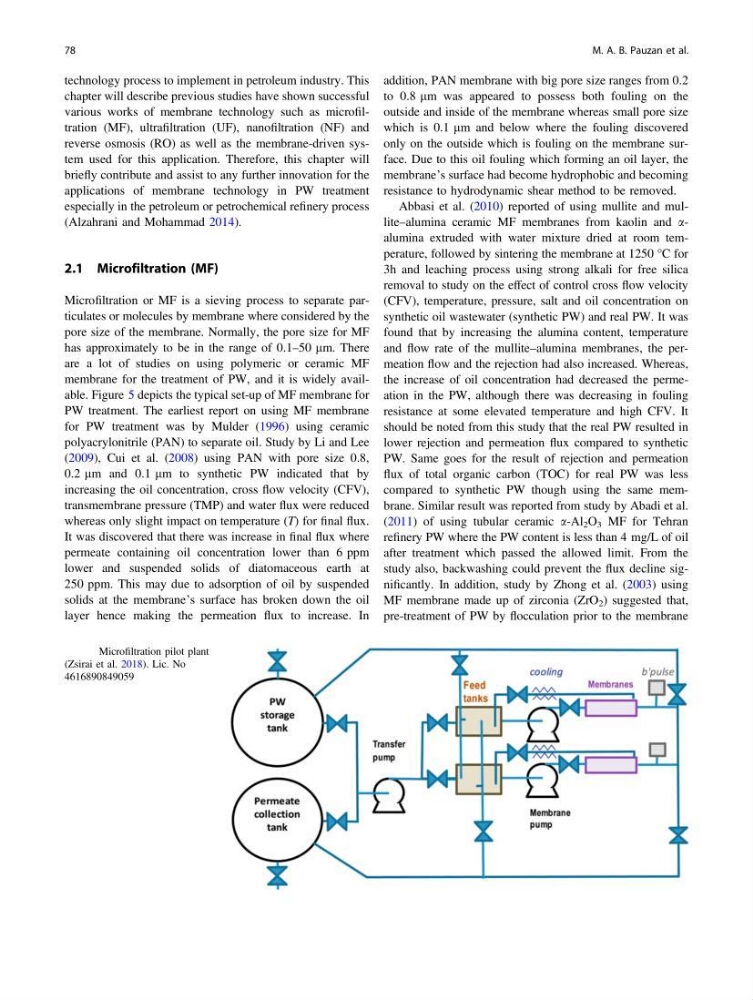
membrane for the treatment of PW, and it is widely available. Figure 5 depicts the typical set-up of MF membrane for
PW treatment. The earliest report on using MF membrane
for PW treatment was by Mulder (1996) using ceramic
polyacrylonitrile (PAN) to separate oil. Study by Li and Lee
(2009), Cui et al. (2008) using PAN with pore size 0.8,
0.2 lm and 0.1 lm to synthetic PW indicated that by
increasing the oil concentration, cross flow velocity (CFV),
transmembrane pressure (TMP) and water flux were reduced
whereas only slight impact on temperature (T) for final flux.
It was discovered that there was increase in final flux where
permeate containing oil concentration lower than 6 ppm
lower and suspended solids of diatomaceous earth at
250 ppm. This may due to adsorption of oil by suspended
solids at the membrane’s surface has broken down the oil
layer hence making the permeation flux to increase. In
addition, PAN membrane with big pore size ranges from 0.2
to 0.8 lm was appeared to possess both fouling on the
outside and inside of the membrane whereas small pore size
which is 0.1 lm and below where the fouling discovered
only on the outside which is fouling on the membrane surface. Due to this oil fouling which forming an oil layer, the
membrane’s surface had become hydrophobic and becoming
resistance to hydrodynamic shear method to be removed.
Abbasi et al. (2010) reported of using mullite and mullite–alumina ceramic MF membranes from kaolin and aalumina extruded with water mixture dried at room temperature, followed by sintering the membrane at 1250 °C for
3h and leaching process using strong alkali for free silica
removal to study on the effect of control cross flow velocity
(CFV), temperature, pressure, salt and oil concentration on
synthetic oil wastewater (synthetic PW) and real PW. It was
found that by increasing the alumina content, temperature
and flow rate of the mullite–alumina membranes, the permeation flow and the rejection had also increased. Whereas,
the increase of oil concentration had decreased the permeation in the PW, although there was decreasing in fouling
resistance at some elevated temperature and high CFV. It
should be noted from this study that the real PW resulted in
lower rejection and permeation flux compared to synthetic
PW. Same goes for the result of rejection and permeation
flux of total organic carbon (TOC) for real PW was less
compared to synthetic PW though using the same membrane. Similar result was reported from study by Abadi et al.
(2011) of using tubular ceramic a-Al 2 O 3 MF for Tehran
refinery PW where the PW content is less than 4 mg/L of oil
after treatment which passed the allowed limit. From the
study also, backwashing could prevent the flux decline significantly. In addition, study by Zhong et al. (2003) using
MF membrane made up of zirconia (ZrO 2 ) suggested that,
pre-treatment of PW by flocculation prior to the membrane
Fig. 5 Microfiltration pilot plant
(Zsirai et al. 2018). Lic. No
4616890849059
78
M. A. B. Pauzan et al.
chapter will describe previous studies have shown successful
various works of membrane technology such as microfiltration (MF), ultrafiltration (UF), nanofiltration (NF) and
reverse osmosis (RO) as well as the membrane-driven system used for this application. Therefore, this chapter will
briefly contribute and assist to any further innovation for the
applications of membrane technology in PW treatment
especially in the petroleum or petrochemical refinery process
(Alzahrani and Mohammad 2014).
2.1 Microfiltration (MF)
Microfiltration or MF is a sieving process to separate particulates or molecules by membrane where considered by the
pore size of the membrane. Normally, the pore size for MF
has approximately to be in the range of 0.1–50 lm. There
are a lot of studies on using polymeric or ceramic MF
membrane for the treatment of PW, and it is widely available. Figure 5 depicts the typical set-up of MF membrane for
PW treatment. The earliest report on using MF membrane
for PW treatment was by Mulder (1996) using ceramic
polyacrylonitrile (PAN) to separate oil. Study by Li and Lee
(2009), Cui et al. (2008) using PAN with pore size 0.8,
0.2 lm and 0.1 lm to synthetic PW indicated that by
increasing the oil concentration, cross flow velocity (CFV),
transmembrane pressure (TMP) and water flux were reduced
whereas only slight impact on temperature (T) for final flux.
It was discovered that there was increase in final flux where
permeate containing oil concentration lower than 6 ppm
lower and suspended solids of diatomaceous earth at
250 ppm. This may due to adsorption of oil by suspended
solids at the membrane’s surface has broken down the oil
layer hence making the permeation flux to increase. In
addition, PAN membrane with big pore size ranges from 0.2
to 0.8 lm was appeared to possess both fouling on the
outside and inside of the membrane whereas small pore size
which is 0.1 lm and below where the fouling discovered
only on the outside which is fouling on the membrane surface. Due to this oil fouling which forming an oil layer, the
membrane’s surface had become hydrophobic and becoming
resistance to hydrodynamic shear method to be removed.
Abbasi et al. (2010) reported of using mullite and mullite–alumina ceramic MF membranes from kaolin and aalumina extruded with water mixture dried at room temperature, followed by sintering the membrane at 1250 °C for
3h and leaching process using strong alkali for free silica
removal to study on the effect of control cross flow velocity
(CFV), temperature, pressure, salt and oil concentration on
synthetic oil wastewater (synthetic PW) and real PW. It was
found that by increasing the alumina content, temperature
and flow rate of the mullite–alumina membranes, the permeation flow and the rejection had also increased. Whereas,
the increase of oil concentration had decreased the permeation in the PW, although there was decreasing in fouling
resistance at some elevated temperature and high CFV. It
should be noted from this study that the real PW resulted in
lower rejection and permeation flux compared to synthetic
PW. Same goes for the result of rejection and permeation
flux of total organic carbon (TOC) for real PW was less
compared to synthetic PW though using the same membrane. Similar result was reported from study by Abadi et al.
(2011) of using tubular ceramic a-Al 2 O 3 MF for Tehran
refinery PW where the PW content is less than 4 mg/L of oil
after treatment which passed the allowed limit. From the
study also, backwashing could prevent the flux decline significantly. In addition, study by Zhong et al. (2003) using
MF membrane made up of zirconia (ZrO 2 ) suggested that,
pre-treatment of PW by flocculation prior to the membrane
Fig. 5 Microfiltration pilot plant
(Zsirai et al. 2018). Lic. No
4616890849059
78
M. A. B. Pauzan et al.