

with the implementation of membrane technology as this
technology has become one of rapid growing industries for
filtration with various applications could be found. Continuous studies and researches have been made to develop the
best membrane not only academically but also in private
industry. The introducing of membrane technology in
hydrocarbon separation is not new discoveries as membrane
technology has become one of the most effective ways to be
used in this petrochemical industry. With the ability to
separate oil from water, membrane also can be used to
separate gas from the mixture and used in produce and
process water treatment before being discharged or injected
to the well. Hence, this chapter provides the information on
the use of membrane technology in hydrocarbon separation
by previous study.
2 Membrane Treatment Processes
in Hydrocarbon Separation
The use of membrane technology for hydrocarbon waste
from chemical and petrochemical/petroleum industries has
been started as early 1950s where the first experiment was
notated. Membrane technology is a simple and safe techniques where the separation requires small energy, and it is
not exaggerated to mention it is an energy-saving technology
as well as the materials used also non-harmful to humankind
and environment (Munirasu et al. 2016).
Basically, a membrane is a barrier used to separate two
phases in a selective manner and controlled by the carrying of
various chemicals. Liquid or solid in form, the structure can
be asymmetric or symmetric, heterogeneous or homogenous
layers, as well as possess a negative or positive charge. The
membrane transport mechanism can be influenced by diffusion or convection by respective molecules, depending on the
concentration, pressure or temperature of the permeate and
filtrate. The membrane can be classified by thickness, pore
and particle size which vary from micro to nano scale.
Driving force or pressure difference is required to run the
membrane, and the performance of the membrane was
evaluated based on any changes of concentration or interaction between two phases of the membrane. The parameters
can be varied depending on the applications of the membrane
where famously used parameters are concentration, pressure
or temperature. Electrical or zeta potential difference also can
be another driving force in membrane separations which only
influenced by the moving of the membranes’ charged molecules or particles (Ravanchi et al. 2009).
Generally, there are four types of methods were applied to
investigate the mechanism of the membrane which are
absorption, adsorption, cryogenics and normal filtration. To
determine the methods going to use, the properties of the
materials used will be defined depending to its specific
applications. Compared to other methods, membranes offer
versatility and simplicity where normally all membranes
possessed similar separation processes regarding any materials and techniques. Among advantageous of membrane
include compact, low labour intensity and maintenance
where moving parts are not required, light in weight, operated
at low capacity, minimum energy required, simple and safe
module configuration for a simple permeation and last but not
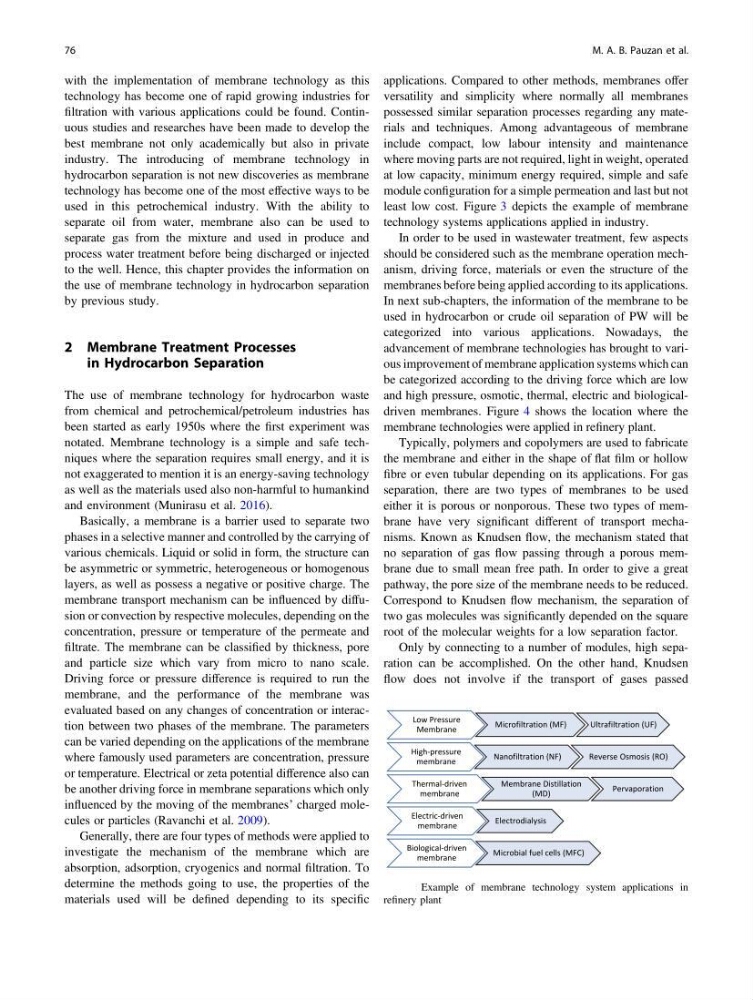
least low cost. Figure 3 depicts the example of membrane
technology systems applications applied in industry.
In order to be used in wastewater treatment, few aspects
should be considered such as the membrane operation mechanism, driving force, materials or even the structure of the
membranes before being applied according to its applications.
In next sub-chapters, the information of the membrane to be
used in hydrocarbon or crude oil separation of PW will be
categorized into various applications. Nowadays, the
advancement of membrane technologies has brought to various improvement of membrane application systems which can
be categorized according to the driving force which are low
and high pressure, osmotic, thermal, electric and biologicaldriven membranes. Figure 4 shows the location where the
membrane technologies were applied in refinery plant.
Typically, polymers and copolymers are used to fabricate
the membrane and either in the shape of flat film or hollow
fibre or even tubular depending on its applications. For gas
separation, there are two types of membranes to be used
either it is porous or nonporous. These two types of membrane have very significant different of transport mechanisms. Known as Knudsen flow, the mechanism stated that
no separation of gas flow passing through a porous membrane due to small mean free path. In order to give a great
pathway, the pore size of the membrane needs to be reduced.
Correspond to Knudsen flow mechanism, the separation of
two gas molecules was significantly depended on the square
root of the molecular weights for a low separation factor.
Only by connecting to a number of modules, high separation can be accomplished. On the other hand, Knudsen
flow does not involve if the transport of gases passed
Low Pressure
Membrane
Microfiltration (MF)
Ultrafiltration (UF)
High-pressure
membrane
Nanofiltration (NF)
Reverse Osmosis (RO)
Thermal-driven
membrane
Membrane Distillation
(MD)
Pervaporation
Electric-driven
membrane
Electrodialysis
Biological-driven
membrane
Microbial fuel cells (MFC)
Fig. 3 Example of membrane technology system applications in
refinery plant
76
M. A. B. Pauzan et al.
technology has become one of rapid growing industries for
filtration with various applications could be found. Continuous studies and researches have been made to develop the
best membrane not only academically but also in private
industry. The introducing of membrane technology in
hydrocarbon separation is not new discoveries as membrane
technology has become one of the most effective ways to be
used in this petrochemical industry. With the ability to
separate oil from water, membrane also can be used to
separate gas from the mixture and used in produce and
process water treatment before being discharged or injected
to the well. Hence, this chapter provides the information on
the use of membrane technology in hydrocarbon separation
by previous study.
2 Membrane Treatment Processes
in Hydrocarbon Separation
The use of membrane technology for hydrocarbon waste
from chemical and petrochemical/petroleum industries has
been started as early 1950s where the first experiment was
notated. Membrane technology is a simple and safe techniques where the separation requires small energy, and it is
not exaggerated to mention it is an energy-saving technology
as well as the materials used also non-harmful to humankind
and environment (Munirasu et al. 2016).
Basically, a membrane is a barrier used to separate two
phases in a selective manner and controlled by the carrying of
various chemicals. Liquid or solid in form, the structure can
be asymmetric or symmetric, heterogeneous or homogenous
layers, as well as possess a negative or positive charge. The
membrane transport mechanism can be influenced by diffusion or convection by respective molecules, depending on the
concentration, pressure or temperature of the permeate and
filtrate. The membrane can be classified by thickness, pore
and particle size which vary from micro to nano scale.
Driving force or pressure difference is required to run the
membrane, and the performance of the membrane was
evaluated based on any changes of concentration or interaction between two phases of the membrane. The parameters
can be varied depending on the applications of the membrane
where famously used parameters are concentration, pressure
or temperature. Electrical or zeta potential difference also can
be another driving force in membrane separations which only
influenced by the moving of the membranes’ charged molecules or particles (Ravanchi et al. 2009).
Generally, there are four types of methods were applied to
investigate the mechanism of the membrane which are
absorption, adsorption, cryogenics and normal filtration. To
determine the methods going to use, the properties of the
materials used will be defined depending to its specific
applications. Compared to other methods, membranes offer
versatility and simplicity where normally all membranes
possessed similar separation processes regarding any materials and techniques. Among advantageous of membrane
include compact, low labour intensity and maintenance
where moving parts are not required, light in weight, operated
at low capacity, minimum energy required, simple and safe
module configuration for a simple permeation and last but not
least low cost. Figure 3 depicts the example of membrane
technology systems applications applied in industry.
In order to be used in wastewater treatment, few aspects
should be considered such as the membrane operation mechanism, driving force, materials or even the structure of the
membranes before being applied according to its applications.
In next sub-chapters, the information of the membrane to be
used in hydrocarbon or crude oil separation of PW will be
categorized into various applications. Nowadays, the
advancement of membrane technologies has brought to various improvement of membrane application systems which can
be categorized according to the driving force which are low
and high pressure, osmotic, thermal, electric and biologicaldriven membranes. Figure 4 shows the location where the
membrane technologies were applied in refinery plant.
Typically, polymers and copolymers are used to fabricate
the membrane and either in the shape of flat film or hollow
fibre or even tubular depending on its applications. For gas
separation, there are two types of membranes to be used
either it is porous or nonporous. These two types of membrane have very significant different of transport mechanisms. Known as Knudsen flow, the mechanism stated that
no separation of gas flow passing through a porous membrane due to small mean free path. In order to give a great
pathway, the pore size of the membrane needs to be reduced.
Correspond to Knudsen flow mechanism, the separation of
two gas molecules was significantly depended on the square
root of the molecular weights for a low separation factor.
Only by connecting to a number of modules, high separation can be accomplished. On the other hand, Knudsen
flow does not involve if the transport of gases passed
Low Pressure
Membrane
Microfiltration (MF)
Ultrafiltration (UF)
High-pressure
membrane
Nanofiltration (NF)
Reverse Osmosis (RO)
Thermal-driven
membrane
Membrane Distillation
(MD)
Pervaporation
Electric-driven
membrane
Electrodialysis
Biological-driven
membrane
Microbial fuel cells (MFC)
Fig. 3 Example of membrane technology system applications in
refinery plant
76
M. A. B. Pauzan et al.