

study of hydrocarbon separation using membrane separation
will emerge the sources of the water, i.e. produced water and
process water will be known generally as PW.
Normally, the process of refining crude oil/gas to simpler
form involves three minors process depending on its size of
molecules and level of separation:
1. Organic matter removal such as emulsified, dispersed and
dissolved grease, oil and gases.
2. Dissolved inorganic matters removal.
3. Particulates removal which include clay, suspended
particles and sand.
If along the process there is natural radioactive chemicals
present, caution should be taken to remove those chemicals.
The chemicals used for the sweetening or additives during
the three steps process also should be removed without
changing the original constituent.
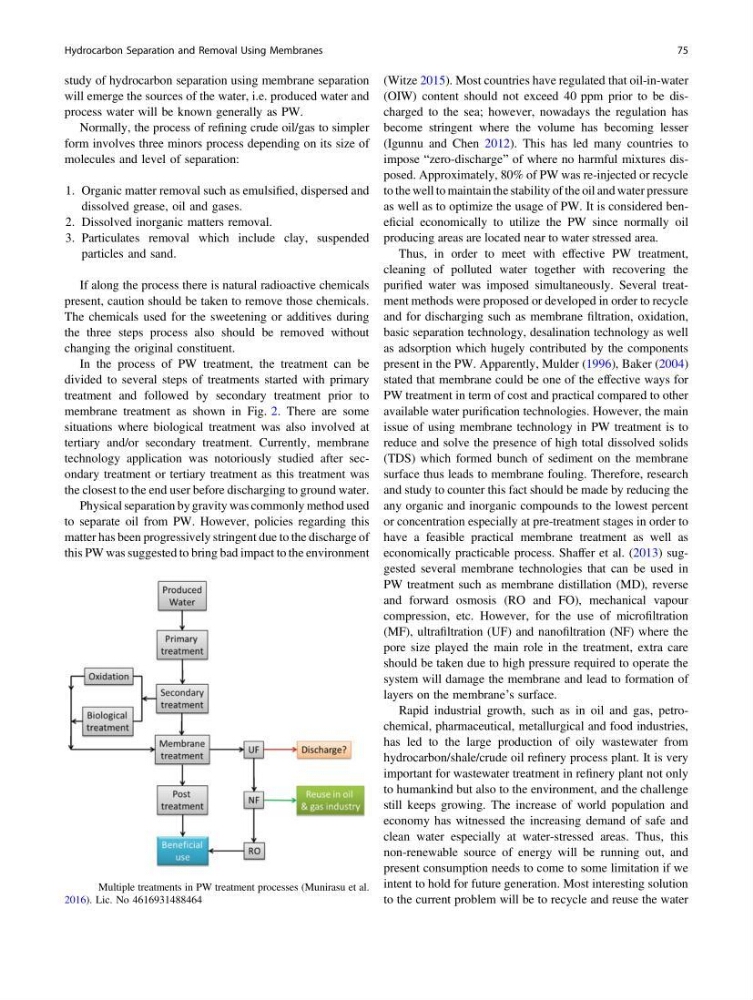
In the process of PW treatment, the treatment can be
divided to several steps of treatments started with primary
treatment and followed by secondary treatment prior to
membrane treatment as shown in Fig. 2. There are some
situations where biological treatment was also involved at
tertiary and/or secondary treatment. Currently, membrane
technology application was notoriously studied after secondary treatment or tertiary treatment as this treatment was
the closest to the end user before discharging to ground water.
Physical separation by gravity was commonly method used
to separate oil from PW. However, policies regarding this
matter has been progressively stringent due to the discharge of
this PW was suggested to bring bad impact to the environment
(Witze 2015). Most countries have regulated that oil-in-water
(OIW) content should not exceed 40 ppm prior to be discharged to the sea; however, nowadays the regulation has
become stringent where the volume has becoming lesser
(Igunnu and Chen 2012). This has led many countries to
impose “zero-discharge” of where no harmful mixtures disposed. Approximately, 80% of PW was re-injected or recycle
to the well to maintain the stability of the oil and water pressure
as well as to optimize the usage of PW. It is considered beneficial economically to utilize the PW since normally oil
producing areas are located near to water stressed area.
Thus, in order to meet with effective PW treatment,
cleaning of polluted water together with recovering the
purified water was imposed simultaneously. Several treatment methods were proposed or developed in order to recycle
and for discharging such as membrane filtration, oxidation,
basic separation technology, desalination technology as well
as adsorption which hugely contributed by the components
present in the PW. Apparently, Mulder (1996), Baker (2004)
stated that membrane could be one of the effective ways for
PW treatment in term of cost and practical compared to other
available water purification technologies. However, the main
issue of using membrane technology in PW treatment is to
reduce and solve the presence of high total dissolved solids
(TDS) which formed bunch of sediment on the membrane
surface thus leads to membrane fouling. Therefore, research
and study to counter this fact should be made by reducing the
any organic and inorganic compounds to the lowest percent
or concentration especially at pre-treatment stages in order to
have a feasible practical membrane treatment as well as
economically practicable process. Shaffer et al. (2013) suggested several membrane technologies that can be used in
PW treatment such as membrane distillation (MD), reverse
and forward osmosis (RO and FO), mechanical vapour
compression, etc. However, for the use of microfiltration
(MF), ultrafiltration (UF) and nanofiltration (NF) where the
pore size played the main role in the treatment, extra care
should be taken due to high pressure required to operate the
system will damage the membrane and lead to formation of
layers on the membrane’s surface.
Rapid industrial growth, such as in oil and gas, petrochemical, pharmaceutical, metallurgical and food industries,
has led to the large production of oily wastewater from
hydrocarbon/shale/crude oil refinery process plant. It is very
important for wastewater treatment in refinery plant not only
to humankind but also to the environment, and the challenge
still keeps growing. The increase of world population and
economy has witnessed the increasing demand of safe and
clean water especially at water-stressed areas. Thus, this
non-renewable source of energy will be running out, and
present consumption needs to come to some limitation if we
intent to hold for future generation. Most interesting solution
to the current problem will be to recycle and reuse the water
Fig. 2 Multiple treatments in PW treatment processes (Munirasu et al.
2016). Lic. No 4616931488464
Hydrocarbon Separation and Removal Using Membranes
75
will emerge the sources of the water, i.e. produced water and
process water will be known generally as PW.
Normally, the process of refining crude oil/gas to simpler
form involves three minors process depending on its size of
molecules and level of separation:
1. Organic matter removal such as emulsified, dispersed and
dissolved grease, oil and gases.
2. Dissolved inorganic matters removal.
3. Particulates removal which include clay, suspended
particles and sand.
If along the process there is natural radioactive chemicals
present, caution should be taken to remove those chemicals.
The chemicals used for the sweetening or additives during
the three steps process also should be removed without
changing the original constituent.
In the process of PW treatment, the treatment can be
divided to several steps of treatments started with primary
treatment and followed by secondary treatment prior to
membrane treatment as shown in Fig. 2. There are some
situations where biological treatment was also involved at
tertiary and/or secondary treatment. Currently, membrane
technology application was notoriously studied after secondary treatment or tertiary treatment as this treatment was
the closest to the end user before discharging to ground water.
Physical separation by gravity was commonly method used
to separate oil from PW. However, policies regarding this
matter has been progressively stringent due to the discharge of
this PW was suggested to bring bad impact to the environment
(Witze 2015). Most countries have regulated that oil-in-water
(OIW) content should not exceed 40 ppm prior to be discharged to the sea; however, nowadays the regulation has
become stringent where the volume has becoming lesser
(Igunnu and Chen 2012). This has led many countries to
impose “zero-discharge” of where no harmful mixtures disposed. Approximately, 80% of PW was re-injected or recycle
to the well to maintain the stability of the oil and water pressure
as well as to optimize the usage of PW. It is considered beneficial economically to utilize the PW since normally oil
producing areas are located near to water stressed area.
Thus, in order to meet with effective PW treatment,
cleaning of polluted water together with recovering the
purified water was imposed simultaneously. Several treatment methods were proposed or developed in order to recycle
and for discharging such as membrane filtration, oxidation,
basic separation technology, desalination technology as well
as adsorption which hugely contributed by the components
present in the PW. Apparently, Mulder (1996), Baker (2004)
stated that membrane could be one of the effective ways for
PW treatment in term of cost and practical compared to other
available water purification technologies. However, the main
issue of using membrane technology in PW treatment is to
reduce and solve the presence of high total dissolved solids
(TDS) which formed bunch of sediment on the membrane
surface thus leads to membrane fouling. Therefore, research
and study to counter this fact should be made by reducing the
any organic and inorganic compounds to the lowest percent
or concentration especially at pre-treatment stages in order to
have a feasible practical membrane treatment as well as
economically practicable process. Shaffer et al. (2013) suggested several membrane technologies that can be used in
PW treatment such as membrane distillation (MD), reverse
and forward osmosis (RO and FO), mechanical vapour
compression, etc. However, for the use of microfiltration
(MF), ultrafiltration (UF) and nanofiltration (NF) where the
pore size played the main role in the treatment, extra care
should be taken due to high pressure required to operate the
system will damage the membrane and lead to formation of
layers on the membrane’s surface.
Rapid industrial growth, such as in oil and gas, petrochemical, pharmaceutical, metallurgical and food industries,
has led to the large production of oily wastewater from
hydrocarbon/shale/crude oil refinery process plant. It is very
important for wastewater treatment in refinery plant not only
to humankind but also to the environment, and the challenge
still keeps growing. The increase of world population and
economy has witnessed the increasing demand of safe and
clean water especially at water-stressed areas. Thus, this
non-renewable source of energy will be running out, and
present consumption needs to come to some limitation if we
intent to hold for future generation. Most interesting solution
to the current problem will be to recycle and reuse the water
Fig. 2 Multiple treatments in PW treatment processes (Munirasu et al.
2016). Lic. No 4616931488464
Hydrocarbon Separation and Removal Using Membranes
75