

pressures. Typical internal and external diameters of these
hollow fibers, respectively, are 50 lm and 100–200 lm
(Baker 2012).
5 A Typical BWRO Plant
The brininess level of typical brackish feed waters needs to
be lowered from a normal range of 2000–10,000 mg/L to
500 mg/L to make it drinkable as per recommendations of
the World Health Organization (WHO). Typical salt rejections and water recoveries of such feeds lie in the ranges of
75–95% and 85–90%, respectively.
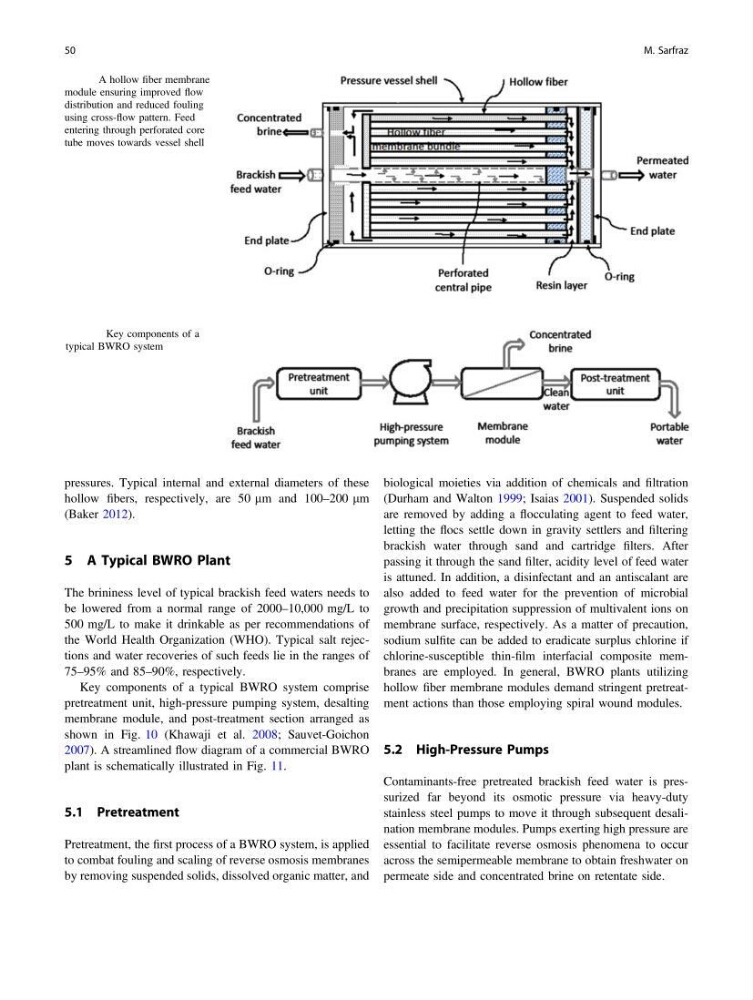
Key components of a typical BWRO system comprise
pretreatment unit, high-pressure pumping system, desalting
membrane module, and post-treatment section arranged as
shown in Fig. 10 (Khawaji et al. 2008; Sauvet-Goichon
2007). A streamlined flow diagram of a commercial BWRO
plant is schematically illustrated in Fig. 11.
5.1 Pretreatment
Pretreatment, the first process of a BWRO system, is applied
to combat fouling and scaling of reverse osmosis membranes
by removing suspended solids, dissolved organic matter, and
biological moieties via addition of chemicals and filtration
(Durham and Walton 1999; Isaias 2001). Suspended solids
are removed by adding a flocculating agent to feed water,
letting the flocs settle down in gravity settlers and filtering
brackish water through sand and cartridge filters. After
passing it through the sand filter, acidity level of feed water
is attuned. In addition, a disinfectant and an antiscalant are
also added to feed water for the prevention of microbial
growth and precipitation suppression of multivalent ions on
membrane surface, respectively. As a matter of precaution,
sodium sulfite can be added to eradicate surplus chlorine if
chlorine-susceptible thin-film interfacial composite membranes are employed. In general, BWRO plants utilizing
hollow fiber membrane modules demand stringent pretreatment actions than those employing spiral wound modules.
5.2 High-Pressure Pumps
Contaminants-free pretreated brackish feed water is pressurized far beyond its osmotic pressure via heavy-duty
stainless steel pumps to move it through subsequent desalination membrane modules. Pumps exerting high pressure are
essential to facilitate reverse osmosis phenomena to occur
across the semipermeable membrane to obtain freshwater on
permeate side and concentrated brine on retentate side.
Fig. 9 A hollow fiber membrane
module ensuring improved flow
distribution and reduced fouling
using cross-flow pattern. Feed
entering through perforated core
tube moves towards vessel shell
Fig. 10 Key components of a
typical BWRO system
50
M. Sarfraz
hollow fibers, respectively, are 50 lm and 100–200 lm
(Baker 2012).
5 A Typical BWRO Plant
The brininess level of typical brackish feed waters needs to
be lowered from a normal range of 2000–10,000 mg/L to
500 mg/L to make it drinkable as per recommendations of
the World Health Organization (WHO). Typical salt rejections and water recoveries of such feeds lie in the ranges of
75–95% and 85–90%, respectively.
Key components of a typical BWRO system comprise
pretreatment unit, high-pressure pumping system, desalting
membrane module, and post-treatment section arranged as
shown in Fig. 10 (Khawaji et al. 2008; Sauvet-Goichon
2007). A streamlined flow diagram of a commercial BWRO
plant is schematically illustrated in Fig. 11.
5.1 Pretreatment
Pretreatment, the first process of a BWRO system, is applied
to combat fouling and scaling of reverse osmosis membranes
by removing suspended solids, dissolved organic matter, and
biological moieties via addition of chemicals and filtration
(Durham and Walton 1999; Isaias 2001). Suspended solids
are removed by adding a flocculating agent to feed water,
letting the flocs settle down in gravity settlers and filtering
brackish water through sand and cartridge filters. After
passing it through the sand filter, acidity level of feed water
is attuned. In addition, a disinfectant and an antiscalant are
also added to feed water for the prevention of microbial
growth and precipitation suppression of multivalent ions on
membrane surface, respectively. As a matter of precaution,
sodium sulfite can be added to eradicate surplus chlorine if
chlorine-susceptible thin-film interfacial composite membranes are employed. In general, BWRO plants utilizing
hollow fiber membrane modules demand stringent pretreatment actions than those employing spiral wound modules.
5.2 High-Pressure Pumps
Contaminants-free pretreated brackish feed water is pressurized far beyond its osmotic pressure via heavy-duty
stainless steel pumps to move it through subsequent desalination membrane modules. Pumps exerting high pressure are
essential to facilitate reverse osmosis phenomena to occur
across the semipermeable membrane to obtain freshwater on
permeate side and concentrated brine on retentate side.
Fig. 9 A hollow fiber membrane
module ensuring improved flow
distribution and reduced fouling
using cross-flow pattern. Feed
entering through perforated core
tube moves towards vessel shell
Fig. 10 Key components of a
typical BWRO system
50
M. Sarfraz