

displayed in Fig. 9 (Kumano et al. 2008). Such a module is
made by containing a bundle of thousands of small-diameter
hollow fibers in a pressure vessel. The bundle of fibers is
closed from one end while kept opened from other end for
the permeate flow. A perforated central pipe is inserted all
along the module length to uniformly distribute brackish
feed water (MacNeil 1988). A portion of pressurized feed
water entering the module via core tube is forced to permeate
radially into the walls of bundled hollow fibers from shell
side. Desalted water leaves the tubes to form their open ends,
whereas the concentrated brine exits the module from its
shell side.
These types of modules are cost-effective, render high
membrane area-to-volume ratio, uniformly high permeate
flow, and high recovery (Marcovecchio et al. 2010;
Nakayama and Sano 2013; Senthilmurugan and Gupta
2006). The production rate of clean water of hollow fiber
modules is almost one order of magnitude higher than that
obtained from spiral wound modules. Notable drawbacks of
these modules, however, include low fouling resistance and
difficult cleaning on account of compact fiber arrangement
and formation of stagnant zones (Kucera 2010; MacNeil
1988; Dupont et al. 1982). In addition, thick-walled fibers
should be made to tolerate high shell-side hydrostatic
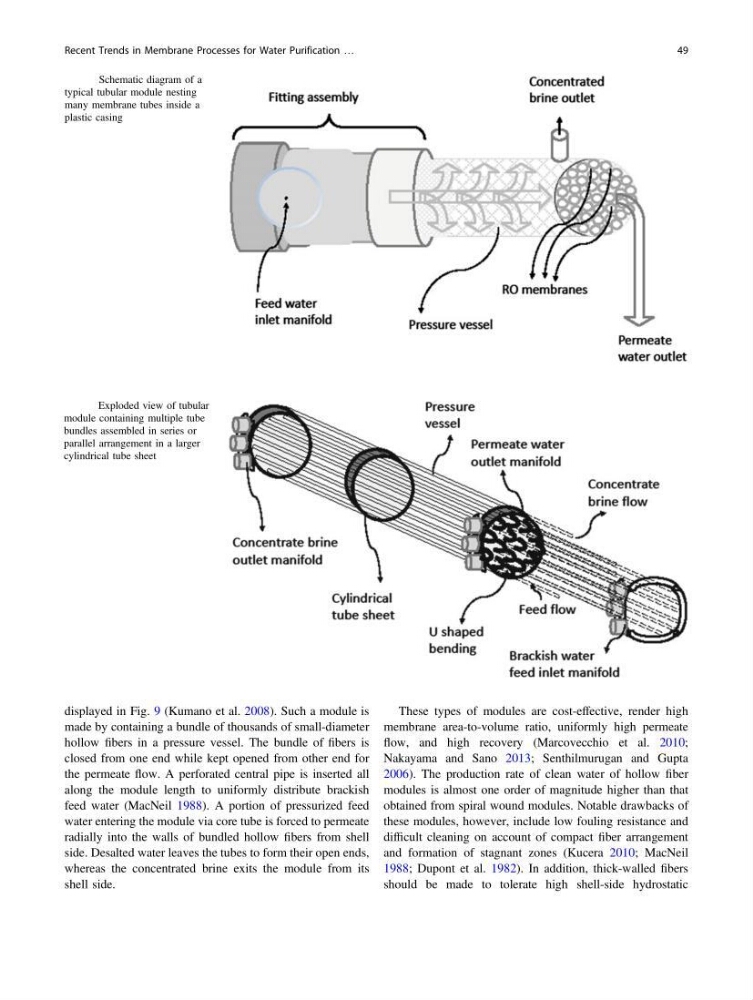
Fig. 7 Schematic diagram of a
typical tubular module nesting
many membrane tubes inside a
plastic casing
Fig. 8 Exploded view of tubular
module containing multiple tube
bundles assembled in series or
parallel arrangement in a larger
cylindrical tube sheet
Recent Trends in Membrane Processes for Water Purification …
49
made by containing a bundle of thousands of small-diameter
hollow fibers in a pressure vessel. The bundle of fibers is
closed from one end while kept opened from other end for
the permeate flow. A perforated central pipe is inserted all
along the module length to uniformly distribute brackish
feed water (MacNeil 1988). A portion of pressurized feed
water entering the module via core tube is forced to permeate
radially into the walls of bundled hollow fibers from shell
side. Desalted water leaves the tubes to form their open ends,
whereas the concentrated brine exits the module from its
shell side.
These types of modules are cost-effective, render high
membrane area-to-volume ratio, uniformly high permeate
flow, and high recovery (Marcovecchio et al. 2010;
Nakayama and Sano 2013; Senthilmurugan and Gupta
2006). The production rate of clean water of hollow fiber
modules is almost one order of magnitude higher than that
obtained from spiral wound modules. Notable drawbacks of
these modules, however, include low fouling resistance and
difficult cleaning on account of compact fiber arrangement
and formation of stagnant zones (Kucera 2010; MacNeil
1988; Dupont et al. 1982). In addition, thick-walled fibers
should be made to tolerate high shell-side hydrostatic
Fig. 7 Schematic diagram of a
typical tubular module nesting
many membrane tubes inside a
plastic casing
Fig. 8 Exploded view of tubular
module containing multiple tube
bundles assembled in series or
parallel arrangement in a larger
cylindrical tube sheet
Recent Trends in Membrane Processes for Water Purification …
49