

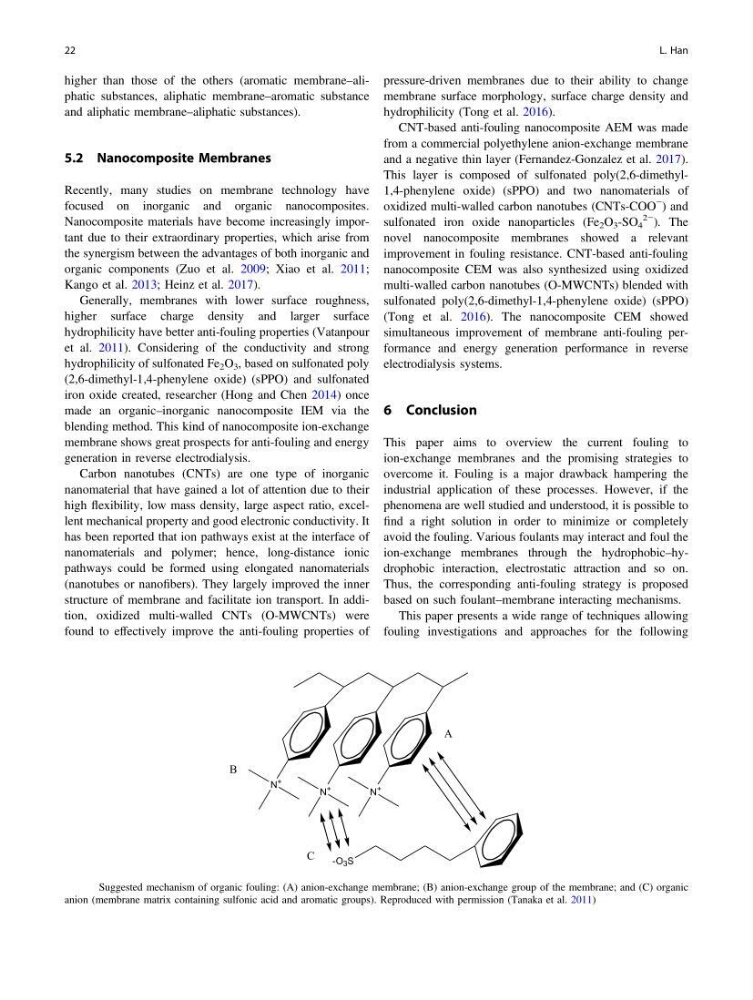
higher than those of the others (aromatic membrane–aliphatic substances, aliphatic membrane–aromatic substance
and aliphatic membrane–aliphatic substances).
5.2 Nanocomposite Membranes
Recently, many studies on membrane technology have
focused on inorganic and organic nanocomposites.
Nanocomposite materials have become increasingly important due to their extraordinary properties, which arise from
the synergism between the advantages of both inorganic and
organic components (Zuo et al. 2009; Xiao et al. 2011;
Kango et al. 2013; Heinz et al. 2017).
Generally, membranes with lower surface roughness,
higher surface charge density and larger surface
hydrophilicity have better anti-fouling properties (Vatanpour
et al. 2011). Considering of the conductivity and strong
hydrophilicity of sulfonated Fe 2 O 3 , based on sulfonated poly
(2,6-dimethyl-1,4-phenylene oxide) (sPPO) and sulfonated
iron oxide created, researcher (Hong and Chen 2014) once
made an organic–inorganic nanocomposite IEM via the
blending method. This kind of nanocomposite ion-exchange
membrane shows great prospects for anti-fouling and energy
generation in reverse electrodialysis.
Carbon nanotubes (CNTs) are one type of inorganic
nanomaterial that have gained a lot of attention due to their
high flexibility, low mass density, large aspect ratio, excellent mechanical property and good electronic conductivity. It
has been reported that ion pathways exist at the interface of
nanomaterials and polymer; hence, long-distance ionic
pathways could be formed using elongated nanomaterials
(nanotubes or nanofibers). They largely improved the inner
structure of membrane and facilitate ion transport. In addition, oxidized multi-walled CNTs (O-MWCNTs) were
found to effectively improve the anti-fouling properties of
pressure-driven membranes due to their ability to change
membrane surface morphology, surface charge density and
hydrophilicity (Tong et al. 2016).
CNT-based anti-fouling nanocomposite AEM was made
from a commercial polyethylene anion-exchange membrane
and a negative thin layer (Fernandez-Gonzalez et al. 2017).
This layer is composed of sulfonated poly(2,6-dimethyl1,4-phenylene oxide) (sPPO) and two nanomaterials of
oxidized multi-walled carbon nanotubes (CNTs-COO
− ) and
sulfonated iron oxide nanoparticles (Fe 2 O 3 -SO 4
2− ). The
novel nanocomposite membranes showed a relevant
improvement in fouling resistance. CNT-based anti-fouling
nanocomposite CEM was also synthesized using oxidized
multi-walled carbon nanotubes (O-MWCNTs) blended with
sulfonated poly(2,6-dimethyl-1,4-phenylene oxide) (sPPO)
(Tong et al. 2016). The nanocomposite CEM showed
simultaneous improvement of membrane anti-fouling performance and energy generation performance in reverse
electrodialysis systems.
6 Conclusion
This paper aims to overview the current fouling to
ion-exchange membranes and the promising strategies to
overcome it. Fouling is a major drawback hampering the
industrial application of these processes. However, if the
phenomena are well studied and understood, it is possible to
find a right solution in order to minimize or completely
avoid the fouling. Various foulants may interact and foul the
ion-exchange membranes through the hydrophobic–hydrophobic interaction, electrostatic attraction and so on.
Thus, the corresponding anti-fouling strategy is proposed
based on such foulant–membrane interacting mechanisms.
This paper presents a wide range of techniques allowing
fouling investigations and approaches for the following
-O 3 S
N
+
N
+
N
+
B
C
A
Fig. 6 Suggested mechanism of organic fouling: (A) anion-exchange membrane; (B) anion-exchange group of the membrane; and (C) organic
anion (membrane matrix containing sulfonic acid and aromatic groups). Reproduced with permission (Tanaka et al. 2011)
22
L. Han
and aliphatic membrane–aliphatic substances).
5.2 Nanocomposite Membranes
Recently, many studies on membrane technology have
focused on inorganic and organic nanocomposites.
Nanocomposite materials have become increasingly important due to their extraordinary properties, which arise from
the synergism between the advantages of both inorganic and
organic components (Zuo et al. 2009; Xiao et al. 2011;
Kango et al. 2013; Heinz et al. 2017).
Generally, membranes with lower surface roughness,
higher surface charge density and larger surface
hydrophilicity have better anti-fouling properties (Vatanpour
et al. 2011). Considering of the conductivity and strong
hydrophilicity of sulfonated Fe 2 O 3 , based on sulfonated poly
(2,6-dimethyl-1,4-phenylene oxide) (sPPO) and sulfonated
iron oxide created, researcher (Hong and Chen 2014) once
made an organic–inorganic nanocomposite IEM via the
blending method. This kind of nanocomposite ion-exchange
membrane shows great prospects for anti-fouling and energy
generation in reverse electrodialysis.
Carbon nanotubes (CNTs) are one type of inorganic
nanomaterial that have gained a lot of attention due to their
high flexibility, low mass density, large aspect ratio, excellent mechanical property and good electronic conductivity. It
has been reported that ion pathways exist at the interface of
nanomaterials and polymer; hence, long-distance ionic
pathways could be formed using elongated nanomaterials
(nanotubes or nanofibers). They largely improved the inner
structure of membrane and facilitate ion transport. In addition, oxidized multi-walled CNTs (O-MWCNTs) were
found to effectively improve the anti-fouling properties of
pressure-driven membranes due to their ability to change
membrane surface morphology, surface charge density and
hydrophilicity (Tong et al. 2016).
CNT-based anti-fouling nanocomposite AEM was made
from a commercial polyethylene anion-exchange membrane
and a negative thin layer (Fernandez-Gonzalez et al. 2017).
This layer is composed of sulfonated poly(2,6-dimethyl1,4-phenylene oxide) (sPPO) and two nanomaterials of
oxidized multi-walled carbon nanotubes (CNTs-COO
− ) and
sulfonated iron oxide nanoparticles (Fe 2 O 3 -SO 4
2− ). The
novel nanocomposite membranes showed a relevant
improvement in fouling resistance. CNT-based anti-fouling
nanocomposite CEM was also synthesized using oxidized
multi-walled carbon nanotubes (O-MWCNTs) blended with
sulfonated poly(2,6-dimethyl-1,4-phenylene oxide) (sPPO)
(Tong et al. 2016). The nanocomposite CEM showed
simultaneous improvement of membrane anti-fouling performance and energy generation performance in reverse
electrodialysis systems.
6 Conclusion
This paper aims to overview the current fouling to
ion-exchange membranes and the promising strategies to
overcome it. Fouling is a major drawback hampering the
industrial application of these processes. However, if the
phenomena are well studied and understood, it is possible to
find a right solution in order to minimize or completely
avoid the fouling. Various foulants may interact and foul the
ion-exchange membranes through the hydrophobic–hydrophobic interaction, electrostatic attraction and so on.
Thus, the corresponding anti-fouling strategy is proposed
based on such foulant–membrane interacting mechanisms.
This paper presents a wide range of techniques allowing
fouling investigations and approaches for the following
-O 3 S
N
+
N
+
N
+
B
C
A
Fig. 6 Suggested mechanism of organic fouling: (A) anion-exchange membrane; (B) anion-exchange group of the membrane; and (C) organic
anion (membrane matrix containing sulfonic acid and aromatic groups). Reproduced with permission (Tanaka et al. 2011)
22
L. Han