

nonwoven fabric, respectively. After being fouled by
organics, the TWEDAI membrane made of an aliphatic
monomer remained of relatively lower electrical resistance,
indicating the best anti-fouling performance. This is mainly
attributed to its small original resistance and the structure
stability. The result is in line with the finding of Tanaka et al.
(2011), Audinos (1997) showed that the fouling potential of
the aromatic membrane and the aromatic substances was
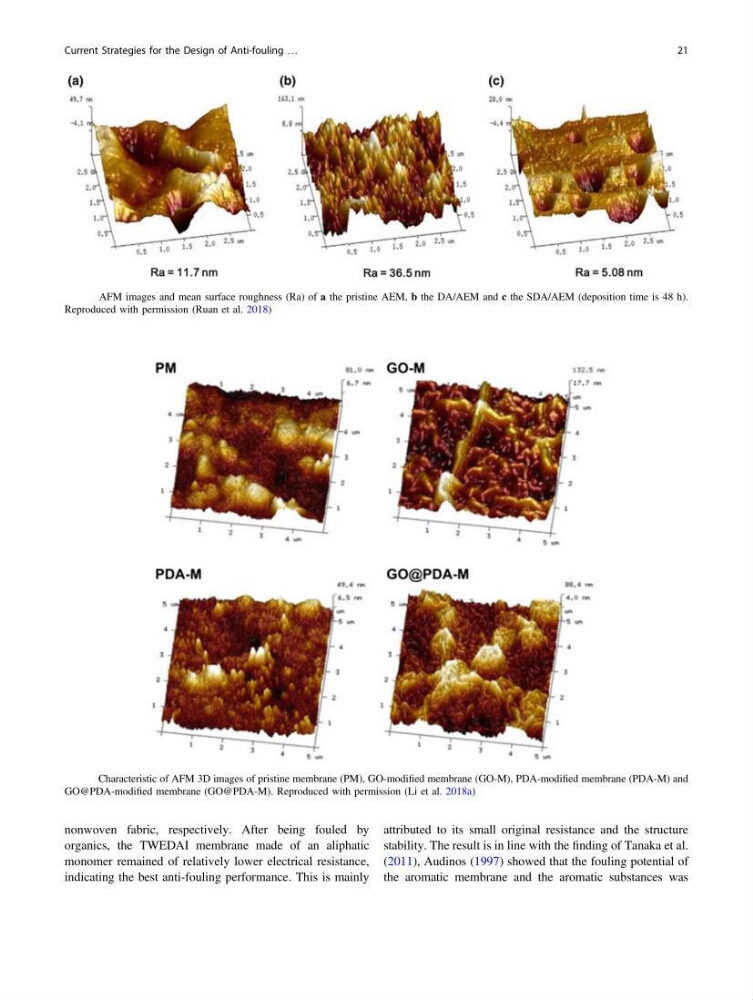
Fig. 4 AFM images and mean surface roughness (Ra) of a the pristine AEM, b the DA/AEM and c the SDA/AEM (deposition time is 48 h).
Reproduced with permission (Ruan et al. 2018)
Fig. 5 Characteristic of AFM 3D images of pristine membrane (PM), GO-modified membrane (GO-M), PDA-modified membrane (PDA-M) and
GO@PDA-modified membrane (GO@PDA-M). Reproduced with permission (Li et al. 2018a)
Current Strategies for the Design of Anti-fouling …
21
organics, the TWEDAI membrane made of an aliphatic
monomer remained of relatively lower electrical resistance,
indicating the best anti-fouling performance. This is mainly
attributed to its small original resistance and the structure
stability. The result is in line with the finding of Tanaka et al.
(2011), Audinos (1997) showed that the fouling potential of
the aromatic membrane and the aromatic substances was
Fig. 4 AFM images and mean surface roughness (Ra) of a the pristine AEM, b the DA/AEM and c the SDA/AEM (deposition time is 48 h).
Reproduced with permission (Ruan et al. 2018)
Fig. 5 Characteristic of AFM 3D images of pristine membrane (PM), GO-modified membrane (GO-M), PDA-modified membrane (PDA-M) and
GO@PDA-modified membrane (GO@PDA-M). Reproduced with permission (Li et al. 2018a)
Current Strategies for the Design of Anti-fouling …
21