

effect, which predominates and favor the chains
rearrangement.
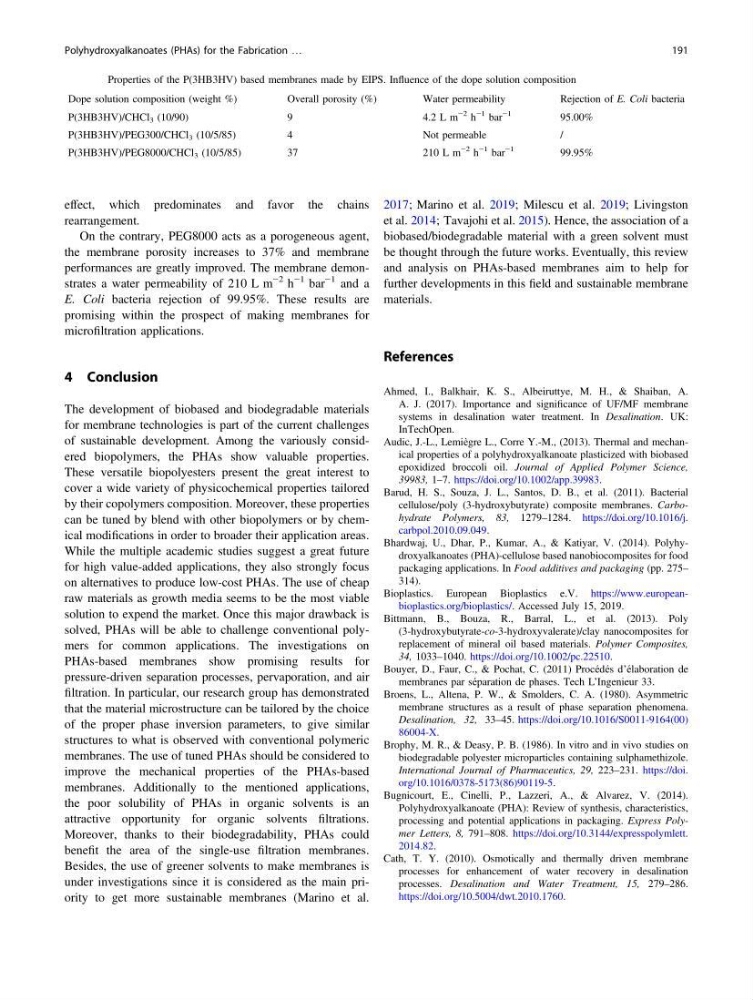
On the contrary, PEG8000 acts as a porogeneous agent,
the membrane porosity increases to 37% and membrane
performances are greatly improved. The membrane demonstrates a water permeability of 210 L m
−2 h
−1 bar
−1 and a
E. Coli bacteria rejection of 99.95%. These results are
promising within the prospect of making membranes for
microfiltration applications.
4 Conclusion
The development of biobased and biodegradable materials
for membrane technologies is part of the current challenges
of sustainable development. Among the variously considered biopolymers, the PHAs show valuable properties.
These versatile biopolyesters present the great interest to
cover a wide variety of physicochemical properties tailored
by their copolymers composition. Moreover, these properties
can be tuned by blend with other biopolymers or by chemical modifications in order to broader their application areas.
While the multiple academic studies suggest a great future
for high value-added applications, they also strongly focus
on alternatives to produce low-cost PHAs. The use of cheap
raw materials as growth media seems to be the most viable
solution to expend the market. Once this major drawback is
solved, PHAs will be able to challenge conventional polymers for common applications. The investigations on
PHAs-based membranes show promising results for
pressure-driven separation processes, pervaporation, and air
filtration. In particular, our research group has demonstrated
that the material microstructure can be tailored by the choice
of the proper phase inversion parameters, to give similar
structures to what is observed with conventional polymeric
membranes. The use of tuned PHAs should be considered to
improve the mechanical properties of the PHAs-based
membranes. Additionally to the mentioned applications,
the poor solubility of PHAs in organic solvents is an
attractive opportunity for organic solvents filtrations.
Moreover, thanks to their biodegradability, PHAs could
benefit the area of the single-use filtration membranes.
Besides, the use of greener solvents to make membranes is
under investigations since it is considered as the main priority to get more sustainable membranes (Marino et al.
2017; Marino et al. 2019; Milescu et al. 2019; Livingston
et al. 2014; Tavajohi et al. 2015). Hence, the association of a
biobased/biodegradable material with a green solvent must
be thought through the future works. Eventually, this review
and analysis on PHAs-based membranes aim to help for
further developments in this field and sustainable membrane
materials.
References
Ahmed, I., Balkhair, K. S., Albeiruttye, M. H., & Shaiban, A.
A. J. (2017). Importance and significance of UF/MF membrane
systems in desalination water treatment. In Desalination. UK:
InTechOpen.
Audic, J.-L., Lemiègre L., Corre Y.-M., (2013). Thermal and mechanical properties of a polyhydroxyalkanoate plasticized with biobased
epoxidized broccoli oil. Journal of Applied Polymer Science,
39983, 1–7. https://doi.org/10.1002/app.39983.
Barud, H. S., Souza, J. L., Santos, D. B., et al. (2011). Bacterial
cellulose/poly (3-hydroxybutyrate) composite membranes. Carbohydrate Polymers, 83, 1279–1284. https://doi.org/10.1016/j.
carbpol.2010.09.049.
Bhardwaj, U., Dhar, P., Kumar, A., & Katiyar, V. (2014). Polyhydroxyalkanoates (PHA)-cellulose based nanobiocomposites for food
packaging applications. In Food additives and packaging (pp. 275–
314).
Bioplastics. European Bioplastics e.V. https://www.europeanbioplastics.org/bioplastics/. Accessed July 15, 2019.
Bittmann, B., Bouza, R., Barral, L., et al. (2013). Poly
(3-hydroxybutyrate-co-3-hydroxyvalerate)/clay nanocomposites for
replacement of mineral oil based materials. Polymer Composites,
34, 1033–1040. https://doi.org/10.1002/pc.22510.
Bouyer, D., Faur, C., & Pochat, C. (2011) Procédés d’élaboration de
membranes par séparation de phases. Tech L’Ingenieur 33.
Broens, L., Altena, P. W., & Smolders, C. A. (1980). Asymmetric
membrane structures as a result of phase separation phenomena.
Desalination, 32, 33–45. https://doi.org/10.1016/S0011-9164(00)
86004-X.
Brophy, M. R., & Deasy, P. B. (1986). In vitro and in vivo studies on
biodegradable polyester microparticles containing sulphamethizole.
International Journal of Pharmaceutics, 29, 223–231. https://doi.
org/10.1016/0378-5173(86)90119-5.
Bugnicourt, E., Cinelli, P., Lazzeri, A., & Alvarez, V. (2014).
Polyhydroxyalkanoate (PHA): Review of synthesis, characteristics,
processing and potential applications in packaging. Express Polymer Letters, 8, 791–808. https://doi.org/10.3144/expresspolymlett.
2014.82.
Cath, T. Y. (2010). Osmotically and thermally driven membrane
processes for enhancement of water recovery in desalination
processes. Desalination and Water Treatment, 15, 279–286.
https://doi.org/10.5004/dwt.2010.1760.
Table 9 Properties of the P(3HB3HV) based membranes made by EIPS. Influence of the dope solution composition
Dope solution composition (weight %)
Overall porosity (%)
Water permeability
Rejection of E. Coli bacteria
P(3HB3HV)/CHCl 3 (10/90)
9
4.2 L m
−2 h
−1 bar
−1
95.00%
P(3HB3HV)/PEG300/CHCl 3 (10/5/85)
4
Not permeable
/
P(3HB3HV)/PEG8000/CHCl 3 (10/5/85)
37
210 L m
−2 h
−1 bar
−1
99.95%
Polyhydroxyalkanoates (PHAs) for the Fabrication …
191
rearrangement.
On the contrary, PEG8000 acts as a porogeneous agent,
the membrane porosity increases to 37% and membrane
performances are greatly improved. The membrane demonstrates a water permeability of 210 L m
−2 h
−1 bar
−1 and a
E. Coli bacteria rejection of 99.95%. These results are
promising within the prospect of making membranes for
microfiltration applications.
4 Conclusion
The development of biobased and biodegradable materials
for membrane technologies is part of the current challenges
of sustainable development. Among the variously considered biopolymers, the PHAs show valuable properties.
These versatile biopolyesters present the great interest to
cover a wide variety of physicochemical properties tailored
by their copolymers composition. Moreover, these properties
can be tuned by blend with other biopolymers or by chemical modifications in order to broader their application areas.
While the multiple academic studies suggest a great future
for high value-added applications, they also strongly focus
on alternatives to produce low-cost PHAs. The use of cheap
raw materials as growth media seems to be the most viable
solution to expend the market. Once this major drawback is
solved, PHAs will be able to challenge conventional polymers for common applications. The investigations on
PHAs-based membranes show promising results for
pressure-driven separation processes, pervaporation, and air
filtration. In particular, our research group has demonstrated
that the material microstructure can be tailored by the choice
of the proper phase inversion parameters, to give similar
structures to what is observed with conventional polymeric
membranes. The use of tuned PHAs should be considered to
improve the mechanical properties of the PHAs-based
membranes. Additionally to the mentioned applications,
the poor solubility of PHAs in organic solvents is an
attractive opportunity for organic solvents filtrations.
Moreover, thanks to their biodegradability, PHAs could
benefit the area of the single-use filtration membranes.
Besides, the use of greener solvents to make membranes is
under investigations since it is considered as the main priority to get more sustainable membranes (Marino et al.
2017; Marino et al. 2019; Milescu et al. 2019; Livingston
et al. 2014; Tavajohi et al. 2015). Hence, the association of a
biobased/biodegradable material with a green solvent must
be thought through the future works. Eventually, this review
and analysis on PHAs-based membranes aim to help for
further developments in this field and sustainable membrane
materials.
References
Ahmed, I., Balkhair, K. S., Albeiruttye, M. H., & Shaiban, A.
A. J. (2017). Importance and significance of UF/MF membrane
systems in desalination water treatment. In Desalination. UK:
InTechOpen.
Audic, J.-L., Lemiègre L., Corre Y.-M., (2013). Thermal and mechanical properties of a polyhydroxyalkanoate plasticized with biobased
epoxidized broccoli oil. Journal of Applied Polymer Science,
39983, 1–7. https://doi.org/10.1002/app.39983.
Barud, H. S., Souza, J. L., Santos, D. B., et al. (2011). Bacterial
cellulose/poly (3-hydroxybutyrate) composite membranes. Carbohydrate Polymers, 83, 1279–1284. https://doi.org/10.1016/j.
carbpol.2010.09.049.
Bhardwaj, U., Dhar, P., Kumar, A., & Katiyar, V. (2014). Polyhydroxyalkanoates (PHA)-cellulose based nanobiocomposites for food
packaging applications. In Food additives and packaging (pp. 275–
314).
Bioplastics. European Bioplastics e.V. https://www.europeanbioplastics.org/bioplastics/. Accessed July 15, 2019.
Bittmann, B., Bouza, R., Barral, L., et al. (2013). Poly
(3-hydroxybutyrate-co-3-hydroxyvalerate)/clay nanocomposites for
replacement of mineral oil based materials. Polymer Composites,
34, 1033–1040. https://doi.org/10.1002/pc.22510.
Bouyer, D., Faur, C., & Pochat, C. (2011) Procédés d’élaboration de
membranes par séparation de phases. Tech L’Ingenieur 33.
Broens, L., Altena, P. W., & Smolders, C. A. (1980). Asymmetric
membrane structures as a result of phase separation phenomena.
Desalination, 32, 33–45. https://doi.org/10.1016/S0011-9164(00)
86004-X.
Brophy, M. R., & Deasy, P. B. (1986). In vitro and in vivo studies on
biodegradable polyester microparticles containing sulphamethizole.
International Journal of Pharmaceutics, 29, 223–231. https://doi.
org/10.1016/0378-5173(86)90119-5.
Bugnicourt, E., Cinelli, P., Lazzeri, A., & Alvarez, V. (2014).
Polyhydroxyalkanoate (PHA): Review of synthesis, characteristics,
processing and potential applications in packaging. Express Polymer Letters, 8, 791–808. https://doi.org/10.3144/expresspolymlett.
2014.82.
Cath, T. Y. (2010). Osmotically and thermally driven membrane
processes for enhancement of water recovery in desalination
processes. Desalination and Water Treatment, 15, 279–286.
https://doi.org/10.5004/dwt.2010.1760.
Table 9 Properties of the P(3HB3HV) based membranes made by EIPS. Influence of the dope solution composition
Dope solution composition (weight %)
Overall porosity (%)
Water permeability
Rejection of E. Coli bacteria
P(3HB3HV)/CHCl 3 (10/90)
9
4.2 L m
−2 h
−1 bar
−1
95.00%
P(3HB3HV)/PEG300/CHCl 3 (10/5/85)
4
Not permeable
/
P(3HB3HV)/PEG8000/CHCl 3 (10/5/85)
37
210 L m
−2 h
−1 bar
−1
99.95%
Polyhydroxyalkanoates (PHAs) for the Fabrication …
191