

bacteria and belonging to the PHAs family have been of
growing interest. They are biobased and biodegradable linear polyesters and have versatile properties due to their
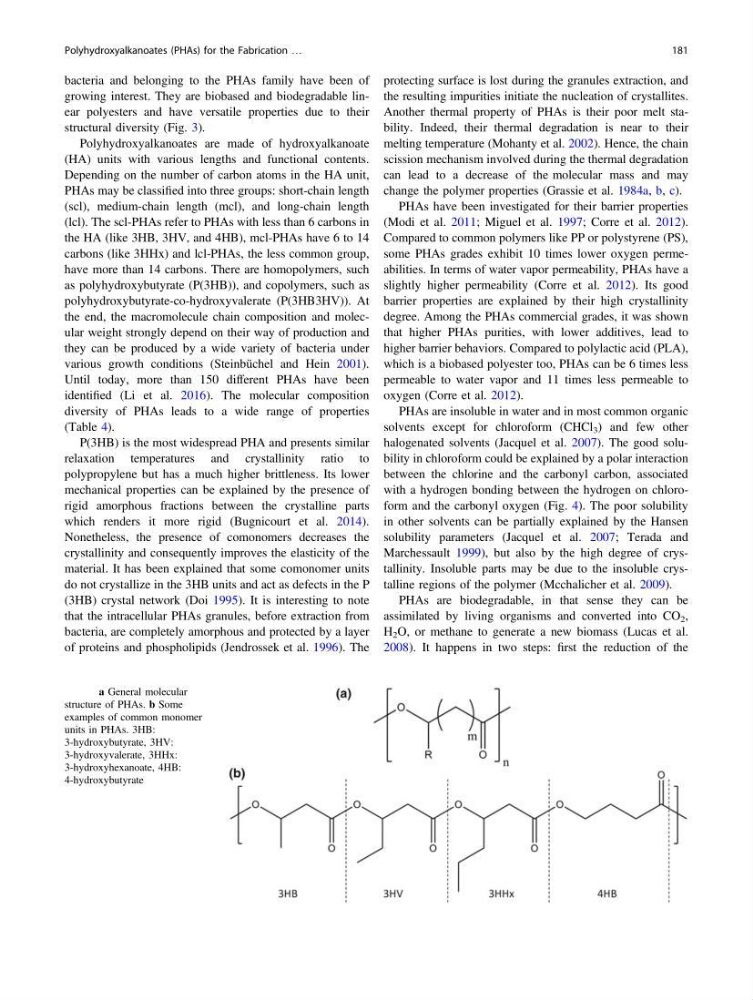
structural diversity (Fig. 3).
Polyhydroxyalkanoates are made of hydroxyalkanoate
(HA) units with various lengths and functional contents.
Depending on the number of carbon atoms in the HA unit,
PHAs may be classified into three groups: short-chain length
(scl), medium-chain length (mcl), and long-chain length
(lcl). The scl-PHAs refer to PHAs with less than 6 carbons in
the HA (like 3HB, 3HV, and 4HB), mcl-PHAs have 6 to 14
carbons (like 3HHx) and lcl-PHAs, the less common group,
have more than 14 carbons. There are homopolymers, such
as polyhydroxybutyrate (P(3HB)), and copolymers, such as
polyhydroxybutyrate-co-hydroxyvalerate (P(3HB3HV)). At
the end, the macromolecule chain composition and molecular weight strongly depend on their way of production and
they can be produced by a wide variety of bacteria under
various growth conditions (Steinbüchel and Hein 2001).
Until today, more than 150 different PHAs have been
identified (Li et al. 2016). The molecular composition
diversity of PHAs leads to a wide range of properties
(Table 4).
P(3HB) is the most widespread PHA and presents similar
relaxation temperatures and crystallinity ratio to
polypropylene but has a much higher brittleness. Its lower
mechanical properties can be explained by the presence of
rigid amorphous fractions between the crystalline parts
which renders it more rigid (Bugnicourt et al. 2014).
Nonetheless, the presence of comonomers decreases the
crystallinity and consequently improves the elasticity of the
material. It has been explained that some comonomer units
do not crystallize in the 3HB units and act as defects in the P
(3HB) crystal network (Doi 1995). It is interesting to note
that the intracellular PHAs granules, before extraction from
bacteria, are completely amorphous and protected by a layer
of proteins and phospholipids (Jendrossek et al. 1996). The
protecting surface is lost during the granules extraction, and
the resulting impurities initiate the nucleation of crystallites.
Another thermal property of PHAs is their poor melt stability. Indeed, their thermal degradation is near to their
melting temperature (Mohanty et al. 2002). Hence, the chain
scission mechanism involved during the thermal degradation
can lead to a decrease of the molecular mass and may
change the polymer properties (Grassie et al. 1984a, b, c).
PHAs have been investigated for their barrier properties
(Modi et al. 2011; Miguel et al. 1997; Corre et al. 2012).
Compared to common polymers like PP or polystyrene (PS),
some PHAs grades exhibit 10 times lower oxygen permeabilities. In terms of water vapor permeability, PHAs have a
slightly higher permeability (Corre et al. 2012). Its good
barrier properties are explained by their high crystallinity
degree. Among the PHAs commercial grades, it was shown
that higher PHAs purities, with lower additives, lead to
higher barrier behaviors. Compared to polylactic acid (PLA),
which is a biobased polyester too, PHAs can be 6 times less
permeable to water vapor and 11 times less permeable to
oxygen (Corre et al. 2012).
PHAs are insoluble in water and in most common organic
solvents except for chloroform (CHCl 3 ) and few other
halogenated solvents (Jacquel et al. 2007). The good solubility in chloroform could be explained by a polar interaction
between the chlorine and the carbonyl carbon, associated
with a hydrogen bonding between the hydrogen on chloroform and the carbonyl oxygen (Fig. 4). The poor solubility
in other solvents can be partially explained by the Hansen
solubility parameters (Jacquel et al. 2007; Terada and
Marchessault 1999), but also by the high degree of crystallinity. Insoluble parts may be due to the insoluble crystalline regions of the polymer (Mcchalicher et al. 2009).
PHAs are biodegradable, in that sense they can be
assimilated by living organisms and converted into CO 2 ,
H 2 O, or methane to generate a new biomass (Lucas et al.
2008). It happens in two steps: first the reduction of the
Fig. 3 a General molecular
structure of PHAs. b Some
examples of common monomer
units in PHAs. 3HB:
3-hydroxybutyrate, 3HV:
3-hydroxyvalerate, 3HHx:
3-hydroxyhexanoate, 4HB:
4-hydroxybutyrate
Polyhydroxyalkanoates (PHAs) for the Fabrication …
181
growing interest. They are biobased and biodegradable linear polyesters and have versatile properties due to their
structural diversity (Fig. 3).
Polyhydroxyalkanoates are made of hydroxyalkanoate
(HA) units with various lengths and functional contents.
Depending on the number of carbon atoms in the HA unit,
PHAs may be classified into three groups: short-chain length
(scl), medium-chain length (mcl), and long-chain length
(lcl). The scl-PHAs refer to PHAs with less than 6 carbons in
the HA (like 3HB, 3HV, and 4HB), mcl-PHAs have 6 to 14
carbons (like 3HHx) and lcl-PHAs, the less common group,
have more than 14 carbons. There are homopolymers, such
as polyhydroxybutyrate (P(3HB)), and copolymers, such as
polyhydroxybutyrate-co-hydroxyvalerate (P(3HB3HV)). At
the end, the macromolecule chain composition and molecular weight strongly depend on their way of production and
they can be produced by a wide variety of bacteria under
various growth conditions (Steinbüchel and Hein 2001).
Until today, more than 150 different PHAs have been
identified (Li et al. 2016). The molecular composition
diversity of PHAs leads to a wide range of properties
(Table 4).
P(3HB) is the most widespread PHA and presents similar
relaxation temperatures and crystallinity ratio to
polypropylene but has a much higher brittleness. Its lower
mechanical properties can be explained by the presence of
rigid amorphous fractions between the crystalline parts
which renders it more rigid (Bugnicourt et al. 2014).
Nonetheless, the presence of comonomers decreases the
crystallinity and consequently improves the elasticity of the
material. It has been explained that some comonomer units
do not crystallize in the 3HB units and act as defects in the P
(3HB) crystal network (Doi 1995). It is interesting to note
that the intracellular PHAs granules, before extraction from
bacteria, are completely amorphous and protected by a layer
of proteins and phospholipids (Jendrossek et al. 1996). The
protecting surface is lost during the granules extraction, and
the resulting impurities initiate the nucleation of crystallites.
Another thermal property of PHAs is their poor melt stability. Indeed, their thermal degradation is near to their
melting temperature (Mohanty et al. 2002). Hence, the chain
scission mechanism involved during the thermal degradation
can lead to a decrease of the molecular mass and may
change the polymer properties (Grassie et al. 1984a, b, c).
PHAs have been investigated for their barrier properties
(Modi et al. 2011; Miguel et al. 1997; Corre et al. 2012).
Compared to common polymers like PP or polystyrene (PS),
some PHAs grades exhibit 10 times lower oxygen permeabilities. In terms of water vapor permeability, PHAs have a
slightly higher permeability (Corre et al. 2012). Its good
barrier properties are explained by their high crystallinity
degree. Among the PHAs commercial grades, it was shown
that higher PHAs purities, with lower additives, lead to
higher barrier behaviors. Compared to polylactic acid (PLA),
which is a biobased polyester too, PHAs can be 6 times less
permeable to water vapor and 11 times less permeable to
oxygen (Corre et al. 2012).
PHAs are insoluble in water and in most common organic
solvents except for chloroform (CHCl 3 ) and few other
halogenated solvents (Jacquel et al. 2007). The good solubility in chloroform could be explained by a polar interaction
between the chlorine and the carbonyl carbon, associated
with a hydrogen bonding between the hydrogen on chloroform and the carbonyl oxygen (Fig. 4). The poor solubility
in other solvents can be partially explained by the Hansen
solubility parameters (Jacquel et al. 2007; Terada and
Marchessault 1999), but also by the high degree of crystallinity. Insoluble parts may be due to the insoluble crystalline regions of the polymer (Mcchalicher et al. 2009).
PHAs are biodegradable, in that sense they can be
assimilated by living organisms and converted into CO 2 ,
H 2 O, or methane to generate a new biomass (Lucas et al.
2008). It happens in two steps: first the reduction of the
Fig. 3 a General molecular
structure of PHAs. b Some
examples of common monomer
units in PHAs. 3HB:
3-hydroxybutyrate, 3HV:
3-hydroxyvalerate, 3HHx:
3-hydroxyhexanoate, 4HB:
4-hydroxybutyrate
Polyhydroxyalkanoates (PHAs) for the Fabrication …
181