

(z
2.5 m). Since the temperature of the MP#1 feed
hV@m2fG60 is 45 °C, the MP#1 permeation generated
13.3 °C of cooling of retentate and permeate
(T
out
V % T
out
L ¼ 31:7
C).
Figure 14 depicts the retentate path on plane T Â P. In
order to investigate the occurrence of condensation in the
retentate path, the dew-point (HCDP) locus of the MP#1
feed (blue line) and the dew-point (HCDP) locus of the
retentate product (dashed-magenta line) are also plotted. It
can be seen that the retentate dew-point locus becomes
gradually hotter due to the loss of light species CO 2 and CH 4
that are transferred to the permeate. In other words, the
retentate becomes gradually heavier on its path through
MP#1, consequently, its dew-point locus gradually moves
from the blue line to the dashed-magenta line. At the same
time, the retentate cools down due to Joule–Thomson effects
associated to the permeation of CH 4 and mostly of CO 2 . This
is seen clearly in Fig. 14 (see the magnified view at the
right); i.e., the retentate path and the retentate dew-point
locus move in opposed directions toward each other. If they
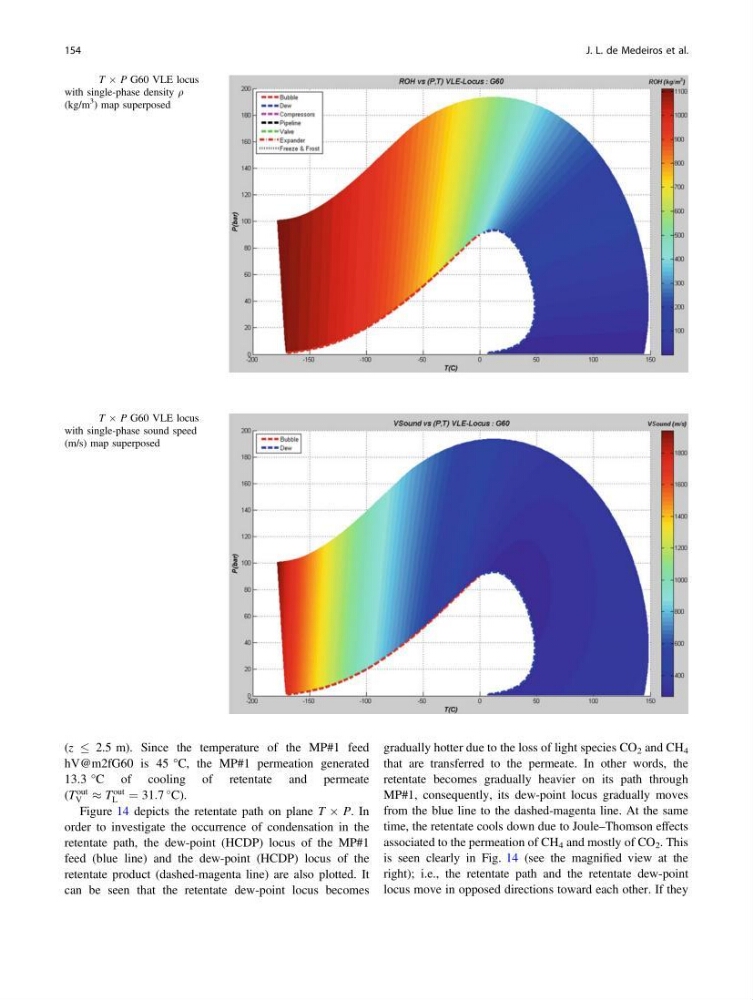
Fig. 7 T Â P G60 VLE locus
with single-phase density q
(kg/m
3
) map superposed
Fig. 8 T Â P G60 VLE locus
with single-phase sound speed
(m/s) map superposed
154
J. L. de Medeiros et al.
2.5 m). Since the temperature of the MP#1 feed
hV@m2fG60 is 45 °C, the MP#1 permeation generated
13.3 °C of cooling of retentate and permeate
(T
out
V % T
out
L ¼ 31:7
C).
Figure 14 depicts the retentate path on plane T Â P. In
order to investigate the occurrence of condensation in the
retentate path, the dew-point (HCDP) locus of the MP#1
feed (blue line) and the dew-point (HCDP) locus of the
retentate product (dashed-magenta line) are also plotted. It
can be seen that the retentate dew-point locus becomes
gradually hotter due to the loss of light species CO 2 and CH 4
that are transferred to the permeate. In other words, the
retentate becomes gradually heavier on its path through
MP#1, consequently, its dew-point locus gradually moves
from the blue line to the dashed-magenta line. At the same
time, the retentate cools down due to Joule–Thomson effects
associated to the permeation of CH 4 and mostly of CO 2 . This
is seen clearly in Fig. 14 (see the magnified view at the
right); i.e., the retentate path and the retentate dew-point
locus move in opposed directions toward each other. If they
Fig. 7 T Â P G60 VLE locus
with single-phase density q
(kg/m
3
) map superposed
Fig. 8 T Â P G60 VLE locus
with single-phase sound speed
(m/s) map superposed
154
J. L. de Medeiros et al.