

narrowing. Furthermore, foulants or blocked pores were
more compact under high permeate flux and great TMP,
enhancing pore-blocking degree.
On another hand, in Fig. 3, the permeability recovery
after membrane cleaning has a direct relationship with TMP
and shear rate. At high TMP, the permeability recovery
elevates linearly with shear rate, implying that irreversible
fouling eliminated with high shear effect. Besides, greater
TMP enhanced the concentration polarization of casein
micelles and caused the compact irreversible fouling of
whey proteins on membrane surface. In general, for SEF
process, a high shear rate and low TMP can sustain a low
irreversible membrane fouling and stable flux operation.
SEF is considered as an important membrane technology that can contribute to pre-treat dairy wastewater and
recycle valuable components such as milk proteins. However, to be efficient, it necessitates the establishment of
proper methods for the assessment of membrane fouling.
Four membrane blocking models proposed by Hermia were
used to quantify and assess the membrane fouling of SEF
observed in dairy wastewater treatment. The experiments
were performed with various shear rates, mean transmembrane pressure, temperature, and membrane types. As
presented in Fig. 4, good agreement between complete
pore-blocking model and experimental data was found,
confirming the validity of the Hermia models for assessing
the membrane fouling of SEF system and that only some
“sealing” of membrane pores occurs, which is due to the
high shearing effect. Furthermore, the increments of shear
rate, TMP, and temperature could decrease the degree of
“sealing” of membrane pores and improve the filtration
performance. In addition, a three-step membrane cleaning
mode had achieved very satisfying results in subsequent
membrane cleaning process. This work confirms that,
unlike traditional filtration mode (DF and CF), SEF possesses a low degree of membrane fouling and a higher
membrane permeability recovery after cleaning.
Concentration Process and Cheese Production
Three kinds of milk (skim milk, whole milk, and dairy
factory whole milk) were separated and concentrated by
SEF-UF (P010P) to produce high concentration protein for
cheese production (Ding et al. 2016). As showed in Fig. 5,
the ending VRRs were 10. Below VRR = 2, the permeate
fluxes clearly reduces; above VRR = 2, permeate fluxes
slightly decrease and become stable. Since at higher VRR,
protein and lipid concentrations straightened, causing a
higher foulant concentration and thicker fouling layer,
causing a greater flux reduction. But with a high shear effect,
the flux at VRR = 10 still exceeded 15 L m
−2 h
−1 . On the
other hand, the Brix in retention elevated with VRR, as more
organic matters (proteins and lipids) were separated and
concentrated, when the concentration polarization improved,
leading to more organic matter through the membrane.
Moreover, thicker fouling layer produced by more organic
matters significantly increased organic matters rejection with
VRR.
After milk concentration tests, the concentrated milk
proteins were used for lactic fermentation and cheese production. Figure 6 illustrates two kinds of cheeses produced
by different fermentation agents [FDDVS YF-L903 (CHR
HANSEN, France) and yogurt (GAZI, France)]. As shown
in 6, the actual performances for these cheeses and traditional cheese have similar pH values, but clearly lower
concentration for protein, total fat, and solids, implying that
the concentration multiple of milk was still insufficient. In
addition, the actual performance of cheeses was characterized by appearance (5 points), texture (5 points), and taste
(10 points) and estimated by a French cheese company.
Yogurts exhibited better performances in texture and taste,
compared with FD-DVS YF-L903. However, traditional
Fig. 2 Effect of shear rate on the complete pore-blocking coefficient.
(Temperature = 35 °C and membrane: UH030P)
Fig. 3 Effect of experimental shear rate and TMP on membrane
permeability recovery for the UH030P membrane
132
W. Zhang et al.
more compact under high permeate flux and great TMP,
enhancing pore-blocking degree.
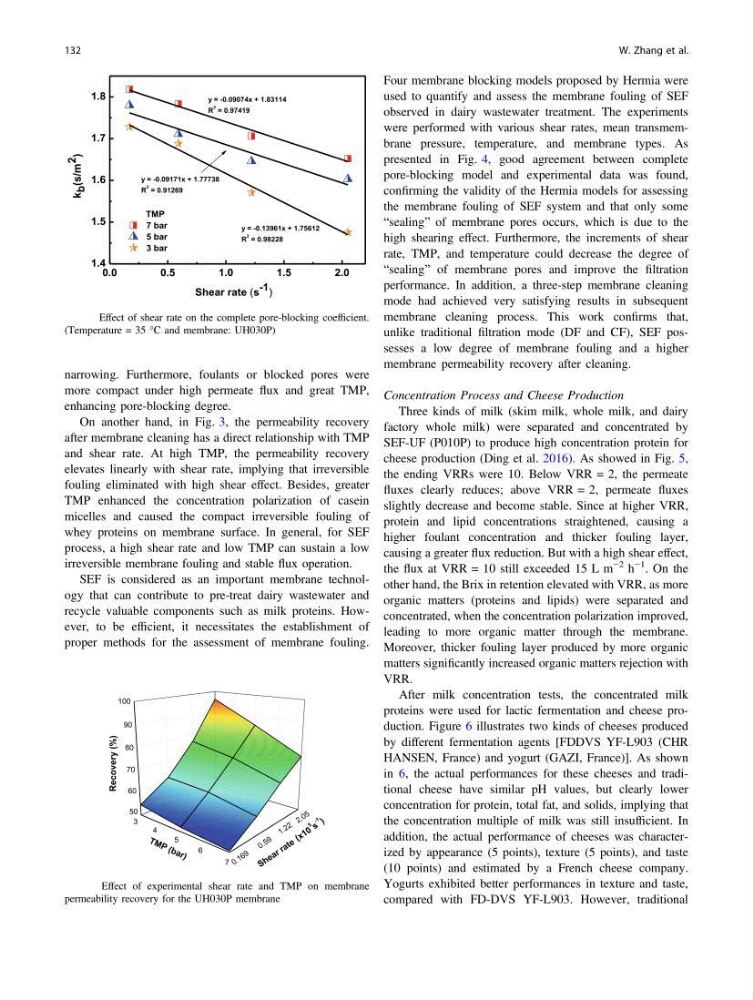
On another hand, in Fig. 3, the permeability recovery
after membrane cleaning has a direct relationship with TMP
and shear rate. At high TMP, the permeability recovery
elevates linearly with shear rate, implying that irreversible
fouling eliminated with high shear effect. Besides, greater
TMP enhanced the concentration polarization of casein
micelles and caused the compact irreversible fouling of
whey proteins on membrane surface. In general, for SEF
process, a high shear rate and low TMP can sustain a low
irreversible membrane fouling and stable flux operation.
SEF is considered as an important membrane technology that can contribute to pre-treat dairy wastewater and
recycle valuable components such as milk proteins. However, to be efficient, it necessitates the establishment of
proper methods for the assessment of membrane fouling.
Four membrane blocking models proposed by Hermia were
used to quantify and assess the membrane fouling of SEF
observed in dairy wastewater treatment. The experiments
were performed with various shear rates, mean transmembrane pressure, temperature, and membrane types. As
presented in Fig. 4, good agreement between complete
pore-blocking model and experimental data was found,
confirming the validity of the Hermia models for assessing
the membrane fouling of SEF system and that only some
“sealing” of membrane pores occurs, which is due to the
high shearing effect. Furthermore, the increments of shear
rate, TMP, and temperature could decrease the degree of
“sealing” of membrane pores and improve the filtration
performance. In addition, a three-step membrane cleaning
mode had achieved very satisfying results in subsequent
membrane cleaning process. This work confirms that,
unlike traditional filtration mode (DF and CF), SEF possesses a low degree of membrane fouling and a higher
membrane permeability recovery after cleaning.
Concentration Process and Cheese Production
Three kinds of milk (skim milk, whole milk, and dairy
factory whole milk) were separated and concentrated by
SEF-UF (P010P) to produce high concentration protein for
cheese production (Ding et al. 2016). As showed in Fig. 5,
the ending VRRs were 10. Below VRR = 2, the permeate
fluxes clearly reduces; above VRR = 2, permeate fluxes
slightly decrease and become stable. Since at higher VRR,
protein and lipid concentrations straightened, causing a
higher foulant concentration and thicker fouling layer,
causing a greater flux reduction. But with a high shear effect,
the flux at VRR = 10 still exceeded 15 L m
−2 h
−1 . On the
other hand, the Brix in retention elevated with VRR, as more
organic matters (proteins and lipids) were separated and
concentrated, when the concentration polarization improved,
leading to more organic matter through the membrane.
Moreover, thicker fouling layer produced by more organic
matters significantly increased organic matters rejection with
VRR.
After milk concentration tests, the concentrated milk
proteins were used for lactic fermentation and cheese production. Figure 6 illustrates two kinds of cheeses produced
by different fermentation agents [FDDVS YF-L903 (CHR
HANSEN, France) and yogurt (GAZI, France)]. As shown
in 6, the actual performances for these cheeses and traditional cheese have similar pH values, but clearly lower
concentration for protein, total fat, and solids, implying that
the concentration multiple of milk was still insufficient. In
addition, the actual performance of cheeses was characterized by appearance (5 points), texture (5 points), and taste
(10 points) and estimated by a French cheese company.
Yogurts exhibited better performances in texture and taste,
compared with FD-DVS YF-L903. However, traditional
Fig. 2 Effect of shear rate on the complete pore-blocking coefficient.
(Temperature = 35 °C and membrane: UH030P)
Fig. 3 Effect of experimental shear rate and TMP on membrane
permeability recovery for the UH030P membrane
132
W. Zhang et al.