

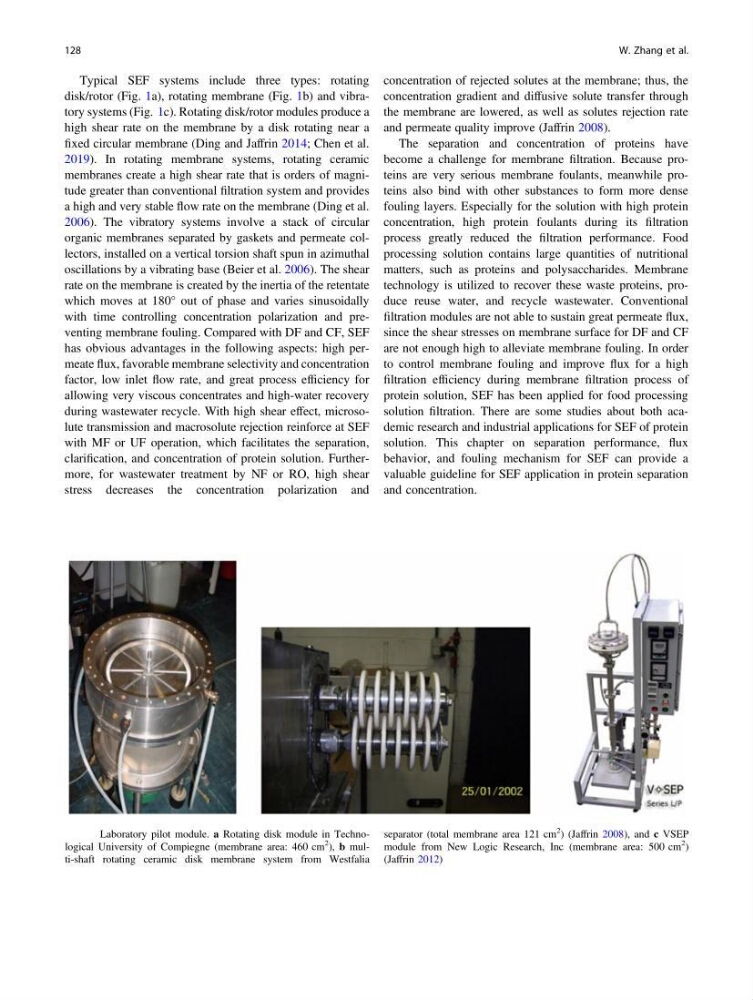
Typical SEF systems include three types: rotating
disk/rotor (Fig. 1a), rotating membrane (Fig. 1b) and vibratory systems (Fig. 1c). Rotating disk/rotor modules produce a
high shear rate on the membrane by a disk rotating near a
fixed circular membrane (Ding and Jaffrin 2014; Chen et al.
2019). In rotating membrane systems, rotating ceramic
membranes create a high shear rate that is orders of magnitude greater than conventional filtration system and provides
a high and very stable flow rate on the membrane (Ding et al.
2006). The vibratory systems involve a stack of circular
organic membranes separated by gaskets and permeate collectors, installed on a vertical torsion shaft spun in azimuthal
oscillations by a vibrating base (Beier et al. 2006). The shear
rate on the membrane is created by the inertia of the retentate
which moves at 180° out of phase and varies sinusoidally
with time controlling concentration polarization and preventing membrane fouling. Compared with DF and CF, SEF
has obvious advantages in the following aspects: high permeate flux, favorable membrane selectivity and concentration
factor, low inlet flow rate, and great process efficiency for
allowing very viscous concentrates and high-water recovery
during wastewater recycle. With high shear effect, microsolute transmission and macrosolute rejection reinforce at SEF
with MF or UF operation, which facilitates the separation,
clarification, and concentration of protein solution. Furthermore, for wastewater treatment by NF or RO, high shear
stress decreases the concentration polarization and
concentration of rejected solutes at the membrane; thus, the
concentration gradient and diffusive solute transfer through
the membrane are lowered, as well as solutes rejection rate
and permeate quality improve (Jaffrin 2008).
The separation and concentration of proteins have
become a challenge for membrane filtration. Because proteins are very serious membrane foulants, meanwhile proteins also bind with other substances to form more dense
fouling layers. Especially for the solution with high protein
concentration, high protein foulants during its filtration
process greatly reduced the filtration performance. Food
processing solution contains large quantities of nutritional
matters, such as proteins and polysaccharides. Membrane
technology is utilized to recover these waste proteins, produce reuse water, and recycle wastewater. Conventional
filtration modules are not able to sustain great permeate flux,
since the shear stresses on membrane surface for DF and CF
are not enough high to alleviate membrane fouling. In order
to control membrane fouling and improve flux for a high
filtration efficiency during membrane filtration process of
protein solution, SEF has been applied for food processing
solution filtration. There are some studies about both academic research and industrial applications for SEF of protein
solution. This chapter on separation performance, flux
behavior, and fouling mechanism for SEF can provide a
valuable guideline for SEF application in protein separation
and concentration.
Fig. 1 Laboratory pilot module. a Rotating disk module in Technological University of Compiegne (membrane area: 460 cm
2
), b multi-shaft rotating ceramic disk membrane system from Westfalia
separator (total membrane area 121 cm
2
) (Jaffrin 2008), and c VSEP
module from New Logic Research, Inc (membrane area: 500 cm
2
)
(Jaffrin 2012)
128
W. Zhang et al.
disk/rotor (Fig. 1a), rotating membrane (Fig. 1b) and vibratory systems (Fig. 1c). Rotating disk/rotor modules produce a
high shear rate on the membrane by a disk rotating near a
fixed circular membrane (Ding and Jaffrin 2014; Chen et al.
2019). In rotating membrane systems, rotating ceramic
membranes create a high shear rate that is orders of magnitude greater than conventional filtration system and provides
a high and very stable flow rate on the membrane (Ding et al.
2006). The vibratory systems involve a stack of circular
organic membranes separated by gaskets and permeate collectors, installed on a vertical torsion shaft spun in azimuthal
oscillations by a vibrating base (Beier et al. 2006). The shear
rate on the membrane is created by the inertia of the retentate
which moves at 180° out of phase and varies sinusoidally
with time controlling concentration polarization and preventing membrane fouling. Compared with DF and CF, SEF
has obvious advantages in the following aspects: high permeate flux, favorable membrane selectivity and concentration
factor, low inlet flow rate, and great process efficiency for
allowing very viscous concentrates and high-water recovery
during wastewater recycle. With high shear effect, microsolute transmission and macrosolute rejection reinforce at SEF
with MF or UF operation, which facilitates the separation,
clarification, and concentration of protein solution. Furthermore, for wastewater treatment by NF or RO, high shear
stress decreases the concentration polarization and
concentration of rejected solutes at the membrane; thus, the
concentration gradient and diffusive solute transfer through
the membrane are lowered, as well as solutes rejection rate
and permeate quality improve (Jaffrin 2008).
The separation and concentration of proteins have
become a challenge for membrane filtration. Because proteins are very serious membrane foulants, meanwhile proteins also bind with other substances to form more dense
fouling layers. Especially for the solution with high protein
concentration, high protein foulants during its filtration
process greatly reduced the filtration performance. Food
processing solution contains large quantities of nutritional
matters, such as proteins and polysaccharides. Membrane
technology is utilized to recover these waste proteins, produce reuse water, and recycle wastewater. Conventional
filtration modules are not able to sustain great permeate flux,
since the shear stresses on membrane surface for DF and CF
are not enough high to alleviate membrane fouling. In order
to control membrane fouling and improve flux for a high
filtration efficiency during membrane filtration process of
protein solution, SEF has been applied for food processing
solution filtration. There are some studies about both academic research and industrial applications for SEF of protein
solution. This chapter on separation performance, flux
behavior, and fouling mechanism for SEF can provide a
valuable guideline for SEF application in protein separation
and concentration.
Fig. 1 Laboratory pilot module. a Rotating disk module in Technological University of Compiegne (membrane area: 460 cm
2
), b multi-shaft rotating ceramic disk membrane system from Westfalia
separator (total membrane area 121 cm
2
) (Jaffrin 2008), and c VSEP
module from New Logic Research, Inc (membrane area: 500 cm
2
)
(Jaffrin 2012)
128
W. Zhang et al.