

that MF membranes are not able to remove dye molecules
via size exclusion because size of dye molecules are smaller
compared to the pore size of average MF membranes. This
has propelled researchers to focus on employment of
nanofiltration (NF) and RO membranes for remediation of
textile effluent via size exclusion due to the significantly
smaller pore size and diameter (Karisma et al. 2017).
However, some research has been carried out using MF
membranes for remediation of these effluents via MF
membrane modification, including surface modification and
incorporation of novel nanomaterials into membrane matrix.
Jedidi et al. successfully produced a MF membrane using
mineral coal fly ash via slip-casting method for removal of
dyes (Jedidi et al. 2011). The fabricated membranes were
able to exhibit high flux values 475 L/hm
2 bar while
retaining respectable dye rejection (75–90%) using raw
textile effluent. The ability of fly ash to produce intrinsic
macropores throughout the membrane matrix when sintered
at 800 °C is cited as a probable factor toward high permeation and respectable rejection performance. In line with
inorganic membranes, Tahri et al. developed an inorganic
carbon-based MF membranes for remediation of textile
effluent, where asymmetric tubular MF membranes were
prepared using mineral coal and phenolic resin (Tahri et al.
2013). The MF membranes exhibited a flux value of 280 L/h
m
2 bar with rejection of dyes of more than 80%. Beqquor
et al. prepared a ceramic-based MF membrane which is
modified with micronized phosphate in means to reduce
membrane pore size during fabrication process (Beqqour
et al. 2019). The modification exhibited the desired effect, as
the developed MF membrane showed flux values between
220 and 240 L/h m
2 bar and dye rejection of more than 99%.
Addition of micronized phosphate significantly reduced
membrane pore size, which instantaneously made the MF
membrane competitive in terms of flux and rejection capabilities compared to UF or NF membranes. On the other
hand, Homem et al. attempted to deposit graphene oxide
(GO) on the surface of PES-PEI MF membranes via
layer-by-layer self-assembly method utilizing electrostatic
interaction (Homem et al. 2019). The surface modification
was able to reduce the size of pores on membrane selective
layer, where a pure water permeability of 99.4 L/hm
2 bar and
a dye rejection up to 90% were achieved, while a flux
recovery ratio up to 80% after fouling was observed.
3.5 Electrodialysis
Electrodialysis (ED) is a latest sophisticated approach of
membrane separation used in the commercial application of
industrial effluents. This method consists of an ion-exchange
membrane and electrical potential are the driving force
needed to apply the method. After passing through the
ion-selective membrane barrier, electrical potential ions from
one solution are transmitted to another solution. The efficiency of an ED method hinges on the current density, pH,
flow rate, ED cell structure, water ionic concentration and
ion-exchange membrane attributes. Membrane fouling is a
significant factor that improves power usage and reduces
membrane flux.
This process is not only part of the electrochemistry
applied, but also part of the field of separation techniques. It
utilizes electrical current rather than pressure to permit ions
to move through the membrane compared to other types of
membrane methods. As well, a small electrical present
amount can be used, which helps to decrease the price of
ED. Furthermore, ED has extra appealing features in which
it is highly selective, able to operate continually, does not
involve chemicals for therapy, green technology and
cost-effectiveness (Li et al. 2017).
For ED application, there are at least five supplementary
components that involves in this technology which are
(a) direct present supply to strengthen ion migration,
(b) electrodes where oxidation/reduction responses happened, (c) membrane for ion exchange, (d) solvents and
(e) electrolytes (current carrier between anode and cathode)
to transform ionic conduction into electron conduction and
thus provide the initial driving force for ion migration.
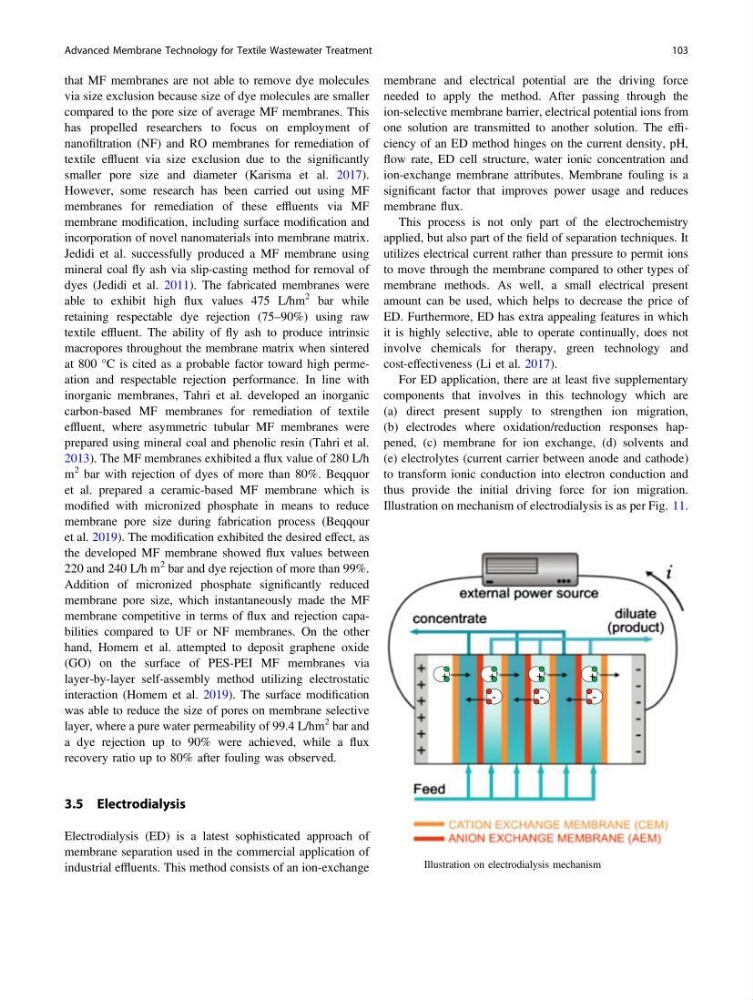
Illustration on mechanism of electrodialysis is as per Fig. 11.
+
-
+
+
+
-
-
Fig. 11 Illustration on electrodialysis mechanism
Advanced Membrane Technology for Textile Wastewater Treatment
103
via size exclusion because size of dye molecules are smaller
compared to the pore size of average MF membranes. This
has propelled researchers to focus on employment of
nanofiltration (NF) and RO membranes for remediation of
textile effluent via size exclusion due to the significantly
smaller pore size and diameter (Karisma et al. 2017).
However, some research has been carried out using MF
membranes for remediation of these effluents via MF
membrane modification, including surface modification and
incorporation of novel nanomaterials into membrane matrix.
Jedidi et al. successfully produced a MF membrane using
mineral coal fly ash via slip-casting method for removal of
dyes (Jedidi et al. 2011). The fabricated membranes were
able to exhibit high flux values 475 L/hm
2 bar while
retaining respectable dye rejection (75–90%) using raw
textile effluent. The ability of fly ash to produce intrinsic
macropores throughout the membrane matrix when sintered
at 800 °C is cited as a probable factor toward high permeation and respectable rejection performance. In line with
inorganic membranes, Tahri et al. developed an inorganic
carbon-based MF membranes for remediation of textile
effluent, where asymmetric tubular MF membranes were
prepared using mineral coal and phenolic resin (Tahri et al.
2013). The MF membranes exhibited a flux value of 280 L/h
m
2 bar with rejection of dyes of more than 80%. Beqquor
et al. prepared a ceramic-based MF membrane which is
modified with micronized phosphate in means to reduce
membrane pore size during fabrication process (Beqqour
et al. 2019). The modification exhibited the desired effect, as
the developed MF membrane showed flux values between
220 and 240 L/h m
2 bar and dye rejection of more than 99%.
Addition of micronized phosphate significantly reduced
membrane pore size, which instantaneously made the MF
membrane competitive in terms of flux and rejection capabilities compared to UF or NF membranes. On the other
hand, Homem et al. attempted to deposit graphene oxide
(GO) on the surface of PES-PEI MF membranes via
layer-by-layer self-assembly method utilizing electrostatic
interaction (Homem et al. 2019). The surface modification
was able to reduce the size of pores on membrane selective
layer, where a pure water permeability of 99.4 L/hm
2 bar and
a dye rejection up to 90% were achieved, while a flux
recovery ratio up to 80% after fouling was observed.
3.5 Electrodialysis
Electrodialysis (ED) is a latest sophisticated approach of
membrane separation used in the commercial application of
industrial effluents. This method consists of an ion-exchange
membrane and electrical potential are the driving force
needed to apply the method. After passing through the
ion-selective membrane barrier, electrical potential ions from
one solution are transmitted to another solution. The efficiency of an ED method hinges on the current density, pH,
flow rate, ED cell structure, water ionic concentration and
ion-exchange membrane attributes. Membrane fouling is a
significant factor that improves power usage and reduces
membrane flux.
This process is not only part of the electrochemistry
applied, but also part of the field of separation techniques. It
utilizes electrical current rather than pressure to permit ions
to move through the membrane compared to other types of
membrane methods. As well, a small electrical present
amount can be used, which helps to decrease the price of
ED. Furthermore, ED has extra appealing features in which
it is highly selective, able to operate continually, does not
involve chemicals for therapy, green technology and
cost-effectiveness (Li et al. 2017).
For ED application, there are at least five supplementary
components that involves in this technology which are
(a) direct present supply to strengthen ion migration,
(b) electrodes where oxidation/reduction responses happened, (c) membrane for ion exchange, (d) solvents and
(e) electrolytes (current carrier between anode and cathode)
to transform ionic conduction into electron conduction and
thus provide the initial driving force for ion migration.
Illustration on mechanism of electrodialysis is as per Fig. 11.
+
-
+
+
+
-
-
Fig. 11 Illustration on electrodialysis mechanism
Advanced Membrane Technology for Textile Wastewater Treatment
103