

3.6 Membrane Bioreactor (MBR)
The limitation of a single technology usually encountered by
the combination of several treatment processes. One of its
kind is the membrane bioreactor (MBR) systems. As be seen
from its name, this treatment process has combining the
membrane filtration and the biological wastewater treatment
processes. Nowadays, this treatment process has gained
great attention and is widely used for the industrial and
municipal wastewater treatment. Unlike the conventional
biological treatment process, the MBR is differ in the separation of the treated wastewater and the activated sludge. In
this process, the common sedimentation in the secondary
clarifier found in the normal biological treatment process is
replaced by the membrane filtration technique.
MBR has become a famous choice in the wastewater
treatment technology due to its ultimate benefit which produces high quality of treated water. In addition, this technique possesses several other advantages namely low
maintenance, consistent high quality of treated water, small
footprint, excellent contaminants removal, low sludge production and high concentration of mixed liquid suspended
solids (Chang et al. 2002). Although this process is limited
by the drawbacks of the membrane fouling derived from the
composition of the wastewater and the grown biomass, the
fouling control strategies during the treatment has combat
these weaknesses. On top of that, the area required for the
MBR system installation as compared to that of conventional system is much smaller attributable to membrane
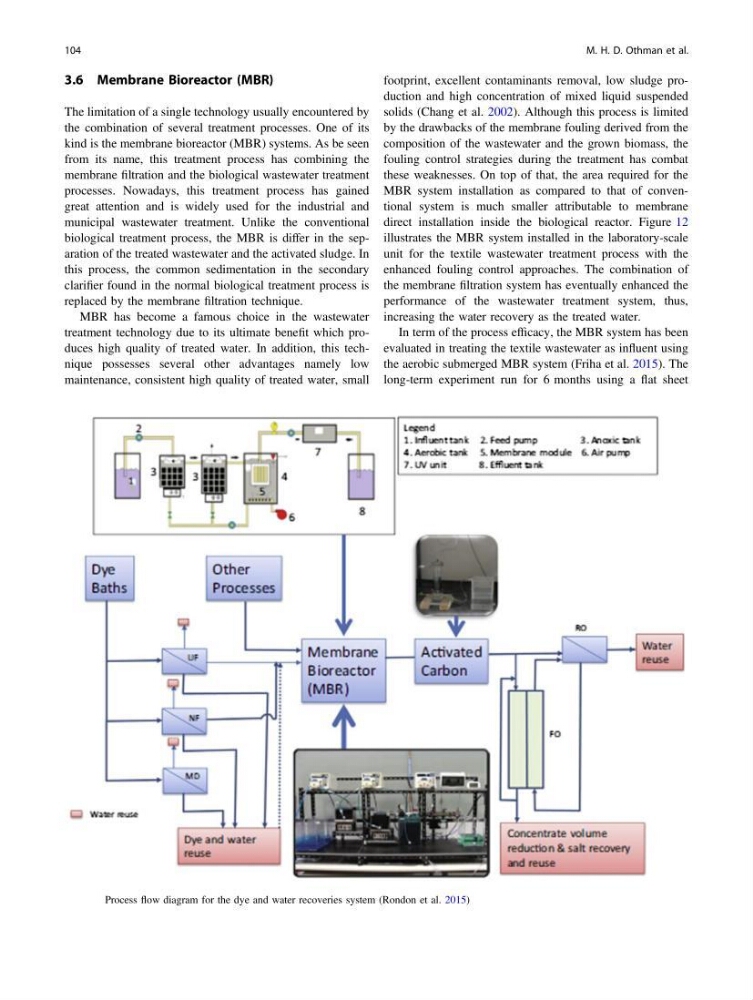
direct installation inside the biological reactor. Figure 12
illustrates the MBR system installed in the laboratory-scale
unit for the textile wastewater treatment process with the
enhanced fouling control approaches. The combination of
the membrane filtration system has eventually enhanced the
performance of the wastewater treatment system, thus,
increasing the water recovery as the treated water.
In term of the process efficacy, the MBR system has been
evaluated in treating the textile wastewater as influent using
the aerobic submerged MBR system (Friha et al. 2015). The
long-term experiment run for 6 months using a flat sheet
Fig. 12 Process flow diagram for the dye and water recoveries system (Rondon et al. 2015)
104
M. H. D. Othman et al.
The limitation of a single technology usually encountered by
the combination of several treatment processes. One of its
kind is the membrane bioreactor (MBR) systems. As be seen
from its name, this treatment process has combining the
membrane filtration and the biological wastewater treatment
processes. Nowadays, this treatment process has gained
great attention and is widely used for the industrial and
municipal wastewater treatment. Unlike the conventional
biological treatment process, the MBR is differ in the separation of the treated wastewater and the activated sludge. In
this process, the common sedimentation in the secondary
clarifier found in the normal biological treatment process is
replaced by the membrane filtration technique.
MBR has become a famous choice in the wastewater
treatment technology due to its ultimate benefit which produces high quality of treated water. In addition, this technique possesses several other advantages namely low
maintenance, consistent high quality of treated water, small
footprint, excellent contaminants removal, low sludge production and high concentration of mixed liquid suspended
solids (Chang et al. 2002). Although this process is limited
by the drawbacks of the membrane fouling derived from the
composition of the wastewater and the grown biomass, the
fouling control strategies during the treatment has combat
these weaknesses. On top of that, the area required for the
MBR system installation as compared to that of conventional system is much smaller attributable to membrane
direct installation inside the biological reactor. Figure 12
illustrates the MBR system installed in the laboratory-scale
unit for the textile wastewater treatment process with the
enhanced fouling control approaches. The combination of
the membrane filtration system has eventually enhanced the
performance of the wastewater treatment system, thus,
increasing the water recovery as the treated water.
In term of the process efficacy, the MBR system has been
evaluated in treating the textile wastewater as influent using
the aerobic submerged MBR system (Friha et al. 2015). The
long-term experiment run for 6 months using a flat sheet
Fig. 12 Process flow diagram for the dye and water recoveries system (Rondon et al. 2015)
104
M. H. D. Othman et al.