

fabricated using phase inversion technique at a different
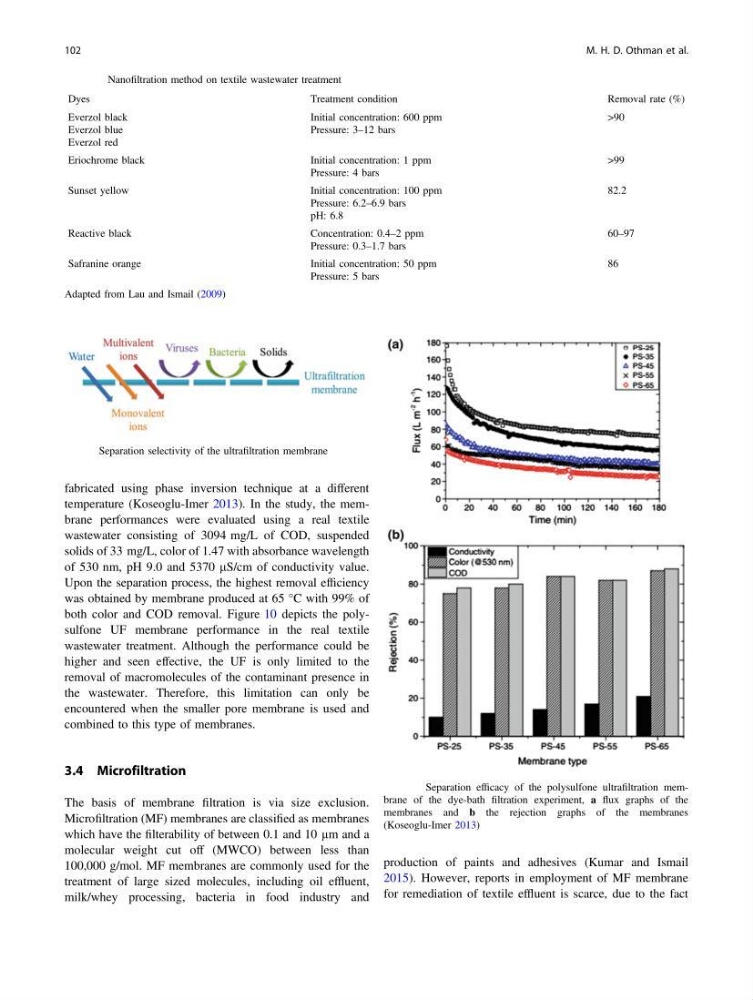
temperature (Koseoglu-Imer 2013). In the study, the membrane performances were evaluated using a real textile
wastewater consisting of 3094 mg/L of COD, suspended
solids of 33 mg/L, color of 1.47 with absorbance wavelength
of 530 nm, pH 9.0 and 5370 lS/cm of conductivity value.
Upon the separation process, the highest removal efficiency
was obtained by membrane produced at 65 °C with 99% of
both color and COD removal. Figure 10 depicts the polysulfone UF membrane performance in the real textile
wastewater treatment. Although the performance could be
higher and seen effective, the UF is only limited to the
removal of macromolecules of the contaminant presence in
the wastewater. Therefore, this limitation can only be
encountered when the smaller pore membrane is used and
combined to this type of membranes.
3.4 Microfiltration
The basis of membrane filtration is via size exclusion.
Microfiltration (MF) membranes are classified as membranes
which have the filterability of between 0.1 and 10 µm and a
molecular weight cut off (MWCO) between less than
100,000 g/mol. MF membranes are commonly used for the
treatment of large sized molecules, including oil effluent,
milk/whey processing, bacteria in food industry and
production of paints and adhesives (Kumar and Ismail
2015). However, reports in employment of MF membrane
for remediation of textile effluent is scarce, due to the fact
Table 7 Nanofiltration method on textile wastewater treatment
Dyes
Treatment condition
Removal rate (%)
Everzol black
Everzol blue
Everzol red
Initial concentration: 600 ppm
Pressure: 3–12 bars
>90
Eriochrome black
Initial concentration: 1 ppm
Pressure: 4 bars
>99
Sunset yellow
Initial concentration: 100 ppm
Pressure: 6.2–6.9 bars
pH: 6.8
82.2
Reactive black
Concentration: 0.4–2 ppm
Pressure: 0.3–1.7 bars
60–97
Safranine orange
Initial concentration: 50 ppm
Pressure: 5 bars
86
Adapted from Lau and Ismail (2009)
Fig. 9 Separation selectivity of the ultrafiltration membrane
Fig. 10 Separation efficacy of the polysulfone ultrafiltration membrane of the dye-bath filtration experiment, a flux graphs of the
membranes and b the rejection graphs of the membranes
(Koseoglu-Imer 2013)
102
M. H. D. Othman et al.
temperature (Koseoglu-Imer 2013). In the study, the membrane performances were evaluated using a real textile
wastewater consisting of 3094 mg/L of COD, suspended
solids of 33 mg/L, color of 1.47 with absorbance wavelength
of 530 nm, pH 9.0 and 5370 lS/cm of conductivity value.
Upon the separation process, the highest removal efficiency
was obtained by membrane produced at 65 °C with 99% of
both color and COD removal. Figure 10 depicts the polysulfone UF membrane performance in the real textile
wastewater treatment. Although the performance could be
higher and seen effective, the UF is only limited to the
removal of macromolecules of the contaminant presence in
the wastewater. Therefore, this limitation can only be
encountered when the smaller pore membrane is used and
combined to this type of membranes.
3.4 Microfiltration
The basis of membrane filtration is via size exclusion.
Microfiltration (MF) membranes are classified as membranes
which have the filterability of between 0.1 and 10 µm and a
molecular weight cut off (MWCO) between less than
100,000 g/mol. MF membranes are commonly used for the
treatment of large sized molecules, including oil effluent,
milk/whey processing, bacteria in food industry and
production of paints and adhesives (Kumar and Ismail
2015). However, reports in employment of MF membrane
for remediation of textile effluent is scarce, due to the fact
Table 7 Nanofiltration method on textile wastewater treatment
Dyes
Treatment condition
Removal rate (%)
Everzol black
Everzol blue
Everzol red
Initial concentration: 600 ppm
Pressure: 3–12 bars
>90
Eriochrome black
Initial concentration: 1 ppm
Pressure: 4 bars
>99
Sunset yellow
Initial concentration: 100 ppm
Pressure: 6.2–6.9 bars
pH: 6.8
82.2
Reactive black
Concentration: 0.4–2 ppm
Pressure: 0.3–1.7 bars
60–97
Safranine orange
Initial concentration: 50 ppm
Pressure: 5 bars
86
Adapted from Lau and Ismail (2009)
Fig. 9 Separation selectivity of the ultrafiltration membrane
Fig. 10 Separation efficacy of the polysulfone ultrafiltration membrane of the dye-bath filtration experiment, a flux graphs of the
membranes and b the rejection graphs of the membranes
(Koseoglu-Imer 2013)
102
M. H. D. Othman et al.