

Witnesses to Radioactive Contamination 189
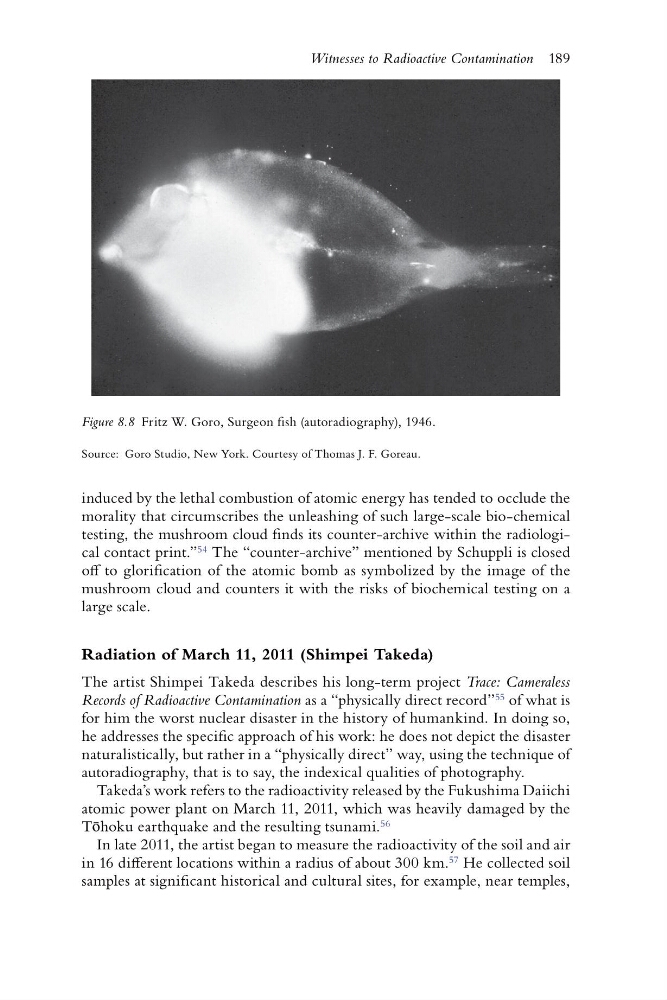
induced by the lethal combustion of atomic energy has tended to occlude the
morality that circumscribes the unleashing of such large-scale bio-chemical
testing, the mushroom cloud finds its counter-archive within the radiological contact print.” 54 The “counter-archive” mentioned by Schuppli is closed
off to glorification of the atomic bomb as symbolized by the image of the
mushroom cloud and counters it with the risks of biochemical testing on a
large scale.
Radiation of March 11, 2011 (Shimpei Takeda)
The artist Shimpei Takeda describes his long-term project Trace: Cameraless
Records of Radioactive Contamination as a “physically direct record” 55 of what is
for him the worst nuclear disaster in the history of humankind. In doing so,
he addresses the specific approach of his work: he does not depict the disaster
naturalistically, but rather in a “physically direct” way, using the technique of
autoradiography, that is to say, the indexical qualities of photography.
Takeda’s work refers to the radioactivity released by the Fukushima Daiichi
atomic power plant on March 11, 2011, which was heavily damaged by the
Tōhoku earthquake and the resulting tsunami. 56
In late 2011, the artist began to measure the radioactivity of the soil and air
in 16 different locations within a radius of about 300 km. 57 He collected soil
samples at significant historical and cultural sites, for example, near temples,
Figure 8.8 Fritz W. Goro, Surgeon fish (autoradiography), 1946.
Source: Goro Studio, New York. Courtesy of Thomas J. F. Goreau.
induced by the lethal combustion of atomic energy has tended to occlude the
morality that circumscribes the unleashing of such large-scale bio-chemical
testing, the mushroom cloud finds its counter-archive within the radiological contact print.” 54 The “counter-archive” mentioned by Schuppli is closed
off to glorification of the atomic bomb as symbolized by the image of the
mushroom cloud and counters it with the risks of biochemical testing on a
large scale.
Radiation of March 11, 2011 (Shimpei Takeda)
The artist Shimpei Takeda describes his long-term project Trace: Cameraless
Records of Radioactive Contamination as a “physically direct record” 55 of what is
for him the worst nuclear disaster in the history of humankind. In doing so,
he addresses the specific approach of his work: he does not depict the disaster
naturalistically, but rather in a “physically direct” way, using the technique of
autoradiography, that is to say, the indexical qualities of photography.
Takeda’s work refers to the radioactivity released by the Fukushima Daiichi
atomic power plant on March 11, 2011, which was heavily damaged by the
Tōhoku earthquake and the resulting tsunami. 56
In late 2011, the artist began to measure the radioactivity of the soil and air
in 16 different locations within a radius of about 300 km. 57 He collected soil
samples at significant historical and cultural sites, for example, near temples,
Figure 8.8 Fritz W. Goro, Surgeon fish (autoradiography), 1946.
Source: Goro Studio, New York. Courtesy of Thomas J. F. Goreau.