

188 Eva Castringius
Goro was also officially commissioned to document the Operation Crossroads
series of atomic bomb tests in 1946, the two Pacific tests Able (atmospheric test)
and Baker (underwater test) located at the lagoon of Bikini Atoll. Goro photographed the preparations, and test and its effects. He also photographed test
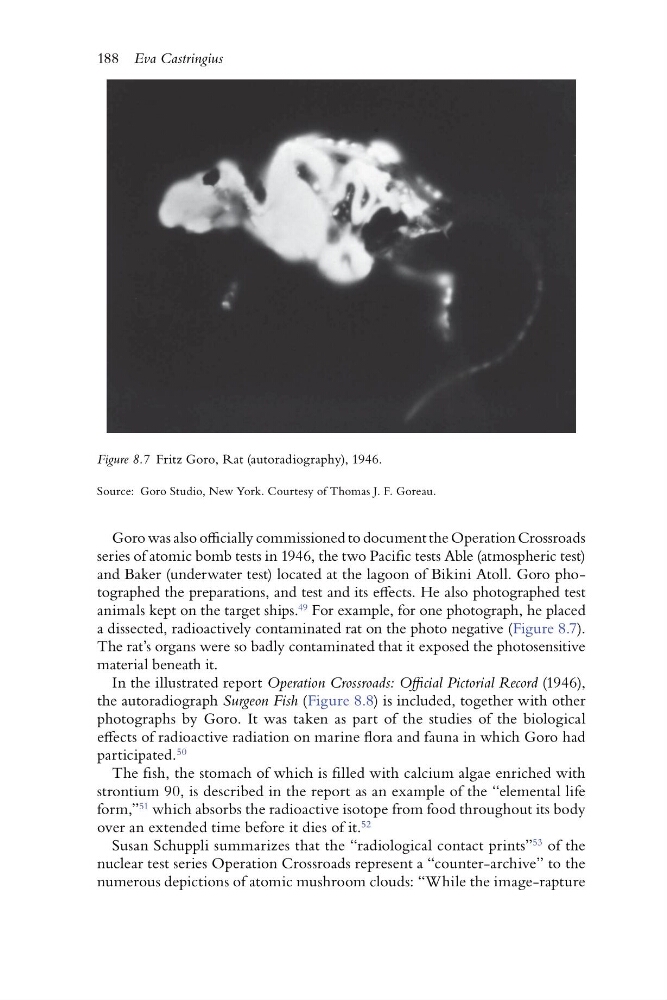
animals kept on the target ships. 49 For example, for one photograph, he placed
a dissected, radioactively contaminated rat on the photo negative (Figure 8.7).
The rat’s organs were so badly contaminated that it exposed the photosensitive
material beneath it.
In the illustrated report Operation Crossroads: Official Pictorial Record (1946),
the autoradiograph Surgeon Fish (Figure 8.8) is included, together with other
photographs by Goro. It was taken as part of the studies of the biological
effects of radioactive radiation on marine flora and fauna in which Goro had
participated. 50
The fish, the stomach of which is filled with calcium algae enriched with
strontium 90, is described in the report as an example of the “elemental life
form,” 51 which absorbs the radioactive isotope from food throughout its body
over an extended time before it dies of it. 52
Susan Schuppli summarizes that the “radiological contact prints” 53 of the
nuclear test series Operation Crossroads represent a “counter-archive” to the
numerous depictions of atomic mushroom clouds: “While the image-rapture
Figure 8.7 Fritz Goro, Rat (autoradiography), 1946.
Source: Goro Studio, New York. Courtesy of Thomas J. F. Goreau.
Goro was also officially commissioned to document the Operation Crossroads
series of atomic bomb tests in 1946, the two Pacific tests Able (atmospheric test)
and Baker (underwater test) located at the lagoon of Bikini Atoll. Goro photographed the preparations, and test and its effects. He also photographed test
animals kept on the target ships. 49 For example, for one photograph, he placed
a dissected, radioactively contaminated rat on the photo negative (Figure 8.7).
The rat’s organs were so badly contaminated that it exposed the photosensitive
material beneath it.
In the illustrated report Operation Crossroads: Official Pictorial Record (1946),
the autoradiograph Surgeon Fish (Figure 8.8) is included, together with other
photographs by Goro. It was taken as part of the studies of the biological
effects of radioactive radiation on marine flora and fauna in which Goro had
participated. 50
The fish, the stomach of which is filled with calcium algae enriched with
strontium 90, is described in the report as an example of the “elemental life
form,” 51 which absorbs the radioactive isotope from food throughout its body
over an extended time before it dies of it. 52
Susan Schuppli summarizes that the “radiological contact prints” 53 of the
nuclear test series Operation Crossroads represent a “counter-archive” to the
numerous depictions of atomic mushroom clouds: “While the image-rapture
Figure 8.7 Fritz Goro, Rat (autoradiography), 1946.
Source: Goro Studio, New York. Courtesy of Thomas J. F. Goreau.