

Witnesses to Radioactive Contamination 187
Although the danger of radioactivity had been little studied, the risks
were known but nevertheless deemed acceptable. Goro’s grandchildren
note in their book On the Nature of Things: “Amazingly, the top brass of the
Manhattan Project—and Goro—had been exposed to radiation at levels that
would now be impermissible because of the risk of cancer. Atom bombs had
been dropped on densely populated Hiroshima and Nagasaki without any
real knowledge of the biological effects of radioactivity.” 46 At the latest, after
the bombs were dropped on Hiroshima and Nagasaki, American scientists
began to systematically study the effects of radiation on living creatures.
It is unlikely that Goro was aware of the full extent of the political explosiveness of his autoradiographs of trinitite. He continued to employ the
technology of autoradiography, for example, when he photographed the
El Dorado Mine in the Northwest Territories of Canada for Life in 1946, 47
which had been the source of the uranium for the Manhattan Project. Taking
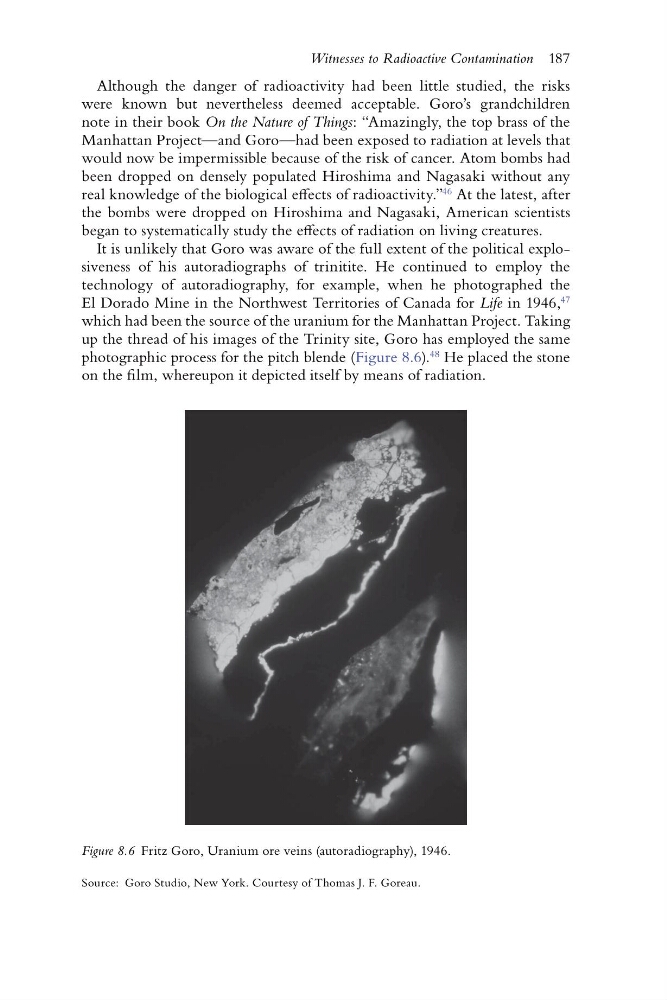
up the thread of his images of the Trinity site, Goro has employed the same
photographic process for the pitch blende (Figure 8.6). 48 He placed the stone
on the film, whereupon it depicted itself by means of radiation.
Figure 8.6 Fritz Goro, Uranium ore veins (autoradiography), 1946.
Source: Goro Studio, New York. Courtesy of Thomas J. F. Goreau.
Although the danger of radioactivity had been little studied, the risks
were known but nevertheless deemed acceptable. Goro’s grandchildren
note in their book On the Nature of Things: “Amazingly, the top brass of the
Manhattan Project—and Goro—had been exposed to radiation at levels that
would now be impermissible because of the risk of cancer. Atom bombs had
been dropped on densely populated Hiroshima and Nagasaki without any
real knowledge of the biological effects of radioactivity.” 46 At the latest, after
the bombs were dropped on Hiroshima and Nagasaki, American scientists
began to systematically study the effects of radiation on living creatures.
It is unlikely that Goro was aware of the full extent of the political explosiveness of his autoradiographs of trinitite. He continued to employ the
technology of autoradiography, for example, when he photographed the
El Dorado Mine in the Northwest Territories of Canada for Life in 1946, 47
which had been the source of the uranium for the Manhattan Project. Taking
up the thread of his images of the Trinity site, Goro has employed the same
photographic process for the pitch blende (Figure 8.6). 48 He placed the stone
on the film, whereupon it depicted itself by means of radiation.
Figure 8.6 Fritz Goro, Uranium ore veins (autoradiography), 1946.
Source: Goro Studio, New York. Courtesy of Thomas J. F. Goreau.