

186 Eva Castringius
seen in the other photographs by Goro. The area had to be accessed by an airtight, lead-sealed tank; protective clothing and radiometers were employed.
The infrastructure of the former test site was seriously damaged by the explosion or burned by the extremely high heat.
Radioactive radiation became a lasting feature of the affected surroundings.
Goro made it visible using autoradiography (Figure 8.4). He placed pieces of
trinitite on negative material overnight, without admitting any light, so that
the radioactive radiation of the melted glass exposed the photographic material. An abstract-looking visual world resulted. Two large points of light look
auratic in the infinite darkness of this supposed macrocosm and are brought
back by means of the surface pattern recognizable in closeups of several pieces
of trinitite. The intense radiation of the material partially overexposed the
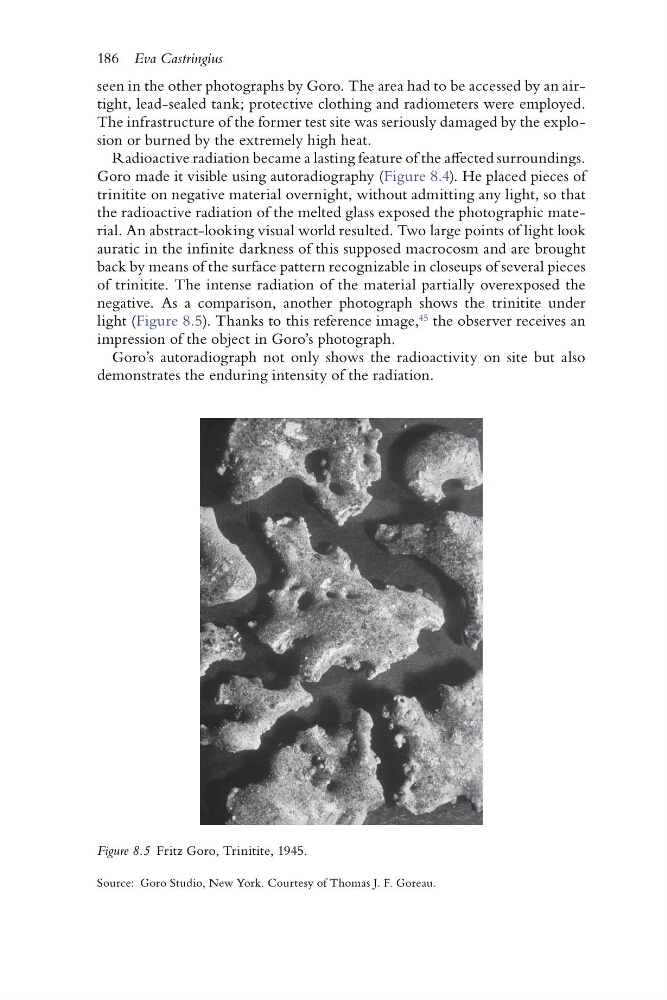
negative. As a comparison, another photograph shows the trinitite under
light (Figure 8.5). Thanks to this reference image, 45 the observer receives an
impression of the object in Goro’s photograph.
Goro’s autoradiograph not only shows the radioactivity on site but also
demonstrates the enduring intensity of the radiation.
Figure 8.5 Fritz Goro, Trinitite, 1945.
Source: Goro Studio, New York. Courtesy of Thomas J. F. Goreau.
seen in the other photographs by Goro. The area had to be accessed by an airtight, lead-sealed tank; protective clothing and radiometers were employed.
The infrastructure of the former test site was seriously damaged by the explosion or burned by the extremely high heat.
Radioactive radiation became a lasting feature of the affected surroundings.
Goro made it visible using autoradiography (Figure 8.4). He placed pieces of
trinitite on negative material overnight, without admitting any light, so that
the radioactive radiation of the melted glass exposed the photographic material. An abstract-looking visual world resulted. Two large points of light look
auratic in the infinite darkness of this supposed macrocosm and are brought
back by means of the surface pattern recognizable in closeups of several pieces
of trinitite. The intense radiation of the material partially overexposed the
negative. As a comparison, another photograph shows the trinitite under
light (Figure 8.5). Thanks to this reference image, 45 the observer receives an
impression of the object in Goro’s photograph.
Goro’s autoradiograph not only shows the radioactivity on site but also
demonstrates the enduring intensity of the radiation.
Figure 8.5 Fritz Goro, Trinitite, 1945.
Source: Goro Studio, New York. Courtesy of Thomas J. F. Goreau.