

190 Eva Castringius
shrines, battlegrounds, castle ruins, and his native town. He placed these
radioactive soil samples on sheets of eight-by-ten-inch negative film and kept
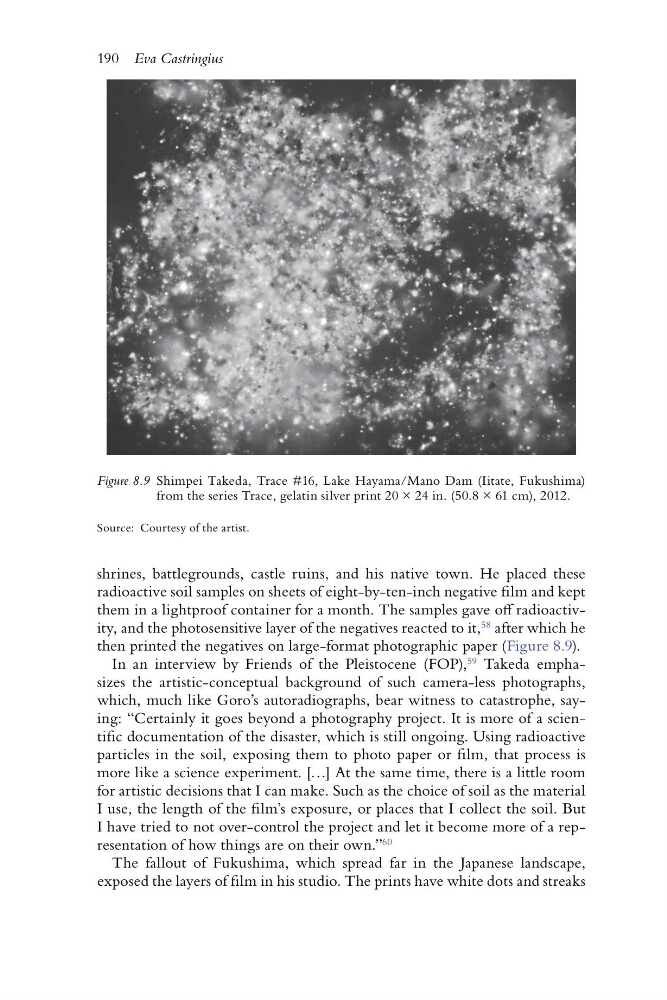
them in a lightproof container for a month. The samples gave off radioactivity, and the photosensitive layer of the negatives reacted to it, 58 after which he
then printed the negatives on large-format photographic paper (Figure 8.9).
In an interview by Friends of the Pleistocene (FOP), 59 Takeda emphasizes the artistic-conceptual background of such camera-less photographs,
which, much like Goro’s autoradiographs, bear witness to catastrophe, saying: “Certainly it goes beyond a photography project. It is more of a scientific documentation of the disaster, which is still ongoing. Using radioactive
particles in the soil, exposing them to photo paper or film, that process is
more like a science experiment. […] At the same time, there is a little room
for artistic decisions that I can make. Such as the choice of soil as the material
I use, the length of the film’s exposure, or places that I collect the soil. But
I have tried to not over-control the project and let it become more of a representation of how things are on their own.” 60
The fallout of Fukushima, which spread far in the Japanese landscape,
exposed the layers of film in his studio. The prints have white dots and streaks
Figure 8.9 Shimpei Takeda, Trace #16, Lake Hayama/Mano Dam (Iitate, Fukushima)
from the series Trace, gelatin silver print 20 × 24 in. (50.8 × 61 cm), 2012.
Source: Courtesy of the artist.
shrines, battlegrounds, castle ruins, and his native town. He placed these
radioactive soil samples on sheets of eight-by-ten-inch negative film and kept
them in a lightproof container for a month. The samples gave off radioactivity, and the photosensitive layer of the negatives reacted to it, 58 after which he
then printed the negatives on large-format photographic paper (Figure 8.9).
In an interview by Friends of the Pleistocene (FOP), 59 Takeda emphasizes the artistic-conceptual background of such camera-less photographs,
which, much like Goro’s autoradiographs, bear witness to catastrophe, saying: “Certainly it goes beyond a photography project. It is more of a scientific documentation of the disaster, which is still ongoing. Using radioactive
particles in the soil, exposing them to photo paper or film, that process is
more like a science experiment. […] At the same time, there is a little room
for artistic decisions that I can make. Such as the choice of soil as the material
I use, the length of the film’s exposure, or places that I collect the soil. But
I have tried to not over-control the project and let it become more of a representation of how things are on their own.” 60
The fallout of Fukushima, which spread far in the Japanese landscape,
exposed the layers of film in his studio. The prints have white dots and streaks
Figure 8.9 Shimpei Takeda, Trace #16, Lake Hayama/Mano Dam (Iitate, Fukushima)
from the series Trace, gelatin silver print 20 × 24 in. (50.8 × 61 cm), 2012.
Source: Courtesy of the artist.