

With the above as background, it is appropriate to return to the central focus of this
entry – air quality standards and guidelines
and their role in the future. The past 40 years
have been a period of major activity in creating
a science based on the health effects of air
pollutants and the use of that science to inform
the development of air quality standards and
guidelines and to inform the development and
implementation of strategies and technologies
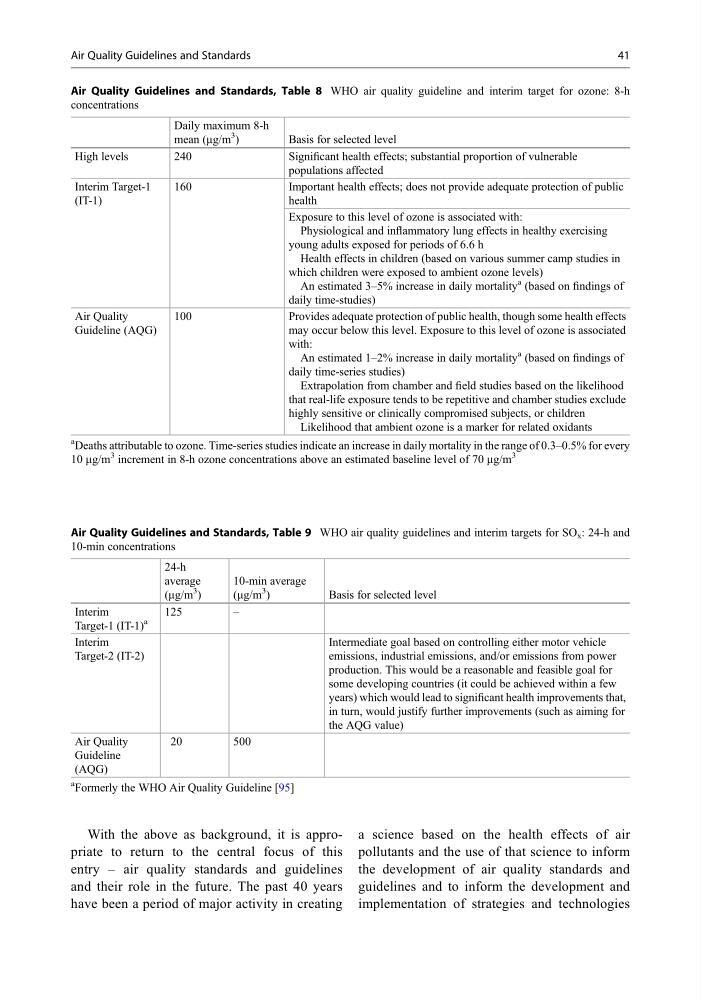
Air Quality Guidelines and Standards, Table 8 WHO air quality guideline and interim target for ozone: 8-h
concentrations
Daily maximum 8-h
mean (mg/m
3
)
Basis for selected level
High levels
240
Significant health effects; substantial proportion of vulnerable
populations affected
Interim Target-1
(IT-1)
160
Important health effects; does not provide adequate protection of public
health
Exposure to this level of ozone is associated with:
Physiological and inflammatory lung effects in healthy exercising
young adults exposed for periods of 6.6 h
Health effects in children (based on various summer camp studies in
which children were exposed to ambient ozone levels)
An estimated 3–5% increase in daily mortality
a (based on findings of
daily time-studies)
Air Quality
Guideline (AQG)
100
Provides adequate protection of public health, though some health effects
may occur below this level. Exposure to this level of ozone is associated
with:
An estimated 1–2% increase in daily mortality
a (based on findings of
daily time-series studies)
Extrapolation from chamber and field studies based on the likelihood
that real-life exposure tends to be repetitive and chamber studies exclude
highly sensitive or clinically compromised subjects, or children
Likelihood that ambient ozone is a marker for related oxidants
a Deaths attributable to ozone. Time-series studies indicate an increase in daily mortality in the range of 0.3–0.5% for every
10 mg/m
3 increment in 8-h ozone concentrations above an estimated baseline level of 70 mg/m
3
Air Quality Guidelines and Standards, Table 9 WHO air quality guidelines and interim targets for SO x : 24-h and
10-min concentrations
24-h
average
(mg/m
3
)
10-min average
(mg/m
3
)
Basis for selected level
Interim
Target-1 (IT-1)
a
125
–
Interim
Target-2 (IT-2)
Intermediate goal based on controlling either motor vehicle
emissions, industrial emissions, and/or emissions from power
production. This would be a reasonable and feasible goal for
some developing countries (it could be achieved within a few
years) which would lead to significant health improvements that,
in turn, would justify further improvements (such as aiming for
the AQG value)
Air Quality
Guideline
(AQG)
20
500
a Formerly the WHO Air Quality Guideline [95]
Air Quality Guidelines and Standards
41
entry – air quality standards and guidelines
and their role in the future. The past 40 years
have been a period of major activity in creating
a science based on the health effects of air
pollutants and the use of that science to inform
the development of air quality standards and
guidelines and to inform the development and
implementation of strategies and technologies
Air Quality Guidelines and Standards, Table 8 WHO air quality guideline and interim target for ozone: 8-h
concentrations
Daily maximum 8-h
mean (mg/m
3
)
Basis for selected level
High levels
240
Significant health effects; substantial proportion of vulnerable
populations affected
Interim Target-1
(IT-1)
160
Important health effects; does not provide adequate protection of public
health
Exposure to this level of ozone is associated with:
Physiological and inflammatory lung effects in healthy exercising
young adults exposed for periods of 6.6 h
Health effects in children (based on various summer camp studies in
which children were exposed to ambient ozone levels)
An estimated 3–5% increase in daily mortality
a (based on findings of
daily time-studies)
Air Quality
Guideline (AQG)
100
Provides adequate protection of public health, though some health effects
may occur below this level. Exposure to this level of ozone is associated
with:
An estimated 1–2% increase in daily mortality
a (based on findings of
daily time-series studies)
Extrapolation from chamber and field studies based on the likelihood
that real-life exposure tends to be repetitive and chamber studies exclude
highly sensitive or clinically compromised subjects, or children
Likelihood that ambient ozone is a marker for related oxidants
a Deaths attributable to ozone. Time-series studies indicate an increase in daily mortality in the range of 0.3–0.5% for every
10 mg/m
3 increment in 8-h ozone concentrations above an estimated baseline level of 70 mg/m
3
Air Quality Guidelines and Standards, Table 9 WHO air quality guidelines and interim targets for SO x : 24-h and
10-min concentrations
24-h
average
(mg/m
3
)
10-min average
(mg/m
3
)
Basis for selected level
Interim
Target-1 (IT-1)
a
125
–
Interim
Target-2 (IT-2)
Intermediate goal based on controlling either motor vehicle
emissions, industrial emissions, and/or emissions from power
production. This would be a reasonable and feasible goal for
some developing countries (it could be achieved within a few
years) which would lead to significant health improvements that,
in turn, would justify further improvements (such as aiming for
the AQG value)
Air Quality
Guideline
(AQG)
20
500
a Formerly the WHO Air Quality Guideline [95]
Air Quality Guidelines and Standards
41