

The earlier section on “Context for Air Quality
Impacts” noted the multitude of risk factors that
impact on health. That section contrasted the burden
of disease attributed to the various risk factors
including urban air pollution and indoor smoke
from household use of solid fuels. The contrast
between the burden of disease for low- and
middle-income countries versus high-income countries was striking. In the former, 3.7% of deaths were
associated with indoor smoke and 1.5% from urban
air pollutions. In contrast, in the high-income countries urban air pollution was estimated to be associated with 1.0% of the deaths and no deaths were
estimated to be associated with indoor smoke. The
health hazards associated with indoor smoke from
use of solid fuels for cooking and heating has not
been reviewed in this entry. It is sufficient to note
here that the greatest hazards from indoor cooking
are those related to burning of wood, agricultural
residue, and coal in the same manner as was
commonplace around the world centuries ago. It is
clear that in the future a major challenge exists to
improve the income of families in low- and middleincome countries so they can move away from
uncontrolled combustion of solid fuels indoors. It
is well recognized that improving the economy of a
country or region inevitably requires increases in
energy usage and the availability of clean water
and adequate foodstuffs. A major challenge exists
in providing adequate energy, in the form of distributed electricity and liquid fuels for transportation
and also avoiding negative impacts on air quality.
Major progress has been made in the highest income
countries in the world in developing low-emission
stationary sources for generating electrical power
and low emission internal combustion [both spark
ignition and compression ignition (diesel)] engines
for on- and off-road use. The challenge is to facilitate the transfer of those low emission technologies
to the rest of the world.
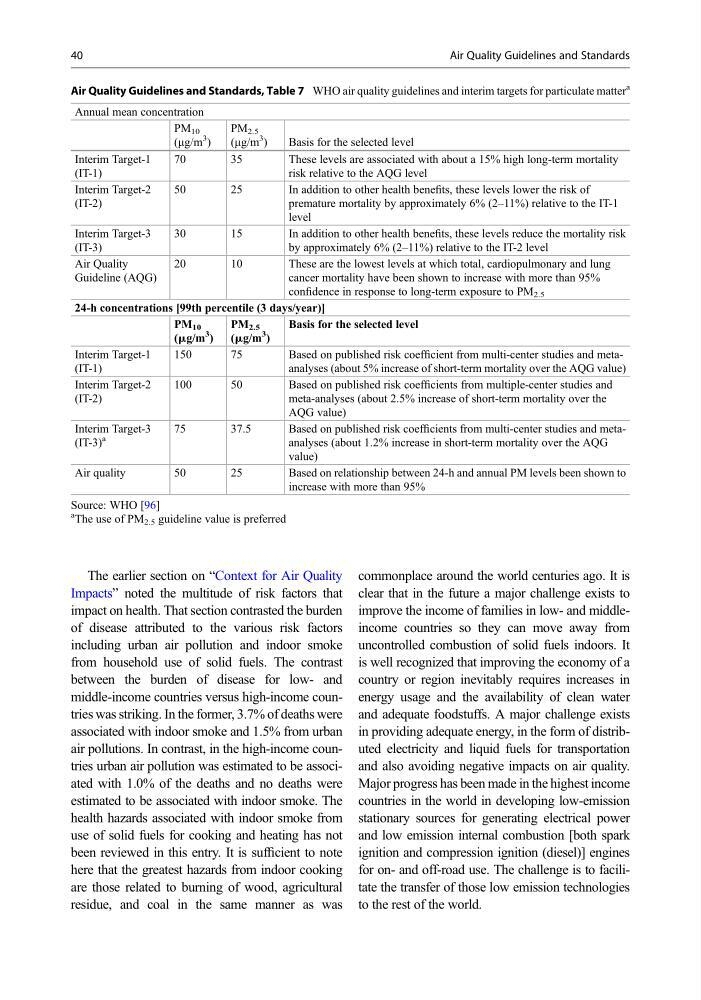
Air Quality Guidelines and Standards, Table 7 WHO air quality guidelines and interim targets for particulate matter
a
Annual mean concentration
PM 10
(mg/m
3
)
PM 2.5
(mg/m
3
)
Basis for the selected level
Interim Target-1
(IT-1)
70
35
These levels are associated with about a 15% high long-term mortality
risk relative to the AQG level
Interim Target-2
(IT-2)
50
25
In addition to other health benefits, these levels lower the risk of
premature mortality by approximately 6% (2–11%) relative to the IT-1
level
Interim Target-3
(IT-3)
30
15
In addition to other health benefits, these levels reduce the mortality risk
by approximately 6% (2–11%) relative to the IT-2 level
Air Quality
Guideline (AQG)
20
10
These are the lowest levels at which total, cardiopulmonary and lung
cancer mortality have been shown to increase with more than 95%
confidence in response to long-term exposure to PM 2.5
24-h concentrations [99th percentile (3 days/year)]
PM 10
(mg/m
3
)
PM 2.5
(mg/m
3
)
Basis for the selected level
Interim Target-1
(IT-1)
150
75
Based on published risk coefficient from multi-center studies and metaanalyses (about 5% increase of short-term mortality over the AQG value)
Interim Target-2
(IT-2)
100
50
Based on published risk coefficients from multiple-center studies and
meta-analyses (about 2.5% increase of short-term mortality over the
AQG value)
Interim Target-3
(IT-3)
a
75
37.5
Based on published risk coefficients from multi-center studies and metaanalyses (about 1.2% increase in short-term mortality over the AQG
value)
Air quality
50
25
Based on relationship between 24-h and annual PM levels been shown to
increase with more than 95%
Source: WHO [96]
a The use of PM 2.5 guideline value is preferred
40
Air Quality Guidelines and Standards
Impacts” noted the multitude of risk factors that
impact on health. That section contrasted the burden
of disease attributed to the various risk factors
including urban air pollution and indoor smoke
from household use of solid fuels. The contrast
between the burden of disease for low- and
middle-income countries versus high-income countries was striking. In the former, 3.7% of deaths were
associated with indoor smoke and 1.5% from urban
air pollutions. In contrast, in the high-income countries urban air pollution was estimated to be associated with 1.0% of the deaths and no deaths were
estimated to be associated with indoor smoke. The
health hazards associated with indoor smoke from
use of solid fuels for cooking and heating has not
been reviewed in this entry. It is sufficient to note
here that the greatest hazards from indoor cooking
are those related to burning of wood, agricultural
residue, and coal in the same manner as was
commonplace around the world centuries ago. It is
clear that in the future a major challenge exists to
improve the income of families in low- and middleincome countries so they can move away from
uncontrolled combustion of solid fuels indoors. It
is well recognized that improving the economy of a
country or region inevitably requires increases in
energy usage and the availability of clean water
and adequate foodstuffs. A major challenge exists
in providing adequate energy, in the form of distributed electricity and liquid fuels for transportation
and also avoiding negative impacts on air quality.
Major progress has been made in the highest income
countries in the world in developing low-emission
stationary sources for generating electrical power
and low emission internal combustion [both spark
ignition and compression ignition (diesel)] engines
for on- and off-road use. The challenge is to facilitate the transfer of those low emission technologies
to the rest of the world.
Air Quality Guidelines and Standards, Table 7 WHO air quality guidelines and interim targets for particulate matter
a
Annual mean concentration
PM 10
(mg/m
3
)
PM 2.5
(mg/m
3
)
Basis for the selected level
Interim Target-1
(IT-1)
70
35
These levels are associated with about a 15% high long-term mortality
risk relative to the AQG level
Interim Target-2
(IT-2)
50
25
In addition to other health benefits, these levels lower the risk of
premature mortality by approximately 6% (2–11%) relative to the IT-1
level
Interim Target-3
(IT-3)
30
15
In addition to other health benefits, these levels reduce the mortality risk
by approximately 6% (2–11%) relative to the IT-2 level
Air Quality
Guideline (AQG)
20
10
These are the lowest levels at which total, cardiopulmonary and lung
cancer mortality have been shown to increase with more than 95%
confidence in response to long-term exposure to PM 2.5
24-h concentrations [99th percentile (3 days/year)]
PM 10
(mg/m
3
)
PM 2.5
(mg/m
3
)
Basis for the selected level
Interim Target-1
(IT-1)
150
75
Based on published risk coefficient from multi-center studies and metaanalyses (about 5% increase of short-term mortality over the AQG value)
Interim Target-2
(IT-2)
100
50
Based on published risk coefficients from multiple-center studies and
meta-analyses (about 2.5% increase of short-term mortality over the
AQG value)
Interim Target-3
(IT-3)
a
75
37.5
Based on published risk coefficients from multi-center studies and metaanalyses (about 1.2% increase in short-term mortality over the AQG
value)
Air quality
50
25
Based on relationship between 24-h and annual PM levels been shown to
increase with more than 95%
Source: WHO [96]
a The use of PM 2.5 guideline value is preferred
40
Air Quality Guidelines and Standards