

processes on human health and the environment.
The goal of green chemistry is similar to that of
end-of-pipe pollution control technologies such as
scrubbers, vapor recovery, GPAO, ESP, cyclones,
and the others we have discussed. However,
instead of treating pollution from the waste
streams, green chemistry prevents pollution emissions by process modification and alternative
manufacturing and through the use of more environmentally friendly materials [127].
The twelve principles of green chemistry outline its scope [127].
1. Prevent waste.
2. Maximize the atom economy.
3. Design less hazardous chemical syntheses.
4. Design safer chemicals and products.
5. Use safer solvents and reaction conditions.
6. Increase energy efficiency.
7. Use renewable feedstocks.
8. Avoid chemical derivatives.
9. Use catalysts instead of stoichiometric
reagents.
10. Design chemicals and products to degrade
after use.
11. Analyze in real time to prevent pollution.
12. Minimize the potential for accidents.
The main considerations are the use of renewable raw material feedstock and designing the
synthesis process such that the final product contains most of the input material, which is also
described as the atom economy. Finally, avoid
waste by restricting the solvents to those that are
nontoxic and biodegradable [7].
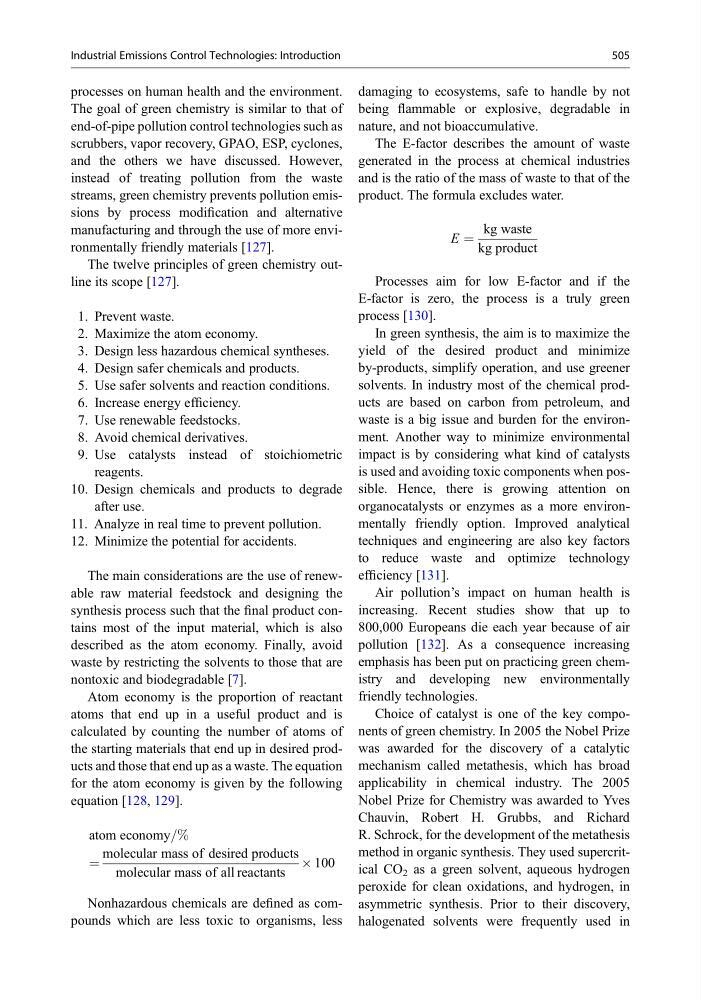
Atom economy is the proportion of reactant
atoms that end up in a useful product and is
calculated by counting the number of atoms of
the starting materials that end up in desired products and those that end up as a waste. The equation
for the atom economy is given by the following
equation [128, 129].
atom economy=%
¼
molecular mass of desired products
molecular mass of all reactants
 100
Nonhazardous chemicals are defined as compounds which are less toxic to organisms, less
damaging to ecosystems, safe to handle by not
being flammable or explosive, degradable in
nature, and not bioaccumulative.
The E-factor describes the amount of waste
generated in the process at chemical industries
and is the ratio of the mass of waste to that of the
product. The formula excludes water.
E ¼
kg waste
kg product
Processes aim for low E-factor and if the
E-factor is zero, the process is a truly green
process [130].
In green synthesis, the aim is to maximize the
yield of the desired product and minimize
by-products, simplify operation, and use greener
solvents. In industry most of the chemical products are based on carbon from petroleum, and
waste is a big issue and burden for the environment. Another way to minimize environmental
impact is by considering what kind of catalysts
is used and avoiding toxic components when possible. Hence, there is growing attention on
organocatalysts or enzymes as a more environmentally friendly option. Improved analytical
techniques and engineering are also key factors
to reduce waste and optimize technology
efficiency [131].
Air pollution’s impact on human health is
increasing. Recent studies show that up to
800,000 Europeans die each year because of air
pollution [132]. As a consequence increasing
emphasis has been put on practicing green chemistry and developing new environmentally
friendly technologies.
Choice of catalyst is one of the key components of green chemistry. In 2005 the Nobel Prize
was awarded for the discovery of a catalytic
mechanism called metathesis, which has broad
applicability in chemical industry. The 2005
Nobel Prize for Chemistry was awarded to Yves
Chauvin, Robert H. Grubbs, and Richard
R. Schrock, for the development of the metathesis
method in organic synthesis. They used supercritical CO 2 as a green solvent, aqueous hydrogen
peroxide for clean oxidations, and hydrogen, in
asymmetric synthesis. Prior to their discovery,
halogenated solvents were frequently used in
Industrial Emissions Control Technologies: Introduction
505
The goal of green chemistry is similar to that of
end-of-pipe pollution control technologies such as
scrubbers, vapor recovery, GPAO, ESP, cyclones,
and the others we have discussed. However,
instead of treating pollution from the waste
streams, green chemistry prevents pollution emissions by process modification and alternative
manufacturing and through the use of more environmentally friendly materials [127].
The twelve principles of green chemistry outline its scope [127].
1. Prevent waste.
2. Maximize the atom economy.
3. Design less hazardous chemical syntheses.
4. Design safer chemicals and products.
5. Use safer solvents and reaction conditions.
6. Increase energy efficiency.
7. Use renewable feedstocks.
8. Avoid chemical derivatives.
9. Use catalysts instead of stoichiometric
reagents.
10. Design chemicals and products to degrade
after use.
11. Analyze in real time to prevent pollution.
12. Minimize the potential for accidents.
The main considerations are the use of renewable raw material feedstock and designing the
synthesis process such that the final product contains most of the input material, which is also
described as the atom economy. Finally, avoid
waste by restricting the solvents to those that are
nontoxic and biodegradable [7].
Atom economy is the proportion of reactant
atoms that end up in a useful product and is
calculated by counting the number of atoms of
the starting materials that end up in desired products and those that end up as a waste. The equation
for the atom economy is given by the following
equation [128, 129].
atom economy=%
¼
molecular mass of desired products
molecular mass of all reactants
 100
Nonhazardous chemicals are defined as compounds which are less toxic to organisms, less
damaging to ecosystems, safe to handle by not
being flammable or explosive, degradable in
nature, and not bioaccumulative.
The E-factor describes the amount of waste
generated in the process at chemical industries
and is the ratio of the mass of waste to that of the
product. The formula excludes water.
E ¼
kg waste
kg product
Processes aim for low E-factor and if the
E-factor is zero, the process is a truly green
process [130].
In green synthesis, the aim is to maximize the
yield of the desired product and minimize
by-products, simplify operation, and use greener
solvents. In industry most of the chemical products are based on carbon from petroleum, and
waste is a big issue and burden for the environment. Another way to minimize environmental
impact is by considering what kind of catalysts
is used and avoiding toxic components when possible. Hence, there is growing attention on
organocatalysts or enzymes as a more environmentally friendly option. Improved analytical
techniques and engineering are also key factors
to reduce waste and optimize technology
efficiency [131].
Air pollution’s impact on human health is
increasing. Recent studies show that up to
800,000 Europeans die each year because of air
pollution [132]. As a consequence increasing
emphasis has been put on practicing green chemistry and developing new environmentally
friendly technologies.
Choice of catalyst is one of the key components of green chemistry. In 2005 the Nobel Prize
was awarded for the discovery of a catalytic
mechanism called metathesis, which has broad
applicability in chemical industry. The 2005
Nobel Prize for Chemistry was awarded to Yves
Chauvin, Robert H. Grubbs, and Richard
R. Schrock, for the development of the metathesis
method in organic synthesis. They used supercritical CO 2 as a green solvent, aqueous hydrogen
peroxide for clean oxidations, and hydrogen, in
asymmetric synthesis. Prior to their discovery,
halogenated solvents were frequently used in
Industrial Emissions Control Technologies: Introduction
505