

radicals. The lifetimes of VOCs are inversely correlated to OH radical concentrations [125].
GPAO has been applied to the removal of
malodorous reduced sulfur compounds (RSC)
emitted from pig farms. The increase of odorous
gas emissions such as ammonia, RSCs, and VOCs
is an issue because it is an issue for neighbors and
because odor itself is regulated in Europe and can
be a limiting factor in the size of an operation. Wet
acid scrubbers are sometimes used for ammonia
control, but they are not suited for RSCs due to
their low water solubility or chemical properties:
H 2 S is an acidic gas, as are malodorous organic
acids [124]. The experiments conducted on an
industrial scale including a wet scrubber achieved
a RE of 90% [124]. This shows that the GPAO
method can have a high performance when operated with other removal technologies. GPAO was
also tested in a Saar region foundry in Germany.
The technology was tested against BTEX
(benzene, toluene, ethyl benzene, and xylenes)
and proved to be effective (80–90% removal).
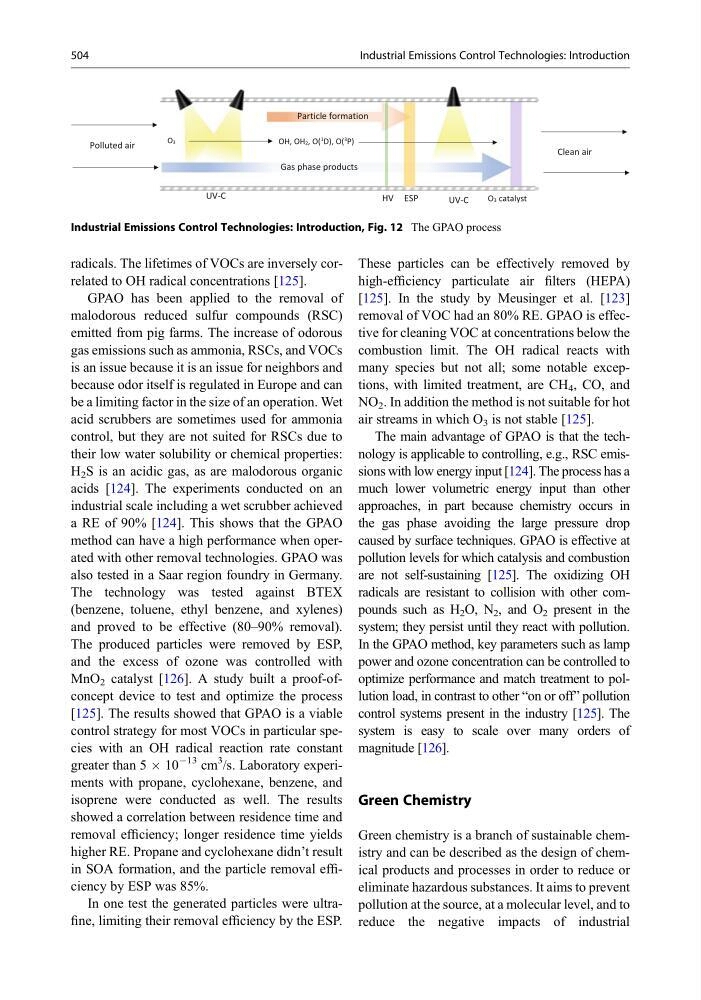
The produced particles were removed by ESP,
and the excess of ozone was controlled with
MnO 2 catalyst [126]. A study built a proof-ofconcept device to test and optimize the process
[125]. The results showed that GPAO is a viable
control strategy for most VOCs in particular species with an OH radical reaction rate constant
greater than 5 Â 10
À13 cm
3 /s. Laboratory experiments with propane, cyclohexane, benzene, and
isoprene were conducted as well. The results
showed a correlation between residence time and
removal efficiency; longer residence time yields
higher RE. Propane and cyclohexane didn’t result
in SOA formation, and the particle removal efficiency by ESP was 85%.
In one test the generated particles were ultrafine, limiting their removal efficiency by the ESP.
These particles can be effectively removed by
high-efficiency particulate air filters (HEPA)
[125]. In the study by Meusinger et al. [123]
removal of VOC had an 80% RE. GPAO is effective for cleaning VOC at concentrations below the
combustion limit. The OH radical reacts with
many species but not all; some notable exceptions, with limited treatment, are CH 4 , CO, and
NO 2 . In addition the method is not suitable for hot
air streams in which O 3 is not stable [125].
The main advantage of GPAO is that the technology is applicable to controlling, e.g., RSC emissions with low energy input [124]. The process has a
much lower volumetric energy input than other
approaches, in part because chemistry occurs in
the gas phase avoiding the large pressure drop
caused by surface techniques. GPAO is effective at
pollution levels for which catalysis and combustion
are not self-sustaining [125]. The oxidizing OH
radicals are resistant to collision with other compounds such as H 2 O, N 2 , and O 2 present in the
system; they persist until they react with pollution.
In the GPAO method, key parameters such as lamp
power and ozone concentration can be controlled to
optimize performance and match treatment to pollution load, in contrast to other “on or off” pollution
control systems present in the industry [125]. The
system is easy to scale over many orders of
magnitude [126].
Green Chemistry
Green chemistry is a branch of sustainable chemistry and can be described as the design of chemical products and processes in order to reduce or
eliminate hazardous substances. It aims to prevent
pollution at the source, at a molecular level, and to
reduce the negative impacts of industrial
Polluted air
O3
OH, OH2, O(
1
D), O(
3
P)
Gas phase products
Particle formation
ESP
HV
O3 catalyst
UV-C
UV-C
Clean air
Industrial Emissions Control Technologies: Introduction, Fig. 12 The GPAO process
504
Industrial Emissions Control Technologies: Introduction
GPAO has been applied to the removal of
malodorous reduced sulfur compounds (RSC)
emitted from pig farms. The increase of odorous
gas emissions such as ammonia, RSCs, and VOCs
is an issue because it is an issue for neighbors and
because odor itself is regulated in Europe and can
be a limiting factor in the size of an operation. Wet
acid scrubbers are sometimes used for ammonia
control, but they are not suited for RSCs due to
their low water solubility or chemical properties:
H 2 S is an acidic gas, as are malodorous organic
acids [124]. The experiments conducted on an
industrial scale including a wet scrubber achieved
a RE of 90% [124]. This shows that the GPAO
method can have a high performance when operated with other removal technologies. GPAO was
also tested in a Saar region foundry in Germany.
The technology was tested against BTEX
(benzene, toluene, ethyl benzene, and xylenes)
and proved to be effective (80–90% removal).
The produced particles were removed by ESP,
and the excess of ozone was controlled with
MnO 2 catalyst [126]. A study built a proof-ofconcept device to test and optimize the process
[125]. The results showed that GPAO is a viable
control strategy for most VOCs in particular species with an OH radical reaction rate constant
greater than 5 Â 10
À13 cm
3 /s. Laboratory experiments with propane, cyclohexane, benzene, and
isoprene were conducted as well. The results
showed a correlation between residence time and
removal efficiency; longer residence time yields
higher RE. Propane and cyclohexane didn’t result
in SOA formation, and the particle removal efficiency by ESP was 85%.
In one test the generated particles were ultrafine, limiting their removal efficiency by the ESP.
These particles can be effectively removed by
high-efficiency particulate air filters (HEPA)
[125]. In the study by Meusinger et al. [123]
removal of VOC had an 80% RE. GPAO is effective for cleaning VOC at concentrations below the
combustion limit. The OH radical reacts with
many species but not all; some notable exceptions, with limited treatment, are CH 4 , CO, and
NO 2 . In addition the method is not suitable for hot
air streams in which O 3 is not stable [125].
The main advantage of GPAO is that the technology is applicable to controlling, e.g., RSC emissions with low energy input [124]. The process has a
much lower volumetric energy input than other
approaches, in part because chemistry occurs in
the gas phase avoiding the large pressure drop
caused by surface techniques. GPAO is effective at
pollution levels for which catalysis and combustion
are not self-sustaining [125]. The oxidizing OH
radicals are resistant to collision with other compounds such as H 2 O, N 2 , and O 2 present in the
system; they persist until they react with pollution.
In the GPAO method, key parameters such as lamp
power and ozone concentration can be controlled to
optimize performance and match treatment to pollution load, in contrast to other “on or off” pollution
control systems present in the industry [125]. The
system is easy to scale over many orders of
magnitude [126].
Green Chemistry
Green chemistry is a branch of sustainable chemistry and can be described as the design of chemical products and processes in order to reduce or
eliminate hazardous substances. It aims to prevent
pollution at the source, at a molecular level, and to
reduce the negative impacts of industrial
Polluted air
O3
OH, OH2, O(
1
D), O(
3
P)
Gas phase products
Particle formation
ESP
HV
O3 catalyst
UV-C
UV-C
Clean air
Industrial Emissions Control Technologies: Introduction, Fig. 12 The GPAO process
504
Industrial Emissions Control Technologies: Introduction