

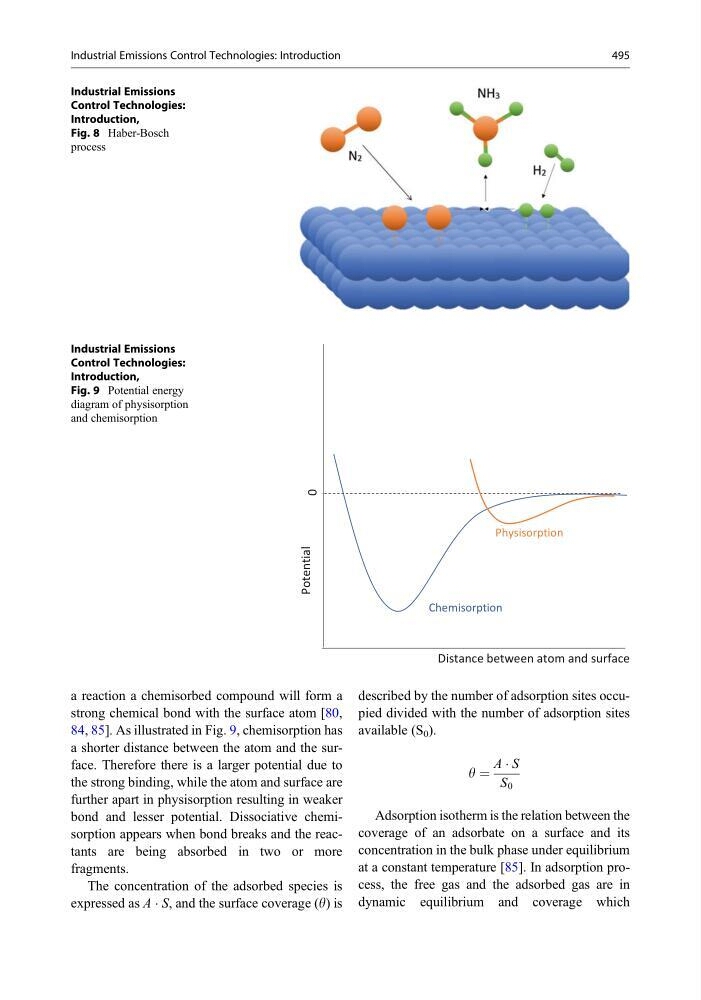
a reaction a chemisorbed compound will form a
strong chemical bond with the surface atom [80,
84, 85]. As illustrated in Fig. 9, chemisorption has
a shorter distance between the atom and the surface. Therefore there is a larger potential due to
the strong binding, while the atom and surface are
further apart in physisorption resulting in weaker
bond and lesser potential. Dissociative chemisorption appears when bond breaks and the reactants are being absorbed in two or more
fragments.
The concentration of the adsorbed species is
expressed as A Á S, and the surface coverage (y) is
described by the number of adsorption sites occupied divided with the number of adsorption sites
available (S 0 ).
y ¼
A Á S
S 0
Adsorption isotherm is the relation between the
coverage of an adsorbate on a surface and its
concentration in the bulk phase under equilibrium
at a constant temperature [85]. In adsorption process, the free gas and the adsorbed gas are in
dynamic equilibrium and coverage which
Industrial Emissions
Control Technologies:
Introduction,
Fig. 8 Haber-Bosch
process
Chemisorption
Physisorption
Potential
Distance between atom and surface
0
Industrial Emissions
Control Technologies:
Introduction,
Fig. 9 Potential energy
diagram of physisorption
and chemisorption
Industrial Emissions Control Technologies: Introduction
495
strong chemical bond with the surface atom [80,
84, 85]. As illustrated in Fig. 9, chemisorption has
a shorter distance between the atom and the surface. Therefore there is a larger potential due to
the strong binding, while the atom and surface are
further apart in physisorption resulting in weaker
bond and lesser potential. Dissociative chemisorption appears when bond breaks and the reactants are being absorbed in two or more
fragments.
The concentration of the adsorbed species is
expressed as A Á S, and the surface coverage (y) is
described by the number of adsorption sites occupied divided with the number of adsorption sites
available (S 0 ).
y ¼
A Á S
S 0
Adsorption isotherm is the relation between the
coverage of an adsorbate on a surface and its
concentration in the bulk phase under equilibrium
at a constant temperature [85]. In adsorption process, the free gas and the adsorbed gas are in
dynamic equilibrium and coverage which
Industrial Emissions
Control Technologies:
Introduction,
Fig. 8 Haber-Bosch
process
Chemisorption
Physisorption
Potential
Distance between atom and surface
0
Industrial Emissions
Control Technologies:
Introduction,
Fig. 9 Potential energy
diagram of physisorption
and chemisorption
Industrial Emissions Control Technologies: Introduction
495