

depends on the pressure of the overlying gas. The
variation of coverage with pressure at a temperature is called an adsorption isotherm.
y ¼
k ads
k des
p
1 þ
k ads
k des
p
k ads is the adsorption rate, k des is the desorption
rate, and p is the pressure of the adsorbing
substance [84].
In a bimolecular catalyzed reaction, two possible
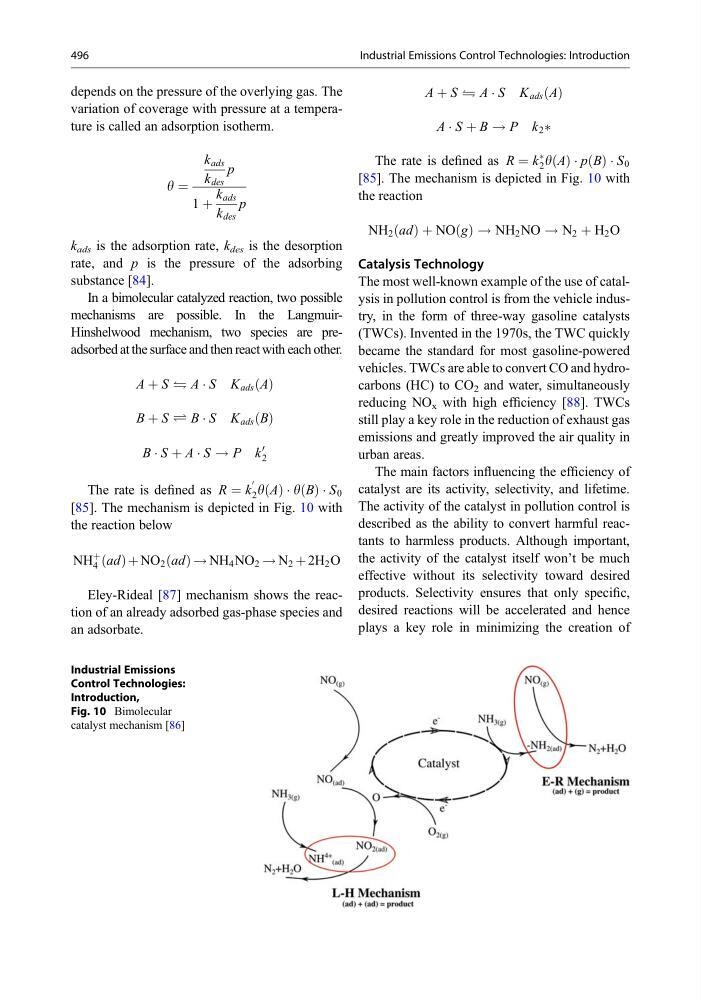
mechanisms are possible. In the LangmuirHinshelwood mechanism, two species are preadsorbed at the surface and then react with each other.
A þ S A Á S K ads A
ð Þ
B þ S Ð B Á S K ads B
ð Þ
B Á S þ A Á S ! P k
0
2
The rate is defined as R ¼ k
0
2 y A
ð Þ Á y B
ð Þ Á S 0
[85]. The mechanism is depicted in Fig. 10 with
the reaction below
NH
þ
4 ad
ð ÞþNO 2 ad
ð Þ!NH 4 NO 2 ! N 2 þ 2H 2 O
Eley-Rideal [87] mechanism shows the reaction of an already adsorbed gas-phase species and
an adsorbate.
A þ S A Á S K ads A
ð Þ
A Á S þ B ! P k 2 Ã
The rate is defined as R ¼ k
Ã
2 y A
ð Þ Á p B
ð Þ Á S 0
[85]. The mechanism is depicted in Fig. 10 with
the reaction
NH 2 ad
ð Þ þ NO g
ð Þ ! NH 2 NO ! N 2 þ H 2 O
Catalysis Technology
The most well-known example of the use of catalysis in pollution control is from the vehicle industry, in the form of three-way gasoline catalysts
(TWCs). Invented in the 1970s, the TWC quickly
became the standard for most gasoline-powered
vehicles. TWCs are able to convert CO and hydrocarbons (HC) to CO 2 and water, simultaneously
reducing NO x with high efficiency [88]. TWCs
still play a key role in the reduction of exhaust gas
emissions and greatly improved the air quality in
urban areas.
The main factors influencing the efficiency of
catalyst are its activity, selectivity, and lifetime.
The activity of the catalyst in pollution control is
described as the ability to convert harmful reactants to harmless products. Although important,
the activity of the catalyst itself won’t be much
effective without its selectivity toward desired
products. Selectivity ensures that only specific,
desired reactions will be accelerated and hence
plays a key role in minimizing the creation of
Industrial Emissions
Control Technologies:
Introduction,
Fig. 10 Bimolecular
catalyst mechanism [86]
496
Industrial Emissions Control Technologies: Introduction
variation of coverage with pressure at a temperature is called an adsorption isotherm.
y ¼
k ads
k des
p
1 þ
k ads
k des
p
k ads is the adsorption rate, k des is the desorption
rate, and p is the pressure of the adsorbing
substance [84].
In a bimolecular catalyzed reaction, two possible
mechanisms are possible. In the LangmuirHinshelwood mechanism, two species are preadsorbed at the surface and then react with each other.
A þ S A Á S K ads A
ð Þ
B þ S Ð B Á S K ads B
ð Þ
B Á S þ A Á S ! P k
0
2
The rate is defined as R ¼ k
0
2 y A
ð Þ Á y B
ð Þ Á S 0
[85]. The mechanism is depicted in Fig. 10 with
the reaction below
NH
þ
4 ad
ð ÞþNO 2 ad
ð Þ!NH 4 NO 2 ! N 2 þ 2H 2 O
Eley-Rideal [87] mechanism shows the reaction of an already adsorbed gas-phase species and
an adsorbate.
A þ S A Á S K ads A
ð Þ
A Á S þ B ! P k 2 Ã
The rate is defined as R ¼ k
Ã
2 y A
ð Þ Á p B
ð Þ Á S 0
[85]. The mechanism is depicted in Fig. 10 with
the reaction
NH 2 ad
ð Þ þ NO g
ð Þ ! NH 2 NO ! N 2 þ H 2 O
Catalysis Technology
The most well-known example of the use of catalysis in pollution control is from the vehicle industry, in the form of three-way gasoline catalysts
(TWCs). Invented in the 1970s, the TWC quickly
became the standard for most gasoline-powered
vehicles. TWCs are able to convert CO and hydrocarbons (HC) to CO 2 and water, simultaneously
reducing NO x with high efficiency [88]. TWCs
still play a key role in the reduction of exhaust gas
emissions and greatly improved the air quality in
urban areas.
The main factors influencing the efficiency of
catalyst are its activity, selectivity, and lifetime.
The activity of the catalyst in pollution control is
described as the ability to convert harmful reactants to harmless products. Although important,
the activity of the catalyst itself won’t be much
effective without its selectivity toward desired
products. Selectivity ensures that only specific,
desired reactions will be accelerated and hence
plays a key role in minimizing the creation of
Industrial Emissions
Control Technologies:
Introduction,
Fig. 10 Bimolecular
catalyst mechanism [86]
496
Industrial Emissions Control Technologies: Introduction