

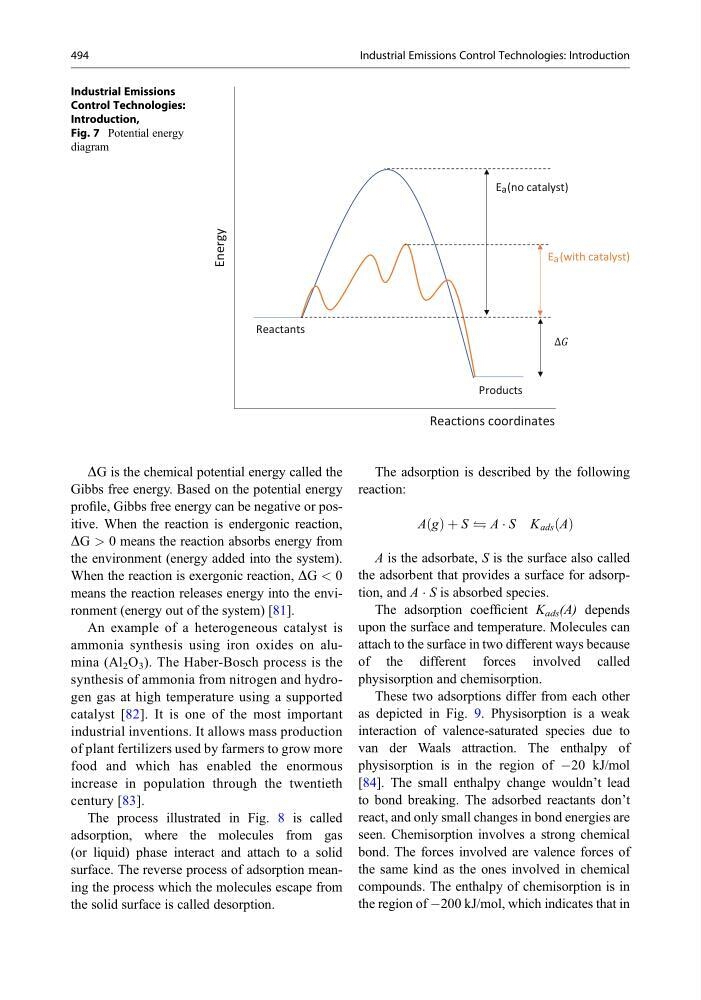
DG is the chemical potential energy called the
Gibbs free energy. Based on the potential energy
profile, Gibbs free energy can be negative or positive. When the reaction is endergonic reaction,
DG > 0 means the reaction absorbs energy from
the environment (energy added into the system).
When the reaction is exergonic reaction, DG < 0
means the reaction releases energy into the environment (energy out of the system) [81].
An example of a heterogeneous catalyst is
ammonia synthesis using iron oxides on alumina (Al 2 O 3 ). The Haber-Bosch process is the
synthesis of ammonia from nitrogen and hydrogen gas at high temperature using a supported
catalyst [82]. It is one of the most important
industrial inventions. It allows mass production
of plant fertilizers used by farmers to grow more
food and which has enabled the enormous
increase in population through the twentieth
century [83].
The process illustrated in Fig. 8 is called
adsorption, where the molecules from gas
(or liquid) phase interact and attach to a solid
surface. The reverse process of adsorption meaning the process which the molecules escape from
the solid surface is called desorption.
The adsorption is described by the following
reaction:
A g
ð Þ þ S A Á S K ads A
ð Þ
A is the adsorbate, S is the surface also called
the adsorbent that provides a surface for adsorption, and A Á S is absorbed species.
The adsorption coefficient K ads (A) depends
upon the surface and temperature. Molecules can
attach to the surface in two different ways because
of the different forces involved called
physisorption and chemisorption.
These two adsorptions differ from each other
as depicted in Fig. 9. Physisorption is a weak
interaction of valence-saturated species due to
van der Waals attraction. The enthalpy of
physisorption is in the region of À20 kJ/mol
[84]. The small enthalpy change wouldn’t lead
to bond breaking. The adsorbed reactants don’t
react, and only small changes in bond energies are
seen. Chemisorption involves a strong chemical
bond. The forces involved are valence forces of
the same kind as the ones involved in chemical
compounds. The enthalpy of chemisorption is in
the region of À200 kJ/mol, which indicates that in
Reactants
Products
E a (no catalyst)
E a (with catalyst)
Energy
Reactions coordinates
Industrial Emissions
Control Technologies:
Introduction,
Fig. 7 Potential energy
diagram
494
Industrial Emissions Control Technologies: Introduction
Gibbs free energy. Based on the potential energy
profile, Gibbs free energy can be negative or positive. When the reaction is endergonic reaction,
DG > 0 means the reaction absorbs energy from
the environment (energy added into the system).
When the reaction is exergonic reaction, DG < 0
means the reaction releases energy into the environment (energy out of the system) [81].
An example of a heterogeneous catalyst is
ammonia synthesis using iron oxides on alumina (Al 2 O 3 ). The Haber-Bosch process is the
synthesis of ammonia from nitrogen and hydrogen gas at high temperature using a supported
catalyst [82]. It is one of the most important
industrial inventions. It allows mass production
of plant fertilizers used by farmers to grow more
food and which has enabled the enormous
increase in population through the twentieth
century [83].
The process illustrated in Fig. 8 is called
adsorption, where the molecules from gas
(or liquid) phase interact and attach to a solid
surface. The reverse process of adsorption meaning the process which the molecules escape from
the solid surface is called desorption.
The adsorption is described by the following
reaction:
A g
ð Þ þ S A Á S K ads A
ð Þ
A is the adsorbate, S is the surface also called
the adsorbent that provides a surface for adsorption, and A Á S is absorbed species.
The adsorption coefficient K ads (A) depends
upon the surface and temperature. Molecules can
attach to the surface in two different ways because
of the different forces involved called
physisorption and chemisorption.
These two adsorptions differ from each other
as depicted in Fig. 9. Physisorption is a weak
interaction of valence-saturated species due to
van der Waals attraction. The enthalpy of
physisorption is in the region of À20 kJ/mol
[84]. The small enthalpy change wouldn’t lead
to bond breaking. The adsorbed reactants don’t
react, and only small changes in bond energies are
seen. Chemisorption involves a strong chemical
bond. The forces involved are valence forces of
the same kind as the ones involved in chemical
compounds. The enthalpy of chemisorption is in
the region of À200 kJ/mol, which indicates that in
Reactants
Products
E a (no catalyst)
E a (with catalyst)
Energy
Reactions coordinates
Industrial Emissions
Control Technologies:
Introduction,
Fig. 7 Potential energy
diagram
494
Industrial Emissions Control Technologies: Introduction