

are created. In the center of the flow channel,
electrodes are maintained at high voltage. These
electrodes produce an electric field that forces the
particles to the walls. Charged dust particles
migrate to the collecting plate due to Coulombic
forces. When the particles are collected at the
plates, they can be removed, which is usually
done by knocking them loose from the plates.
Then the particles slide down into a hopper and
are evacuated. Different types of ESP are known,
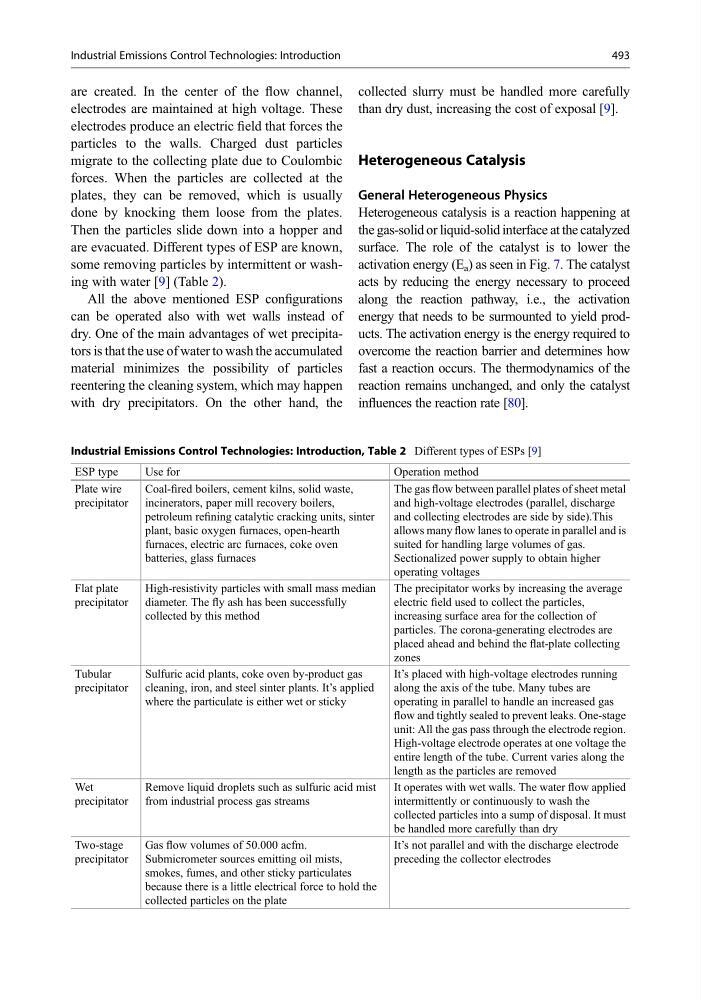
some removing particles by intermittent or washing with water [9] (Table 2).
All the above mentioned ESP configurations
can be operated also with wet walls instead of
dry. One of the main advantages of wet precipitators is that the use of water to wash the accumulated
material minimizes the possibility of particles
reentering the cleaning system, which may happen
with dry precipitators. On the other hand, the
collected slurry must be handled more carefully
than dry dust, increasing the cost of exposal [9].
Heterogeneous Catalysis
General Heterogeneous Physics
Heterogeneous catalysis is a reaction happening at
the gas-solid or liquid-solid interface at the catalyzed
surface. The role of the catalyst is to lower the
activation energy (E a ) as seen in Fig. 7. The catalyst
acts by reducing the energy necessary to proceed
along the reaction pathway, i.e., the activation
energy that needs to be surmounted to yield products. The activation energy is the energy required to
overcome the reaction barrier and determines how
fast a reaction occurs. The thermodynamics of the
reaction remains unchanged, and only the catalyst
influences the reaction rate [80].
Industrial Emissions Control Technologies: Introduction, Table 2 Different types of ESPs [9]
ESP type
Use for
Operation method
Plate wire
precipitator
Coal-fired boilers, cement kilns, solid waste,
incinerators, paper mill recovery boilers,
petroleum refining catalytic cracking units, sinter
plant, basic oxygen furnaces, open-hearth
furnaces, electric arc furnaces, coke oven
batteries, glass furnaces
The gas flow between parallel plates of sheet metal
and high-voltage electrodes (parallel, discharge
and collecting electrodes are side by side).This
allows many flow lanes to operate in parallel and is
suited for handling large volumes of gas.
Sectionalized power supply to obtain higher
operating voltages
Flat plate
precipitator
High-resistivity particles with small mass median
diameter. The fly ash has been successfully
collected by this method
The precipitator works by increasing the average
electric field used to collect the particles,
increasing surface area for the collection of
particles. The corona-generating electrodes are
placed ahead and behind the flat-plate collecting
zones
Tubular
precipitator
Sulfuric acid plants, coke oven by-product gas
cleaning, iron, and steel sinter plants. It’s applied
where the particulate is either wet or sticky
It’s placed with high-voltage electrodes running
along the axis of the tube. Many tubes are
operating in parallel to handle an increased gas
flow and tightly sealed to prevent leaks. One-stage
unit: All the gas pass through the electrode region.
High-voltage electrode operates at one voltage the
entire length of the tube. Current varies along the
length as the particles are removed
Wet
precipitator
Remove liquid droplets such as sulfuric acid mist
from industrial process gas streams
It operates with wet walls. The water flow applied
intermittently or continuously to wash the
collected particles into a sump of disposal. It must
be handled more carefully than dry
Two-stage
precipitator
Gas flow volumes of 50.000 acfm.
Submicrometer sources emitting oil mists,
smokes, fumes, and other sticky particulates
because there is a little electrical force to hold the
collected particles on the plate
It’s not parallel and with the discharge electrode
preceding the collector electrodes
Industrial Emissions Control Technologies: Introduction
493
electrodes are maintained at high voltage. These
electrodes produce an electric field that forces the
particles to the walls. Charged dust particles
migrate to the collecting plate due to Coulombic
forces. When the particles are collected at the
plates, they can be removed, which is usually
done by knocking them loose from the plates.
Then the particles slide down into a hopper and
are evacuated. Different types of ESP are known,
some removing particles by intermittent or washing with water [9] (Table 2).
All the above mentioned ESP configurations
can be operated also with wet walls instead of
dry. One of the main advantages of wet precipitators is that the use of water to wash the accumulated
material minimizes the possibility of particles
reentering the cleaning system, which may happen
with dry precipitators. On the other hand, the
collected slurry must be handled more carefully
than dry dust, increasing the cost of exposal [9].
Heterogeneous Catalysis
General Heterogeneous Physics
Heterogeneous catalysis is a reaction happening at
the gas-solid or liquid-solid interface at the catalyzed
surface. The role of the catalyst is to lower the
activation energy (E a ) as seen in Fig. 7. The catalyst
acts by reducing the energy necessary to proceed
along the reaction pathway, i.e., the activation
energy that needs to be surmounted to yield products. The activation energy is the energy required to
overcome the reaction barrier and determines how
fast a reaction occurs. The thermodynamics of the
reaction remains unchanged, and only the catalyst
influences the reaction rate [80].
Industrial Emissions Control Technologies: Introduction, Table 2 Different types of ESPs [9]
ESP type
Use for
Operation method
Plate wire
precipitator
Coal-fired boilers, cement kilns, solid waste,
incinerators, paper mill recovery boilers,
petroleum refining catalytic cracking units, sinter
plant, basic oxygen furnaces, open-hearth
furnaces, electric arc furnaces, coke oven
batteries, glass furnaces
The gas flow between parallel plates of sheet metal
and high-voltage electrodes (parallel, discharge
and collecting electrodes are side by side).This
allows many flow lanes to operate in parallel and is
suited for handling large volumes of gas.
Sectionalized power supply to obtain higher
operating voltages
Flat plate
precipitator
High-resistivity particles with small mass median
diameter. The fly ash has been successfully
collected by this method
The precipitator works by increasing the average
electric field used to collect the particles,
increasing surface area for the collection of
particles. The corona-generating electrodes are
placed ahead and behind the flat-plate collecting
zones
Tubular
precipitator
Sulfuric acid plants, coke oven by-product gas
cleaning, iron, and steel sinter plants. It’s applied
where the particulate is either wet or sticky
It’s placed with high-voltage electrodes running
along the axis of the tube. Many tubes are
operating in parallel to handle an increased gas
flow and tightly sealed to prevent leaks. One-stage
unit: All the gas pass through the electrode region.
High-voltage electrode operates at one voltage the
entire length of the tube. Current varies along the
length as the particles are removed
Wet
precipitator
Remove liquid droplets such as sulfuric acid mist
from industrial process gas streams
It operates with wet walls. The water flow applied
intermittently or continuously to wash the
collected particles into a sump of disposal. It must
be handled more carefully than dry
Two-stage
precipitator
Gas flow volumes of 50.000 acfm.
Submicrometer sources emitting oil mists,
smokes, fumes, and other sticky particulates
because there is a little electrical force to hold the
collected particles on the plate
It’s not parallel and with the discharge electrode
preceding the collector electrodes
Industrial Emissions Control Technologies: Introduction
493