

cyclone, centrifugal separators, and baffle chamber. Cyclones and centrifugal separators are both
often used for industrial purpose.
In cyclonic separators, gas is forced to spin in a
vortex through the tube. Centrifugal separators
use the same circular motion as the cyclone but
have a rotating vane in the collector itself to both
move the air and separate the dust. Centrifugal
separators are mostly used for coarse particles,
while cyclones are used for fine particles[9]
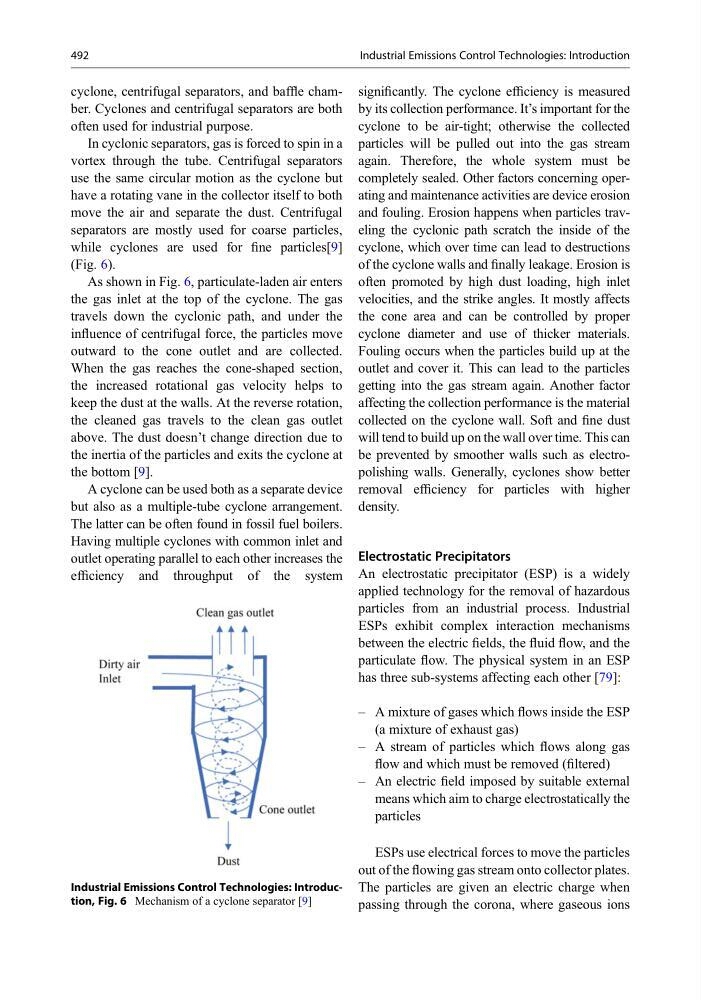
(Fig. 6).
As shown in Fig. 6, particulate-laden air enters
the gas inlet at the top of the cyclone. The gas
travels down the cyclonic path, and under the
influence of centrifugal force, the particles move
outward to the cone outlet and are collected.
When the gas reaches the cone-shaped section,
the increased rotational gas velocity helps to
keep the dust at the walls. At the reverse rotation,
the cleaned gas travels to the clean gas outlet
above. The dust doesn’t change direction due to
the inertia of the particles and exits the cyclone at
the bottom [9].
A cyclone can be used both as a separate device
but also as a multiple-tube cyclone arrangement.
The latter can be often found in fossil fuel boilers.
Having multiple cyclones with common inlet and
outlet operating parallel to each other increases the
efficiency and throughput of the system
significantly. The cyclone efficiency is measured
by its collection performance. It’s important for the
cyclone to be air-tight; otherwise the collected
particles will be pulled out into the gas stream
again. Therefore, the whole system must be
completely sealed. Other factors concerning operating and maintenance activities are device erosion
and fouling. Erosion happens when particles traveling the cyclonic path scratch the inside of the
cyclone, which over time can lead to destructions
of the cyclone walls and finally leakage. Erosion is
often promoted by high dust loading, high inlet
velocities, and the strike angles. It mostly affects
the cone area and can be controlled by proper
cyclone diameter and use of thicker materials.
Fouling occurs when the particles build up at the
outlet and cover it. This can lead to the particles
getting into the gas stream again. Another factor
affecting the collection performance is the material
collected on the cyclone wall. Soft and fine dust
will tend to build up on the wall over time. This can
be prevented by smoother walls such as electropolishing walls. Generally, cyclones show better
removal efficiency for particles with higher
density.
Electrostatic Precipitators
An electrostatic precipitator (ESP) is a widely
applied technology for the removal of hazardous
particles from an industrial process. Industrial
ESPs exhibit complex interaction mechanisms
between the electric fields, the fluid flow, and the
particulate flow. The physical system in an ESP
has three sub-systems affecting each other [79]:
– A mixture of gases which flows inside the ESP
(a mixture of exhaust gas)
– A stream of particles which flows along gas
flow and which must be removed (filtered)
– An electric field imposed by suitable external
means which aim to charge electrostatically the
particles
ESPs use electrical forces to move the particles
out of the flowing gas stream onto collector plates.
The particles are given an electric charge when
passing through the corona, where gaseous ions
Industrial Emissions Control Technologies: Introduction, Fig. 6 Mechanism of a cyclone separator [9]
492
Industrial Emissions Control Technologies: Introduction
often used for industrial purpose.
In cyclonic separators, gas is forced to spin in a
vortex through the tube. Centrifugal separators
use the same circular motion as the cyclone but
have a rotating vane in the collector itself to both
move the air and separate the dust. Centrifugal
separators are mostly used for coarse particles,
while cyclones are used for fine particles[9]
(Fig. 6).
As shown in Fig. 6, particulate-laden air enters
the gas inlet at the top of the cyclone. The gas
travels down the cyclonic path, and under the
influence of centrifugal force, the particles move
outward to the cone outlet and are collected.
When the gas reaches the cone-shaped section,
the increased rotational gas velocity helps to
keep the dust at the walls. At the reverse rotation,
the cleaned gas travels to the clean gas outlet
above. The dust doesn’t change direction due to
the inertia of the particles and exits the cyclone at
the bottom [9].
A cyclone can be used both as a separate device
but also as a multiple-tube cyclone arrangement.
The latter can be often found in fossil fuel boilers.
Having multiple cyclones with common inlet and
outlet operating parallel to each other increases the
efficiency and throughput of the system
significantly. The cyclone efficiency is measured
by its collection performance. It’s important for the
cyclone to be air-tight; otherwise the collected
particles will be pulled out into the gas stream
again. Therefore, the whole system must be
completely sealed. Other factors concerning operating and maintenance activities are device erosion
and fouling. Erosion happens when particles traveling the cyclonic path scratch the inside of the
cyclone, which over time can lead to destructions
of the cyclone walls and finally leakage. Erosion is
often promoted by high dust loading, high inlet
velocities, and the strike angles. It mostly affects
the cone area and can be controlled by proper
cyclone diameter and use of thicker materials.
Fouling occurs when the particles build up at the
outlet and cover it. This can lead to the particles
getting into the gas stream again. Another factor
affecting the collection performance is the material
collected on the cyclone wall. Soft and fine dust
will tend to build up on the wall over time. This can
be prevented by smoother walls such as electropolishing walls. Generally, cyclones show better
removal efficiency for particles with higher
density.
Electrostatic Precipitators
An electrostatic precipitator (ESP) is a widely
applied technology for the removal of hazardous
particles from an industrial process. Industrial
ESPs exhibit complex interaction mechanisms
between the electric fields, the fluid flow, and the
particulate flow. The physical system in an ESP
has three sub-systems affecting each other [79]:
– A mixture of gases which flows inside the ESP
(a mixture of exhaust gas)
– A stream of particles which flows along gas
flow and which must be removed (filtered)
– An electric field imposed by suitable external
means which aim to charge electrostatically the
particles
ESPs use electrical forces to move the particles
out of the flowing gas stream onto collector plates.
The particles are given an electric charge when
passing through the corona, where gaseous ions
Industrial Emissions Control Technologies: Introduction, Fig. 6 Mechanism of a cyclone separator [9]
492
Industrial Emissions Control Technologies: Introduction