

from the reaction chamber by the exhaust. Vapor
incinerators are considered very efficient (RE% of
99.99) and proven methods for destroying VOC.
However, they are not recommended for removing
gases containing halogenated or sulfur-containing
compounds. Due to possible corrosive acid gas
formation, an additional post-oxidation step for
acid control might be necessary [75].
To reduce the temperature required for oxidation and increase the reaction rate, catalysts can be
used. Catalytic incinerators have very similar
operation methods as standard thermal incinerators, but after passing through a flame mixing
chamber, the gas goes through the catalyst bed.
Accelerated reaction rate results in lower temperatures, a shorter residence time, and a smaller
device [9]. Catalytic incinerators are however
not without their flaws. They can be easily
clogged with PM or poisoned by chemicals present in the vapor such as Pb, Cl, or S. Finally, the
initial cost of the catalytic oxidizers is much
higher than standard thermal oxidizers [76].
Energy efficiency in thermal oxidation might
also be achieved via changes in incinerator
design. Installation of the heat exchanger in the
system might significantly improve the thermal
efficiency of the device by partial heat recovery
from the exhaust gas. Since heat is delivered by
burning the fuel, a lot of money can be saved by
reusing the existing energy to preheat the incoming waste gas [9]. Heat exchangers are also called
recuperators and can recover ca. 70% of the waste
heat from exhaust gases [77]. The developed alternative to the traditional heat exchanger,
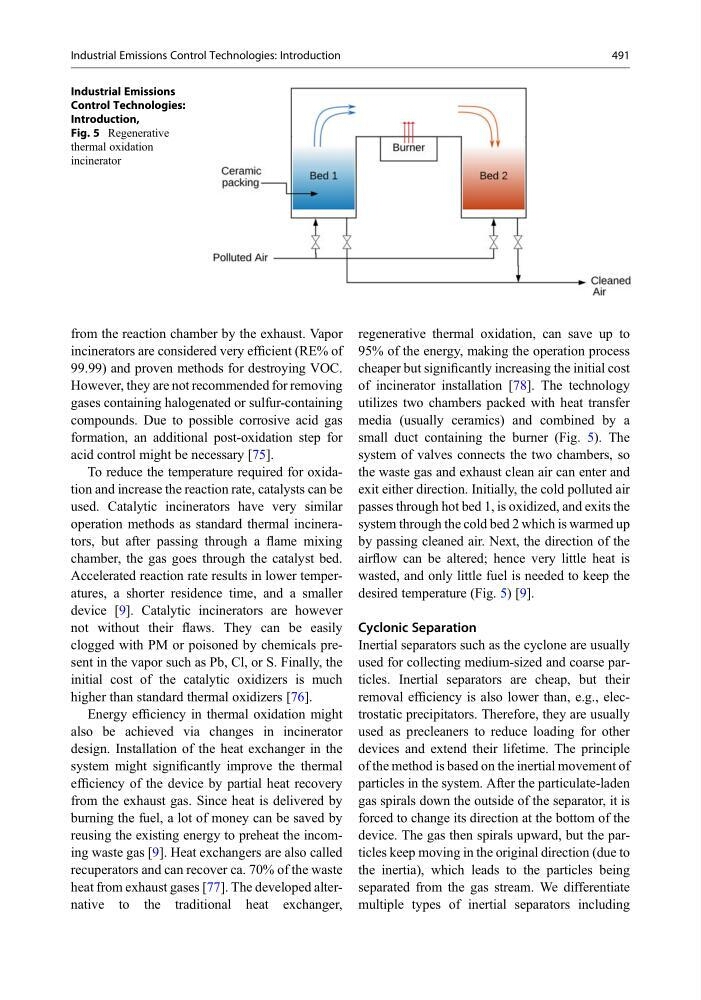
regenerative thermal oxidation, can save up to
95% of the energy, making the operation process
cheaper but significantly increasing the initial cost
of incinerator installation [78]. The technology
utilizes two chambers packed with heat transfer
media (usually ceramics) and combined by a
small duct containing the burner (Fig. 5). The
system of valves connects the two chambers, so
the waste gas and exhaust clean air can enter and
exit either direction. Initially, the cold polluted air
passes through hot bed 1, is oxidized, and exits the
system through the cold bed 2 which is warmed up
by passing cleaned air. Next, the direction of the
airflow can be altered; hence very little heat is
wasted, and only little fuel is needed to keep the
desired temperature (Fig. 5) [9].
Cyclonic Separation
Inertial separators such as the cyclone are usually
used for collecting medium-sized and coarse particles. Inertial separators are cheap, but their
removal efficiency is also lower than, e.g., electrostatic precipitators. Therefore, they are usually
used as precleaners to reduce loading for other
devices and extend their lifetime. The principle
of the method is based on the inertial movement of
particles in the system. After the particulate-laden
gas spirals down the outside of the separator, it is
forced to change its direction at the bottom of the
device. The gas then spirals upward, but the particles keep moving in the original direction (due to
the inertia), which leads to the particles being
separated from the gas stream. We differentiate
multiple types of inertial separators including
Industrial Emissions
Control Technologies:
Introduction,
Fig. 5 Regenerative
thermal oxidation
incinerator
Industrial Emissions Control Technologies: Introduction
491
incinerators are considered very efficient (RE% of
99.99) and proven methods for destroying VOC.
However, they are not recommended for removing
gases containing halogenated or sulfur-containing
compounds. Due to possible corrosive acid gas
formation, an additional post-oxidation step for
acid control might be necessary [75].
To reduce the temperature required for oxidation and increase the reaction rate, catalysts can be
used. Catalytic incinerators have very similar
operation methods as standard thermal incinerators, but after passing through a flame mixing
chamber, the gas goes through the catalyst bed.
Accelerated reaction rate results in lower temperatures, a shorter residence time, and a smaller
device [9]. Catalytic incinerators are however
not without their flaws. They can be easily
clogged with PM or poisoned by chemicals present in the vapor such as Pb, Cl, or S. Finally, the
initial cost of the catalytic oxidizers is much
higher than standard thermal oxidizers [76].
Energy efficiency in thermal oxidation might
also be achieved via changes in incinerator
design. Installation of the heat exchanger in the
system might significantly improve the thermal
efficiency of the device by partial heat recovery
from the exhaust gas. Since heat is delivered by
burning the fuel, a lot of money can be saved by
reusing the existing energy to preheat the incoming waste gas [9]. Heat exchangers are also called
recuperators and can recover ca. 70% of the waste
heat from exhaust gases [77]. The developed alternative to the traditional heat exchanger,
regenerative thermal oxidation, can save up to
95% of the energy, making the operation process
cheaper but significantly increasing the initial cost
of incinerator installation [78]. The technology
utilizes two chambers packed with heat transfer
media (usually ceramics) and combined by a
small duct containing the burner (Fig. 5). The
system of valves connects the two chambers, so
the waste gas and exhaust clean air can enter and
exit either direction. Initially, the cold polluted air
passes through hot bed 1, is oxidized, and exits the
system through the cold bed 2 which is warmed up
by passing cleaned air. Next, the direction of the
airflow can be altered; hence very little heat is
wasted, and only little fuel is needed to keep the
desired temperature (Fig. 5) [9].
Cyclonic Separation
Inertial separators such as the cyclone are usually
used for collecting medium-sized and coarse particles. Inertial separators are cheap, but their
removal efficiency is also lower than, e.g., electrostatic precipitators. Therefore, they are usually
used as precleaners to reduce loading for other
devices and extend their lifetime. The principle
of the method is based on the inertial movement of
particles in the system. After the particulate-laden
gas spirals down the outside of the separator, it is
forced to change its direction at the bottom of the
device. The gas then spirals upward, but the particles keep moving in the original direction (due to
the inertia), which leads to the particles being
separated from the gas stream. We differentiate
multiple types of inertial separators including
Industrial Emissions
Control Technologies:
Introduction,
Fig. 5 Regenerative
thermal oxidation
incinerator
Industrial Emissions Control Technologies: Introduction
491