

temperature for a time long enough to obtain
pollutant destruction at wanted or required by
regulations level.
The main principle of operation can be concluded in so-called “three Ts” parameter – temperature, time, and turbulence. The efficiency of
thermal oxidation is dependent on those three
factors and the availability of oxygen in the system. Sufficiently high temperature and time spent
in the system are crucial for the nearly complete
destruction of polluting gasses. Additionally, turbulence promotes proper mixing of VOC and
oxygen molecules and assures that the pollutant
will be oxidized before leaving the system
[9]. Incomplete oxidation results in the formation
of pollutants such as CO and smaller molecular
weight hydrocarbons. Poor combustion may emit
a significant amount of pollutants including compounds which were not present in the gas mixture
before thermal oxidation, e.g., formaldehyde
(Fig. 5).
Construction and maintenance of an efficient
thermal oxidizing device requires a considerable
design effort. Usually, the temperature, time, and
removal efficiency of the system are specified by
regulations and sometimes selected from experience. The flow of the combustion fuel, size of the
device, and residence time have to be selected
according to heat and material balance of the system [9]. Generally, a standard vapor incinerator
consists of only a few simple parts. The polluted
air is directed to the mixing chamber where high
temperature is maintained by burner fueled with
fuel gas. The oxidized gases are then discarded
Industrial Emissions
Control Technologies:
Introduction,
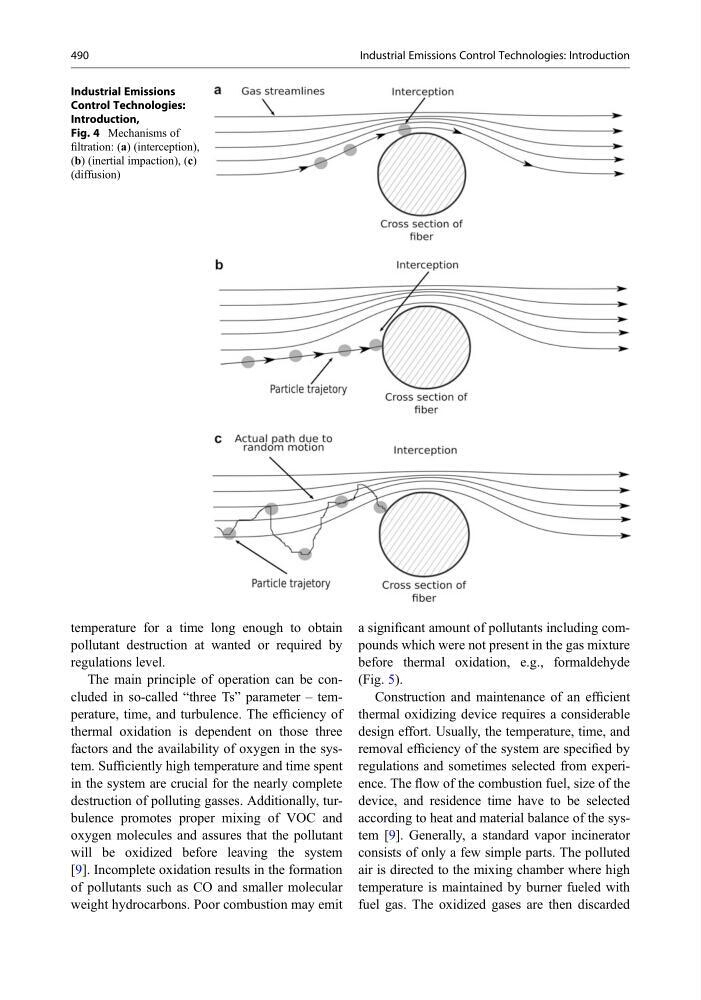
Fig. 4 Mechanisms of
filtration: (a) (interception),
(b) (inertial impaction), (c)
(diffusion)
490
Industrial Emissions Control Technologies: Introduction
pollutant destruction at wanted or required by
regulations level.
The main principle of operation can be concluded in so-called “three Ts” parameter – temperature, time, and turbulence. The efficiency of
thermal oxidation is dependent on those three
factors and the availability of oxygen in the system. Sufficiently high temperature and time spent
in the system are crucial for the nearly complete
destruction of polluting gasses. Additionally, turbulence promotes proper mixing of VOC and
oxygen molecules and assures that the pollutant
will be oxidized before leaving the system
[9]. Incomplete oxidation results in the formation
of pollutants such as CO and smaller molecular
weight hydrocarbons. Poor combustion may emit
a significant amount of pollutants including compounds which were not present in the gas mixture
before thermal oxidation, e.g., formaldehyde
(Fig. 5).
Construction and maintenance of an efficient
thermal oxidizing device requires a considerable
design effort. Usually, the temperature, time, and
removal efficiency of the system are specified by
regulations and sometimes selected from experience. The flow of the combustion fuel, size of the
device, and residence time have to be selected
according to heat and material balance of the system [9]. Generally, a standard vapor incinerator
consists of only a few simple parts. The polluted
air is directed to the mixing chamber where high
temperature is maintained by burner fueled with
fuel gas. The oxidized gases are then discarded
Industrial Emissions
Control Technologies:
Introduction,
Fig. 4 Mechanisms of
filtration: (a) (interception),
(b) (inertial impaction), (c)
(diffusion)
490
Industrial Emissions Control Technologies: Introduction